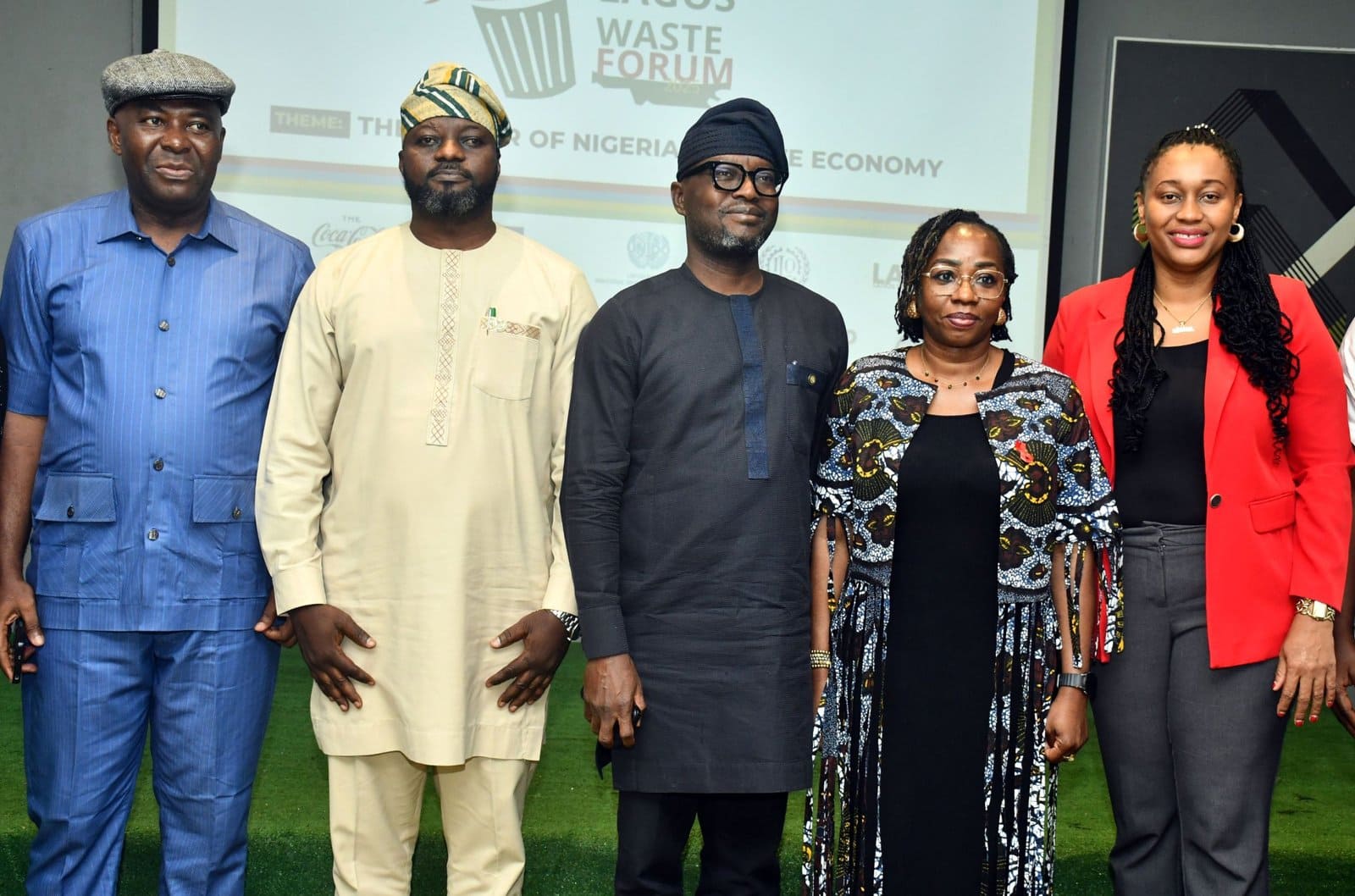

Government leaders, industry executives, civil society organisations, and international development partners gathered at the Radisson Blu, Ikeja, for the 6th Lagos Waste Forum, an influential platform driving Nigeria’s transition to a circular, resource-efficient economy.
Organised by the SWEEP Foundation NG and co-sponsored by UNIDO, the European Union and Coca‑Cola Nigeria, the 2025 edition, themed “The Power of Nigeria’s Waste Economy”, convened top minds in sustainability, environmental governance, and innovative waste management.
Notable attendees included Lagos State Governor Babajide Sanwo-Olu (represented by Special Adviser on the Environment, Olakunle Rotimi‑Akodu), LAWMA Managing Director Dr Muyiwa Gbadegesin, Ogun State Commissioner for the Environment Dr Ola Oresanya, Special Adviser on Climate Change and Circular Economy Mrs Titi Oshodi, Circular Economy Innovation Partnership Executive Director, Ms Natalie Beinisch, UNIDO Field Coordination and Gender Expert, Ms Emem Umana, Policy Adviser at the Consulate of the Kingdom of the Netherlands Opeyemi Orinowo, and Ambassador Obuesi Phillips, President/CEO SWEEP Foundation NG.
Representing the Lagos State Governor, Mr Rotimi‑Akodu emphasised the city’s central role in shaping Nigeria’s circular economy. “Lagos generates vast quantities of waste,” he noted, “but within this challenge lies a significant opportunity — one realised through structure, innovation, and entrepreneurial intelligence.”
He highlighted the state’s investments, progressive policies, and strategic partnerships that are advancing a shift from traditional waste disposal to modern circular systems built on recycling, resource recovery, and green job creation.
“Agencies like LAWMA, working alongside the private sector, are building an integrated framework that positions Lagos as a hub of circular economy innovation,” he said, reaffirming the government’s commitment to reforms and initiatives that transform waste into a driver of economic resilience.
Speaking in his personal capacity, Rotimi-Akodu said he was favourably disposed to the Lagos State government partnering with the forum to make future editions of the event known as the Lagos International Waste Forum, adding that he would discuss the proposal with the relevant authorities.
In his welcome remarks, Ambassador Phillips underscored the importance of collaboration between government, private enterprise, and partners, including the EU, UNIDO, and Coca-Cola.
“Nigeria’s waste sector has vast untapped potential,” he said, describing dumpsites as emerging “waste mines” that feed materials back into productive value chains. He called for enabling policies, financial mechanisms such as a dedicated Green Bank offering single-digit interest loans to waste enterprises, and the eventual creation of a Ministry of Waste Resources to reflect Lagos’s leadership in recycling and environmental innovation.
Delivering the forum’s lecture, the Ogun State Commissioner for the Environment, Dr Ola Oresanya, stressed that tackling Nigeria’s environmental challenges requires more than policy declarations. “Solutions must be guided by research, innovation, and evidence-based interventions tailored to Nigeria’s local contexts,” he said, urging capacity‑building across all tiers of government and advocating for a technically skilled environmental workforce.
Delivering the keynote, a representative of the Food and Beverage Recycling Alliance (FBRA) highlighted Nigeria’s annual production of 32 million tonnes of waste — 13% plastic — and its economic promise. Citing the Federal Government and UNDP’s Imagine Nigeria report, the alliance pointed to a green economy potential of up to $250 billion, with Lagos alone generating ₦18 billion in recycling value in 2021.
“Circularity is not just an ecological necessity, but a strategic pathway to jobs, innovation, and environmental protection,” the FBRA representative said.
Forum sessions tackled financing for circular enterprises, waste-to-wealth entrepreneurship, women’s leadership in environmental governance, packaging innovation, state-level policy alignment, and Nigeria’s integration with global sustainability standards. Across all discussions, a central theme emerged: the waste economy can simultaneously address environmental challenges and unlock significant economic growth.
The 6th Lagos Waste Forum closed with strong pledges of collaboration among government, private sector, and development partners. Stakeholders agreed to prioritise financing, technology adoption, capacity‑building, and community engagement as Nigeria accelerates towards a resource-efficient, climate-smart, and economically vibrant waste ecosystem.
6th Lagos Waste forum positions waste as Nigeria’s next economic frontier