- In today’s CEO Daily: Fortune Editor-in-Chief Alyson Shontell shares her interview with Google’s AI head.
- The big leadership story: AI is improving productivity, but it’s also burning workers out.
- The markets: Mixed globally, as an AI tax-planning tool triggered a selloff in financial advisory stocks.
- Plus: All the news and watercooler chat from Fortune.
Good morning. We’re in the thick of the AI revolution. But we may look back on January 2014 as one the most pivotal moments in business history. That was the month Demis Hassabis sold his AI company, DeepMind, to Google.
He rebuffed a higher offer from Meta’s Mark Zuckerberg. And the idea of Google owning something so powerful scared Elon Musk to such a degree that he decided to launch a rival company with Sam Altman: OpenAI.
Fast forward to today, and Demis is still the one to beat. He runs all of Google’s AI initiatives, including Gemini, which is quickly eating away at OpenAI’s user base.
In his spare time, Demis won a Nobel Prize for being able to accurately predict how proteins fold, and he runs a startup, Isomorphic, that wants to use AI to “solve all disease.”
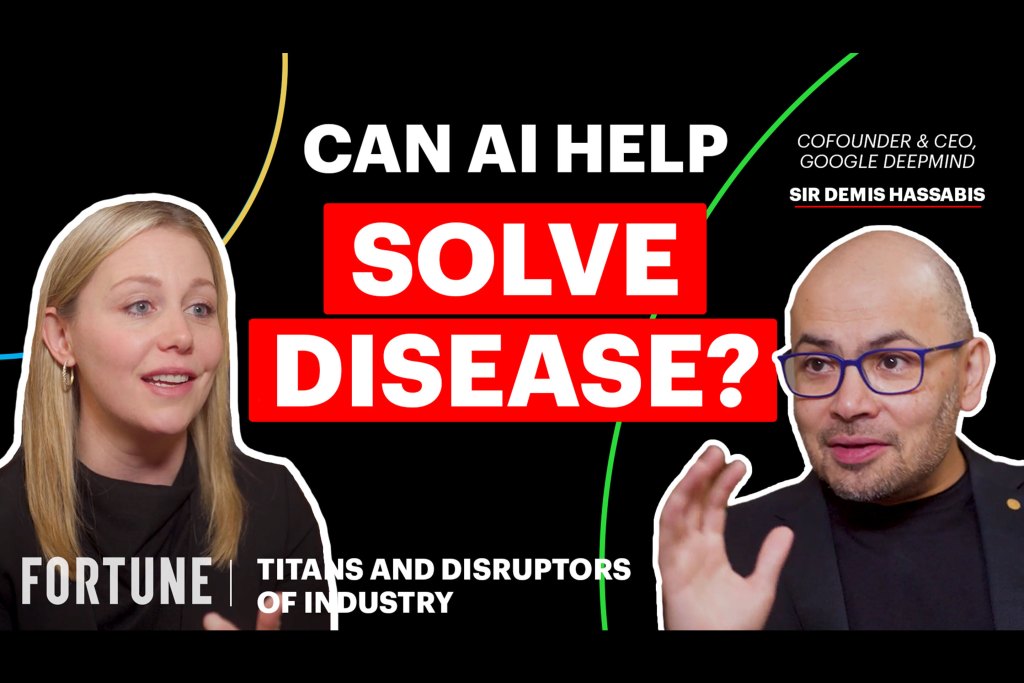
Naturally, I wanted to meet this man to learn how he thinks and where he believes the AI world is heading. We sat down together at the World Economic Forum in Davos, where I asked him how he manages his teams—and his time—to do two hard jobs at once (he splits his day into two, with his second work day going from 10 p.m. to 4 a.m., after which he clocks some sleep). We discussed how he is setting targets to return Google to its “golden era” of constant shipping and innovation, after a period when it felt like it was asleep at the AI wheel. “It is a classic innovator’s dilemma,” Hassabis admitted. “If we don’t disrupt ourselves, someone else will.”
He broke his strategy down into four steps:
- Nail the underlying technology and make it best in class. This serves as Google’s “nucleus” for all its products. “None of it matters if your models aren’t best-in-class and state of the art,” Hassabis says. “And so that’s what we focused on, first with the Gemini models, but also our other models, things like Nano Banana, and Veo.”
- Rebuild internal processes across the organization to capitalize on the best-in-class model quickly. “That took a year to 18 months to get right,” Hassabis says. “I think there are still more improvements that can be made, and we can have even faster velocity.”
- Force the team to focus on only the biggest opportunities and priorities. “I think the other thing is instilling this culture of intensity and pace and focus, and cutting out distractions,” he says.
- Make good decisions consistently. “In today’s very noisy world, it’s important to consistently deliver good, rational decisions with minimal drama,” Hassabis says. “It’s amazing how much that compounds over time.”
I walked away thinking I would not want to be Sam Altman, Mark Zuckerberg, or Elon Musk right now. You don’t want to be up against this soft-spoken yet fierce competitor.
For the full conversation, please subscribe to Fortune 500: Titans & Disruptors of Industry on Spotify or Apple. You can also read the full transcript here. Special thanks to Deloitte for sponsoring the show. If you like Titans & Disruptors, please leave a review and share it with your team or friends. And for more on Demis, who was Fortune‘s cover star in our February/March issue, read all about him on Fortune.com.
Contact CEO Daily via Diane Brady at diane.brady@fortune.com
This story was originally featured on Fortune.com