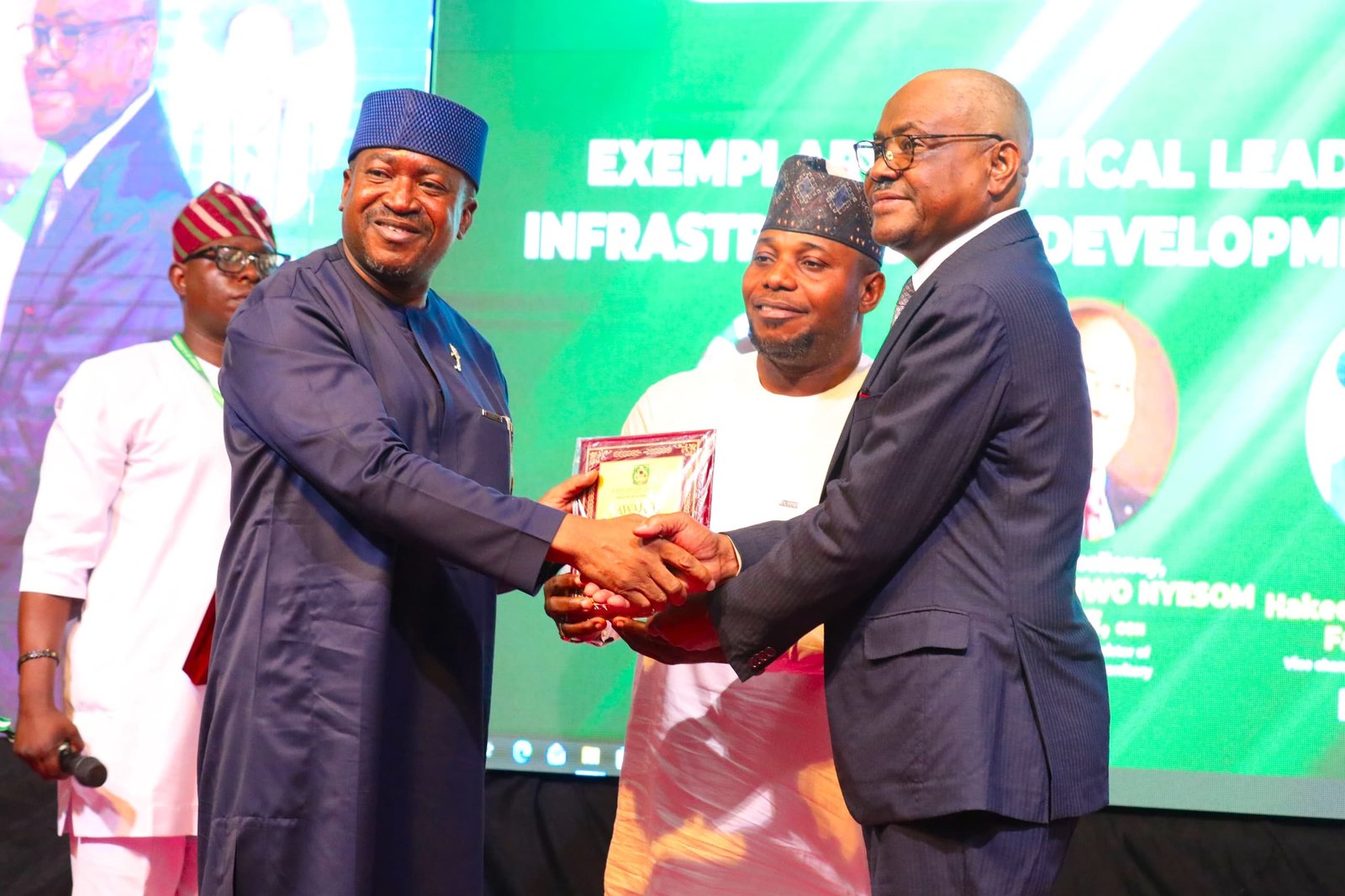

A Distinguished Personality Lecture of the Faculty of Social Sciences, University of Abuja delivered by His Excellency, Ezenwo Nyesom Wike at the Faculty of Social Sciences Auditorium, main campus of the University of Abuja.
Opening Remarks
I am profoundly honoured to address this distinguished gathering in the University of Abuja, a university uniquely situated at the political heart of our nation. I thank the pioneer faculty of this prestigious university – the Faculty of Social Sciences – for this invitation and for sustaining a tradition that underscores a fundamental truth: that the fate of nations is shaped not merely by power, but by ideas; not merely by authority, but by leadership anchored in thought, conscience, and responsibility.
Across the world, universities occupy a sacred space in national life. They are not simply centres of instruction; they are arenas where societies interrogate themselves, refine their values, imagine better futures and train the needed man-power. To speak within such a space is therefore both a privilege and a solemn duty, especially at a moment like this in our national journey.
This Distinguished Personality Lecture Series is particularly timely. Nigeria stands at a critical juncture where democracy must be re-examined not as a ritual, but as a responsibility; not as a slogan, but as a living system that must deliver tangible value to the people. The theme before us – “The Impact of Political Leadership on Infrastructural Development in Nigeria: Between Dividends of Democracy and Good Governance” – goes to the very heart of our collective experience. It compels us to confront a difficult but necessary question: Why has democracy, despite its promise, sometimes raised great hopes without fulfilling them – and how can purposeful leadership bridge that widening gap between expectation and reality?
Democracy Beyond Rituals
Nigeria has practiced democracy continuously since 1999, yet a fundamental question continues to confront us: what kind of democracy are we practicing? Is it one that merely confers political legitimacy through periodic elections, or one that translates political freedom into tangible improvements in the everyday lives of the people – through infrastructure that works, services that deliver, and opportunities that uplift? Properly understood, democracy is a social contract. Its credibility is measured not only at the ballot box, but in the quality of life it creates and sustains.
The democracy Nigeria requires, therefore, must go beyond electoral rituals to manifest in everyday accountability, transparency, and active citizen participation. It must be a system that treats public office not as a privilege to be exploited, but as a sacred trust to be honoured; not as an avenue for personal enrichment, but as a platform for collective transformation. Good governance is the engine that drives this aspiration, ensuring that institutions function efficiently and equitably, and that government remains responsive to the needs, dignity, and legitimate expectations of the people.
Yet we must remind ourselves that democracy, though widely regarded as the best form of government, is among the most demanding to establish on firm footing and even more difficult to sustain. Democracy is not a potted plant that can be transplanted into any soil and expected to flourish without commitment, sacrifice, and vigilance. As Larry Diamond aptly observes, “It is one thing to get democracy. It is another thing, often more difficult, to keep it, to consolidate it, to breathe real life and meaning into it, to make it endure.” The Nigerian democratic project therefore calls us not merely to desire democracy, but to work for it – daily and deliberately – through responsible leadership, engaged citizenship, and an unyielding commitment to justice and equity.
For the ordinary citizen – the market woman, the civil servant, the artisan, and the student – democracy is not an abstract ideal. It must translate into concrete realities: roads that work, schools that inspire, hospitals that heal, water that runs, security that reassures, and cities that dignify human life. It is in these everyday encounters with the state that democracy is either validated or questioned.
Where democracy delivers infrastructure, it earns legitimacy; where it fails, it breeds cynicism. This is why infrastructure is far more than concrete and steel – it is political education in physical form. It teaches citizens that governance is real, leadership is purposeful, and the state exists not as an abstraction, but as a servant of the common good. Where these assurances are absent, democracy becomes fragile; reduced to ritual without substance, form without meaning.
Political Leadership as the Bridge Between Democracy and Development
Many scholars and analysts agree that Nigeria’s most persistent obstacle to development is not the absence of ideas or resources, but the scourge of poor and mediocre leadership. Chinua Achebe captured this reality with unsettling clarity in The Trouble with Nigeria when he argued that the nation’s fundamental problem is the failure of leadership. However uncomfortable, this verdict remains difficult to refute. Too often, leadership has emerged from self serving arrangements detached from national vision, public interest, and developmental purpose.
The consequences have been predictable: a succession of leaders lacking preparation, courage, patriotism, and character. It is therefore unsurprising that Nigeria has spent decades struggling with issues that should be foundational – basic infrastructure, primary healthcare, effective democratic and judicial institutions, and a functional economy. These are not failures of imagination or policy design; they are failures of leadership. Institutions matter, policies matter, and resources matter, but leadership ultimately determines whether they function or fail. Nations are not built by resources alone; they are built by the quality of leadership that gives direction, coherence, and purpose to those resources.
Political leadership, in this sense, is the decisive bridge between democratic ideals and developmental realities. Democracy promises participation, accountability, and representation, but without purposeful leadership these promises remain abstract. Development does not occur by accident. Infrastructural growth, social inclusion, and economic transformation are outcomes of deliberate vision, disciplined execution, and political courage. Where leadership is transactional, infrastructure stagnates and institutions decay. Where leadership is decisive and purposeful, infrastructure becomes a catalyst for growth, confidence, and national cohesion.
Nigeria’s development challenges, therefore, are not primarily a deficit of ideas, plans, or capacity. More often, they reflect failures of vision, courage, and prioritization. Infrastructure suffers when politics is divorced from ideology, when power is pursued as an end rather than a responsibility, and when short term political gain is preferred to long term public interest. True political leadership demands difficult choices: choosing systems over personalities, service over self, accountability over convenience, and national interest over narrow advantage. It is only through such leadership that democracy moves beyond promise to performance, and development becomes the lived experience of the people rather than a distant aspiration.
It is against this backdrop that one must acknowledge, with pride, the emergence of President Bola Ahmed Tinubu, GCFR, as a leader who exhibits key attributes of purposeful and servant-oriented leadership. His long-standing commitment to the democratic struggle – at great personal risk – established his credentials well before he assumed the presidency. His record in Lagos State demonstrated a capacity for translating vision into sustained development, particularly in the areas of internally generated revenue, infrastructure, and institutional reform.
As President, he signaled uncommon resolve from his first day in office by removing the fuel subsidy, a policy long acknowledged as economically destructive but avoided by successive administrations for lack of political courage. While the reform has generated short term pains and resistance, it has also freed resources for subnational development, halted the spiral of unsustainable debt, and initiated the difficult process of restoring market discipline to the energy sector. This decision exemplifies leadership willing to endure temporary unpopularity in pursuit of long term national interest.
Beyond this, the administration has begun confronting Nigeria’s structural imbalances through the devolution of development initiatives via zonal and regional commissions, responding to long standing complaints about over centralization and weakened federalism. Security reforms, increased funding, and systematic training of the armed forces further reflect an effort to rebuild state capacity and restore public confidence. Taken together, these measures suggest a deliberate attempt to reposition Nigeria on a path of reform, responsibility, and renewal, where leadership consciously serves as the hinge between democratic authority and developmental outcomes.
Yet no leader – however visionary or courageous – can succeed in isolation. National transformation ultimately depends on the active cooperation of citizens. Nigeria must rise above years of cynicism and disengagement to embrace a renewed sense of collective responsibility. History is unequivocal on this point: progress is forged where leadership and followership work in synergy. Nelson Mandela’s South Africa and the developmental trajectory of Dubai illustrate how shared belief, disciplined leadership, and collective action convert vision into reality.
The present moment therefore demands more than criticism; it calls for commitment. The time for belief is now, and the time for action is now. With purposeful political leadership and responsible citizenship working in concert, Nigeria can begin the serious task of institutionalizing a political order in which democracy delivers development, and leadership truly functions as the bridge between aspiration and achievement.
Infrastructure is not simply roads and bridges; it is the circuitry of nationhood. It connects destinies, unlocks human potential, and provides the physical and digital foundations upon which national transformation rests. No nation becomes great without robust infrastructure. A truly functional Nigeria is one where a child in rural Zamfara enjoys the same quality of education, healthcare, and opportunity as one in the FCT; where efficient transport, reliable power, and digital innovation are not privileges but everyday realities. Infrastructure, in this sense, is the architecture of equality; it delivers dignity, inclusion, productivity, and hope.
It is for this reason that infrastructure remains the most honest measure of governance. It is the clearest language through which governments reveal their priorities, values, and seriousness of purpose. Roads points to what truly matters; urban planning reflects what is valued; public transportation signals inclusiveness; housing policy exposes whether leadership understands dignity as a public good. Infrastructure is therefore not merely physical; it is social, economic, and moral.
When governments build roads, they connect not only cities but economies. When they invest in schools, they shape not only literacy but citizenship. When they provide reliable power, they energize not only industry but human dignity. In this way, infrastructure becomes political education cast in concrete and steel – teaching citizens that governance is real, leadership is purposeful, and the state exists to serve.
Even the sternest critic of President Bola Ahmed Tinubu will concede that Nigeria is witnessing tangible improvement in infrastructure. His Renewed Hope Agenda is more than a slogan; it represents a deliberate reordering of national priorities toward sustainable development. Through decisive investment and political courage, the administration is confronting long-standing structural challenges that previous governments avoided. Without infrastructure, development stalls; with it, progress becomes not only possible but inevitable.
Where infrastructure is transparently planned and faithfully executed, it builds trust between the state and the people. Where it is neglected, politicized, or abandoned, it deepens alienation and fuels cynicism. The dividends of democracy are not speeches or promises; they must be felt daily by citizens in visible, functional, and enduring ways. In this regard, infrastructure is the point at which democracy is tested and governance is authenticated.
The rapid transformation of Abuja under my watch stands as compelling evidence of this philosophy in action. In less than three years, the Federal Capital Territory has accelerated toward the standards of a modern city befitting a great nation. This progress reflects not chance but commitment, made possible by the unwavering support and leadership of President Bola Ahmed Tinubu, GCFR, and increasingly affirmed by both local commentators and international observers.
The Federal Capital Territory occupies a unique place in Nigeria’s democratic imagination. Abuja is not merely a city; it is a national statement. It tells Nigerians – and the world – who we are, what we value, and how seriously we take governance. How we build, maintain, and renew Abuja ultimately signal the kind of democracy we are determined to practice and the standard of leadership we are willing to uphold. In this sense, Abuja is not just a capital; it is a mirror of our national conscience and a measure of our collective ambition.
Good Governance: The Moral Foundation of Development
Good governance is the moral foundation upon which sustainable development rests. Infrastructure alone does not define leadership; the moral architecture of those who wield power matters just as much. Roads, schools, and public utilities are visible symbols, but without ethical stewardship, they remain superficial – cosmetic rather than transformative.
True governance demands transparency in decision-making, accountability in resource use, fairness in policy implementation, and respect for institutions and the rule of law. Infrastructure built without these principles collapses, not always physically, but institutionally. Democracy without good governance produces inequality, resentment, and instability. Democracy guided by ethical, disciplined leadership produces resilience, innovation, and shared prosperity.
Good governance is therefore not optional; it is foundational.
It requires moral discipline, institutional courage, and the willingness to make difficult decisions even when they are unpopular. Leadership must be anchored on values rather than expediency, and on the long-term national interest rather than short-term political gain. Development without rules and accountability is unsustainable; orderless democracy is fragile. Governance must be firm, fair, and forward-looking, ensuring that society benefits collectively from leadership that is principled, courageous, and unwavering.
The FCT as a Laboratory of Dividends of Democratic Governance
The experience of the Federal Capital Territory exemplifies a fundamental truth of democratic governance: leadership is not about pleasing everyone; it is about doing what is right, lawful, and necessary for the collective progress of the people. Our interventions in the FCT since 2023 demonstrate that when authority is exercised with accountability, infrastructure becomes more than concrete and steel. It becomes a visible lesson in ethical leadership, a tangible affirmation that the state exists to serve, and a durable foundation for social and economic transformation.
Permit me to state that the Federal Capital Territory is cited here not for self-praise, but as concrete evidence of what becomes possible when political leadership aligns authority with responsibility. Abuja was conceived as a symbol of national unity, order, and purposeful governance. Over time, however, that founding vision came under strain: unplanned settlements expanded, infrastructure became overstretched, urban discipline weakened, and the credibility of governance itself was gradually eroded.
Our task has therefore been clear and non-negotiable: to restore Abuja to its founding ideals while deliberately adapting it to the realities of a rapidly growing and modern capital. In recent times, the transformation of the Federal Capital Territory has demonstrated what focused, principled, and intentional leadership can achieve when democracy is treated not as a ceremonial ritual, but as a continuing responsibility to deliver public good.
This commitment has found expression in massive investment in road networks to improve mobility, stimulate economic activity, reconnect communities, ease congestion, and unlock productivity. It has also involved the systematic renewal of urban infrastructure to enhance safety, aesthetics, and operational efficiency, recognising that a capital city must not only function effectively, but also embody dignity, order, and national pride.
Equally important has been the firm yet humane enforcement of planning regulations, guided by the conviction that a city without order cannot truly serve its people. Legality has been balanced with compassion, and discipline pursued not as punishment, but as a prerequisite for shared prosperity. Alongside this is a deliberate commitment to inclusive development, ensuring that growth does not terminate at the city centre but extends meaningfully to satellite towns and surrounding communities, so that no part of the capital is left behind.
Across Abuja today, there is an unmistakable momentum toward infrastructural renewal: abandoned projects are being revived, public spaces reclaimed, service delivery strengthened, and urban order progressively restored. These interventions are not cosmetic gestures; they are structural reforms. They reflect a philosophy of governance that insists that democracy must be visible, functional, and fair.
In the Federal Capital Territory, infrastructure is treated not as a favour dispensed by power, but as a right owed to citizens; not as propaganda, but as policy. In this sense, Abuja is increasingly emerging as a living laboratory of democratic governance; where the dividends of democracy are translated into everyday realities, and where leadership is judged not by promises made, but by systems built, sustained, and trusted.
The Place of the University in the Consolidation of democracy and Nation-Building
Universities occupy a strategic and historic position in every nation’s democratic ecosystem. Their classrooms are far more than spaces for instruction; they are crucibles where ideas are tested, values are formed, and the conscience of future leadership is refined. Within these intellectual laboratories, policymakers, diplomats, administrators, analysts, and leaders-in-waiting are shaped. The depth of scholarship cultivated in universities ultimately determines the quality of governance, for the decisions that guide society tomorrow are born in the classrooms, debates, and research cultures of today. Universities occupy a sacred space in nation-building. They preserve memory, interrogate power, and cultivate the courage to speak truth to authority. The Faculty of Social Sciences stands at the intersection of knowledge and policy, theory and practice, shaping minds that will shape society. Your duty is not merely to interpret society, but to challenge it; not merely to produce graduates, but to cultivate conscience, critical thinking, and ethical commitment. Democracy flourishes where ideas are free, scholarship is rigorous, and truth is spoken without fear or favour.
Equally crucial is the role of political education. In this regard, institutions like the University of Abuja play a historic role. They shape minds that will shape policy, leadership, and society. A nation that neglects political education prepares the ground for democratic decay. Universities must actively empower people to:
• Demand accountability
• Participate meaningfully in nation building
• Reject manipulation
• Defend democratic norms
In fulfilling this mission, the University ensures that democracy transcends ritual and rhetoric, becoming a lived and sustaining reality—anchored by informed minds, engaged citizens, and principled leadership. In shaping such citizens, the university does far more than educate; it acts as a custodian of the nation’s future. This responsibility rests with particular weight on the University of Abuja, standing as the gateway to Nigeria’s tertiary education system and a sentinel at the threshold of the nation’s democratic and intellectual life.
Conclusion
Nigeria’s future will not be secured by eloquence or promise alone, but by leadership that understands democracy as a continuous obligation rather than a periodic event. Democracy must yield tangible dividends for the people; infrastructure must serve human dignity; and governance must be ethical, inclusive, and forward-looking. These are not abstract ideals but enduring responsibilities. The task before us is undoubtedly demanding, yet it remains achievable—if leadership stays purposeful and citizens remain vigilant, informed, and engaged.
History reminds us that power is fleeting, but legacy endures. Leaders are remembered not for the offices they occupied, but for the lives they transformed; not for elections won, but for the institutions they strengthened and the opportunities they created. Democracy derives its moral authority only when it works for the people. Infrastructure attains its highest meaning when it restores dignity and improves wellbeing. Leadership reaches its noblest expression when power is exercised with conscience, guided by vision, and committed to service. In this sense, political leadership is stewardship—the sacred duty of converting authority into opportunity and responsibility into lasting progress.
It is my hope that this lecture will provoke reflection, stimulate debate, and renew commitment – especially among scholars, students, policymakers, and young citizens – to the demanding but noble task of building a democratic Nigeria anchored on good governance, ethical leadership, and inclusive development. I am deeply grateful to the Faculty of Social Sciences, University of Abuja for the honour of this platform. This recognition strengthens my resolve to continue serving the nation, advancing democratic consolidation, and contributing to sustainable national development.
Let me end by wishing you a most engaging and intellectually enriching two-day discourse on themes that strike at the very heart of democratic consolidation and the prosperity of our nation-building enterprise. Democracy must never remain a mere procedural exercise; it must be practiced in ways that tangibly enhance the welfare, dignity, and well-being of the Nigerian people. Only then can it fulfil its true promise as a vehicle for collective progress and development.
May our democracy deepen.
May our governance mature.
May Nigeria rise to her full potential.
Thank you and
God bless the University of Abuja.
God bless the Federal Capital Territory.
God bless the Federal Republic of Nigeria.
Nyesom Wike: Impact of political leadership on infrastructural development in Nigeria