Moscow – The capital’s Department of Transport has summarised the results of a large-scale upgrade to the city’s public transport navigation system.
Over the past year, specialists from the Metro’s Passenger Services Department have implemented a series of technological solutions designed to make getting around the city more comfortable for both residents and tourists.
The key change was the first update to the metro map design in 11 years.
The lines on the map now feature smoother curves, visually expanding the available space.
To aid orientation, the map now includes more than 30 parks, as well as recognisable architectural landmarks: railway terminals and the skyscrapers of Moscow City.
In 2025, Moscow’s public transport began using AI Voice — a speech synthesis system virtually indistinguishable from a live announcer’s voice.
The technology is currently being tested on the Line 1 and in the driverless tram. Its main advantage is the ability to instantly broadcast urgent announcements in a tone familiar to passengers.
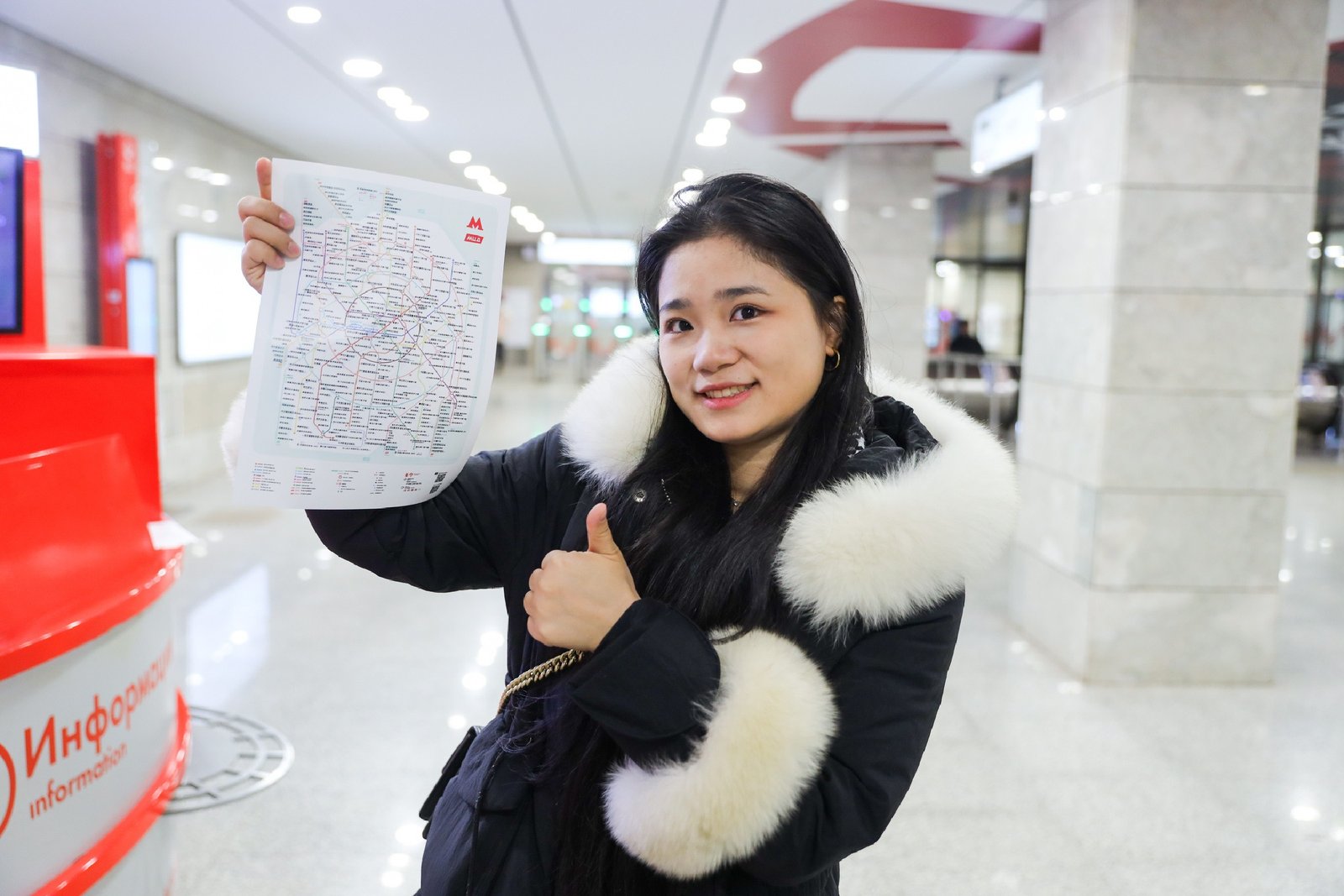
Moscow is actively adapting its infrastructure for international tourists: metro maps in Chinese and Arabic have been created.
Station names have been translated with attention to both meaning and transliteration.
For example, Park Kultury in Chinese conveys the meaning “park”, while Kuznetskiy Most in Arabic sounds like “Kuznitski Must.”
Printed versions of the maps are available at Live Communication information stands, while digital versions can be found on the Unified Transport Portal.
Digitalisation has also reached new stations: four stations on the Line 16 (Vavilovskaya, Krymskaya, Akademicheskaya, and ZIL) opened with digital navigation systems from day one.
The interchange between Akademicheskaya on the Lines 16 and 6 has become the first fully digital transfer point.
The number of digital signs in the metro has more than doubled — exceeding 130 units — and allows for remote content updates.
To improve in-carriage navigation, exit numbers at interchange hubs have begun appearing above the doors of Moskva-2020 and Moskva-2024 train series.
The technology is now operational in 100 trainsets on the Lines 6 and 16 and Circle.
Priority seating stickers have also been refreshed: over 24 000 decals have been replaced, swapping generic pictograms for friendly, approachable illustrations.
Changes have also affected surface transport.
All 37 tram routes have been equipped with new signs highlighting key streets and interchange points.
On the river route Novospasskiy – ZIL, digital information pillars with real-time schedules and navigational flags have been installed.
Temporarily, during the closure of a section of the Line 1, color-coded floor navigation was successfully tested at Salaryevo Station to guide passengers toward replacement bus services.
Looking ahead to 2026, plans include expanding digital navigation to the Line 17, introducing consistent exit numbering at new interchanges, and extending the AI Voice technology to additional metro lines.
“Moscow Mayor Sergey Sobyanin summarised the results of the Transport Complex’s work in 2025. We are continuously enhancing travel comfort, with a primary focus on cutting-edge solutions that integrate familiar passenger services with modern technologies,” stated Maksim Liksutov, Deputy Mayor of Moscow for Transport and Industry.
“For instance, last year we deployed digital navigation systems at four new stations on the Line 16.
“This enables us to display relevant information quickly and efficiently.
“According to the Moscow Transport Development Strategy through 2030, more than 30% of the metro’s navigation elements will be digital.”
The post Moscow Modernises Transport System With Digital Innovations, Passenger Conveniences appeared first on The Bulrushes.