“We will not look back. We will not deviate, and as the heat of oppression mounts, we shall become purer and purer, learning new lessons, and leaving all the dross of racialism and similar evils behind to emerge as a people mentally and physically disciplined” – Robert Mangaliso Sobukwe.
Forty-eight years after his passing, Robert Sobukwe’s name still sends shivers down the spines of those who perpetuated apartheid’s brutal regime, and the renaming of his birth town, Graaff-Reinet, to “Robert Sobukwe Town” has struck a nerve.
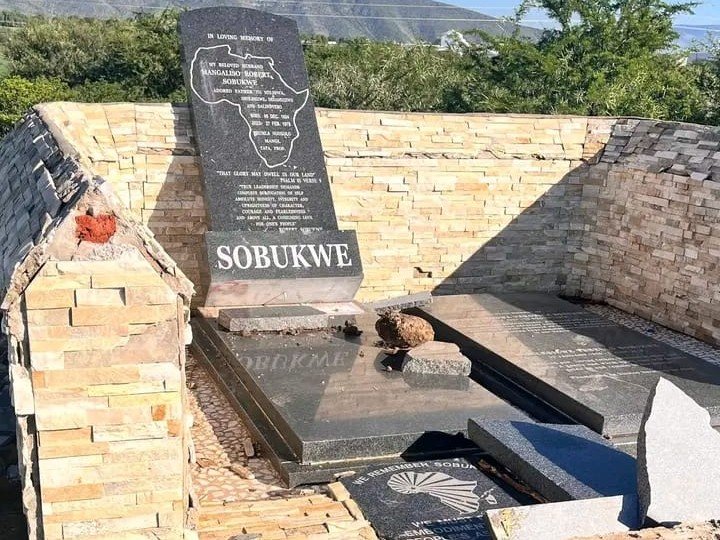
The recent desecration of his grave in Robert Sobukwe Town is a stark reminder that his legacy continues to unsettle those who benefited from oppression.
At the heart of Sobukwe’s impact is a bold, uncompromising insistence on freedom with responsibility.
He did not merely call for the end of categorization by race; he demanded a vision of humanity that transcended narrow identities.
The vandalism, which has left Sobukwe’s grave in a state of disarray, is not an isolated incident.
It’s a continuation of the systemic disrespect and fear that has surrounded his name for decades.
Yet, this latest act has sparked a renewed interest in Sobukwe’s life and vision, with his name on the lips of everyone, friend and foe alike.
His legacy continues to be relevant today.
The desecration of his grave has brought attention to his life and work, highlighting the fear he inspired in the apartheid regime and the impact he had on South Africa’s struggle for freedom.
The desecration of Sobukwe’s grave occurred not only during the weeks surrounding the renaming of Graaf-Reinet to Robert Sobukwe Town but also coincided with the eve of the Sharpeville/Langa massacre.
The massacre that occurred on 21 March 1960, a date long regarded as a turning point in South African politics, was not only inspired but led by Sobukwe.
This is not the first time this barbaric act has happened, nor is it the second or third time.
This vandalism started long before Prof’s, as Sobukwe is fondly referred to, grave was declared a heritage site.
I, as a person, years ago, stopped being angry at Sobukwe’s gravesite being repeatedly vandalised.
I have come to accept that it will not be the last time his gravesite will be desecrated.
This is not merely a nostalgic memory of a heroic past.
Sobukwe’s ideas catalysed fear within the apparatus of oppression, the fear that a liberated consciousness could destabilise the apartheid regime from within.
Despite the recent desecration of Sobukwe’s grave, there’s a silver lining: it’s sparked interest in his life and legacy.
Sobukwe’s vision for African freedom instilled fear in the apartheid regime, leading to his isolation on Robben Island.
He was sentenced without trial, and his imprisonment was made law through the infamous “Sobukwe Clause”.
This clause allowed for the extraordinary detention and isolation of Sobukwe, effectively placing him beyond the ordinary legal process and separating him from other political prisoners on Robben Island.
The very fact that Sobukwe’s incarceration was gazetted into law speaks to the fear he inspired, and to the resilience with which he faced that fear.
The clause was designed not only to isolate Sobukwe physically but to stigmatize and bureaucratically render him exceptional, illustrating how a regime weaponised law to shape political perception.
The Sobukwe Clause remains a historical reminder of the lengths to which a regime will go to suppress dissent.
This shows how the racist apartheid regime was threatened by his ideas, which led not only to the banning of political parties but also sparked and gave birth to the armed struggle in South Africa.
In Robben Island, Sobukwe was placed under state control and restricted from direct contact with other prisoners, establishing a unique and controversial form of confinement.
His isolation reflected the fear he inspired within the apartheid machine: that a single, articulate thinker could mobilize moral clarity and a different form of collective action.
There is a paradox that must be acknowledged.
The continued vilification or vandalism of Sobukwe’s grave, an act that desecrates a site of memory, does more than insult a mortal; it amplifies his message.
It invites people to learn the story behind the tombstone, to ask who Sobukwe was and why his ideas continue to provoke fear and admiration in equal measure.
The strong response to such vandalism can be a form of democratic resilience: a refusal to allow a single act of destruction to rewrite a history that belongs to many.
Sobukwe’s story is one of courage, his clarion call for African freedom and independence instilled fear in the apartheid regime, leading to his imprisonment on Robben Island, separated from other inmates, and gazetted as a law– the infamous Sobukwe Clause.
The “Sobukwe Clause”, a legal and historical oddity of confinement that marked him in a legalistic way, became astark emblem of how a single individual’s ideas can threaten an entire system.
It is not merely a footnote in legal history; it is a symbol of the power of a single voice to disrupt the machinery of oppression.
The very fact that Sobukwe’s incarceration was gazetted into law speaks to the fear he inspired, and to the resilience with which he faced that fear.
His ideas sparked the armed struggle in South Africa and led to the banning of political parties.
Worldwide, there’s no other leader who’s been persecuted like Mangaliso Sobukwe.
Yet, he refuses to be silenced, and his legacy continues to inspire. Vandalism of sacred sites often reveals more about the vandals than the victim; it becomes an invitation to educate, to dialogue, and to understand the historical context.
As Sobukwe’s words echo through time: “We will go on… until the cry of African freedom and independence is heard… until government of the Africans by the Africans for the Africans is a fait accompli”.
Sobukwe’s vision was clear.
His legacy will continue to haunt those who clenched power and perpetuated oppression.
He refused to be broken, and his ideas refuse to be silenced; his name may have been targeted, but his message remains loud and clear.
Sobukwe’s courage in the face of oppression has cemented his place in history.
His insistence on African dignity, his insistence on a future where Africans govern themselves, resonates with movements across the continent and beyond.
The reminder that “Sobukwe lives” is a reminder that an idea cannot be contained by time or by the attempts to erase it.
If legacies are measured by the capacity to inspire future generations to imagine a better world, Sobukwe’s life stands as a testament to enduring possibility.
His famous exhortations, often quoted and re-quoted, contain a stubborn fidelity to a future in which Africans walk their streets as free men and women, their heads held high, and where the color of a person’s skin becomes as irrelevant as the shape of their ears.
He spoke of a dawn in which government of the Africans by the Africans for the Africans would be a fait accompli, not as atriumph over others, but as a reclamation of dignity and sovereignty.
In closing, Sobukwe’s legacy is not a relic, nor is it a mere chapter in a schoolbook.
It is a living, breathing challenge to the present: to question how we define freedom, how we honor memory, and how we respond to acts that seek to diminish a person who spoke truth to power.
He did not seek to erase others; he sought to awaken a broader humanity that could imagine a future beyond the narrow confines of racial hierarchy.
In this sense, Sobukwe’s legacy remains a haunting reminder of what resistance looks like when it refuses to be silenced or privatised.
Sobukwe does not simply “live” in the sense of memory; he lives in the ongoing struggle to transform the political and moral landscape of our time. Sobukwe will never die; Sobukwe lives.
*Xola ‘eXTee’ Tyamzashe is an APLA veteran. and a prominent figure in South African history and politics, known for his contributions to the Pan-Africanist movement. The views expressed by Xola ‘eXTee’ Tyamzashe are not necessarily those of The Bulrushes
The post Sobukwe Lives: The Legacy That Haunts Verwoerd And Vorster’s Descendants appeared first on The Bulrushes.
