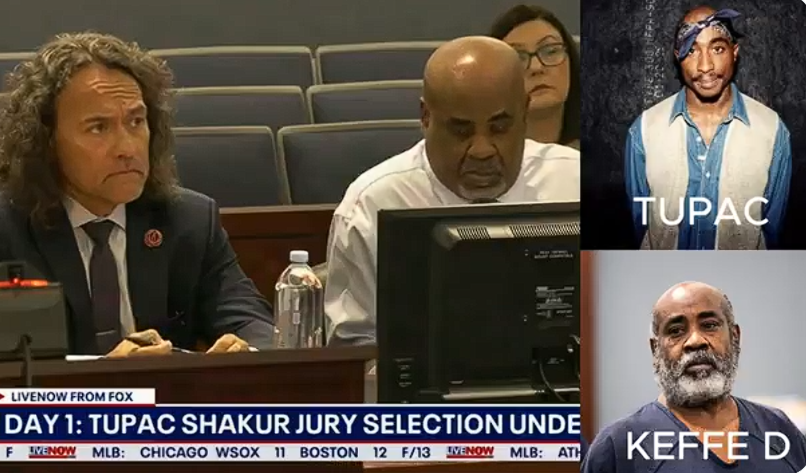
Las Vegas – Three decades after the drive-by shooting that silenced one of hip-hop’s brightest stars, the long-delayed murder trial of Duane “Keffe D” Davis has begun in Las Vegas.
Jury selection opened Monday, August 10, 2026, in Clark County District Court before Judge Carli Kierny, nearly 30 years after Tupac Shakur was fatally shot on a September night near the Las Vegas Strip.
The accused, 63-year-old Davis, a former leader of the South Side Compton Crips, faces a single count of murder with a deadly weapon with the intent to promote, further or assist a criminal gang.
He has pleaded not guilty.
Prosecutors do not allege he pulled the trigger; they contend he orchestrated the attack and provided the gun used in the shooting.
If convicted, he faces the possibility of life in prison.
The trial is expected to last about a month, possibly longer.
(Source: usatoday.com)
Davis is the only person charged in connection with the killing.
The three other men prosecutors say were in the white Cadillac that night—his nephew Orlando “Baby Lane” Anderson, Deandrae “Freaky” or “Big Dre” Smith, and Terrence “T-Brown” or “Bubble Up” Brown—have all since died.
Anderson was killed in a 1998 Compton shooting.
(Source: nytimes.com)
The case had gone cold for years until Davis’s own public statements revived it.
In his 2019 memoir Compton Street Legend, interviews promoting the book, and earlier statements to investigators, he described being in the Cadillac and providing a weapon.
Prosecutors have built much of their case around those admissions.
A 2008 police interview has been ruled admissible, and the book itself is expected to feature prominently.
Grand jury testimony has offered competing accounts of who fired the shots—some pointing to Anderson, others to Smith—but the core allegation against Davis is that he was the “shot caller” who set the plan in motion as retaliation for a fight earlier that evening.
No murder weapon or getaway vehicle is expected to be presented; the prosecution’s case rests heavily on Davis’s words, witness recollections, and contextual evidence of gang rivalries.
(Source: mercurynews.com)
Prosecutors have released a lengthy witness list containing more than 200 names.
Potential witnesses include members of the Shakur family (among them his sister Sekyiwa and stepbrother Maurice “Mopreme” Shakur), former Las Vegas Mayor Oscar Goodman, Nevada Gov. Joe Lombardo (who was involved in earlier investigative stages as sheriff), Death Row security figure Reggie Wright, the photographer who took the last known image of Tupac alive that night, and others connected to the events or the broader hip-hop and gang landscape of the mid-1990s.
Documentarians and individuals who previously testified before the grand jury also appear. Not everyone listed will necessarily take the stand.
(Source: 8newsnow.com)
Marion “Suge” Knight figures prominently in both the history of the case and the potential witness roster.
The co-founder of Death Row Records was driving the black BMW in which Shakur rode as a passenger when the shots were fired.
Knight sustained only minor injuries from bullet fragments.
He is currently serving a 28-year prison sentence in California for voluntary manslaughter stemming from a separate 2015 hit-and-run incident in which a man was killed.
Knight has publicly stated he does not want to testify, telling interviewers the trial has “nothing to do with me” and that compelling his appearance would not help either side.
Whether he is ultimately called remains to be seen.
(Source: usatoday.com)
Tupac Amaru Shakur was born Lesane Crooks on June 16, 1971, in Brooklyn, New York, to Afeni Shakur, a Black Panther activist who renamed him after an Incan revolutionary.
He grew up moving between cities, attended the Baltimore School for the Arts, and rose rapidly in the early 1990s as a charismatic, prolific rapper and actor whose work blended street narratives, social commentary, vulnerability, and bravado.
Signed to Death Row after a period of legal troubles, he released landmark albums and starred in films.
By 1996, he was one of the most influential and commercially successful figures in hip-hop, deeply entangled in the era’s East Coast–West Coast tensions and local gang affiliations—though he was not himself a formal gang member.
On the evening of September 7, 1996, Shakur and Knight attended Mike Tyson’s first-round knockout of Bruce Seldon at the MGM Grand.
After the fight, a scuffle broke out in the hotel involving Shakur, Knight, and others against a group that included Orlando Anderson.
Surveillance captured elements of the altercation.
Later that night, around 11 p.m., as Knight drove the BMW on Las Vegas Boulevard toward Club 662, a white Cadillac pulled alongside at a traffic light or stop.
Gunfire erupted—more than a dozen rounds by some accounts. Shakur was struck four times, including twice in the chest.
He was rushed to University Medical Center, underwent surgeries, and remained critical.
He died on September 13, 1996, at age 25.
The motive has long been framed as gang retaliation tied to the earlier fight and the broader rivalries between Death Row (linked to Bloods/Mob Piru sets) and Crips factions associated with the Compton group.
(Source: apnews.com)
The trial opens a rare window into one of popular culture’s most persistent unsolved cases.
For fans, family, and the industry, it represents a chance—however imperfect—at accountability after decades of speculation, documentaries, and street lore.
Jury selection, involving panels of potential jurors questioned about conflicts, media exposure, and the ability to serve through a high-profile proceeding expected to last weeks, marks the first formal step. Opening statements and testimony will follow.
Whatever the verdict, the proceedings will test memories faded by time, the reliability of a defendant’s own past statements, and the enduring weight of a killing that helped define an era in American music.
Disclaimer: This article was compiled using the AI tool Grok on X and may contain inaccuracies
The post Tupac Shakur Murder: Jury Selection Begins Ahead Of Duane ‘Keffe D’ Davis’ Trial appeared first on The Bulrushes.