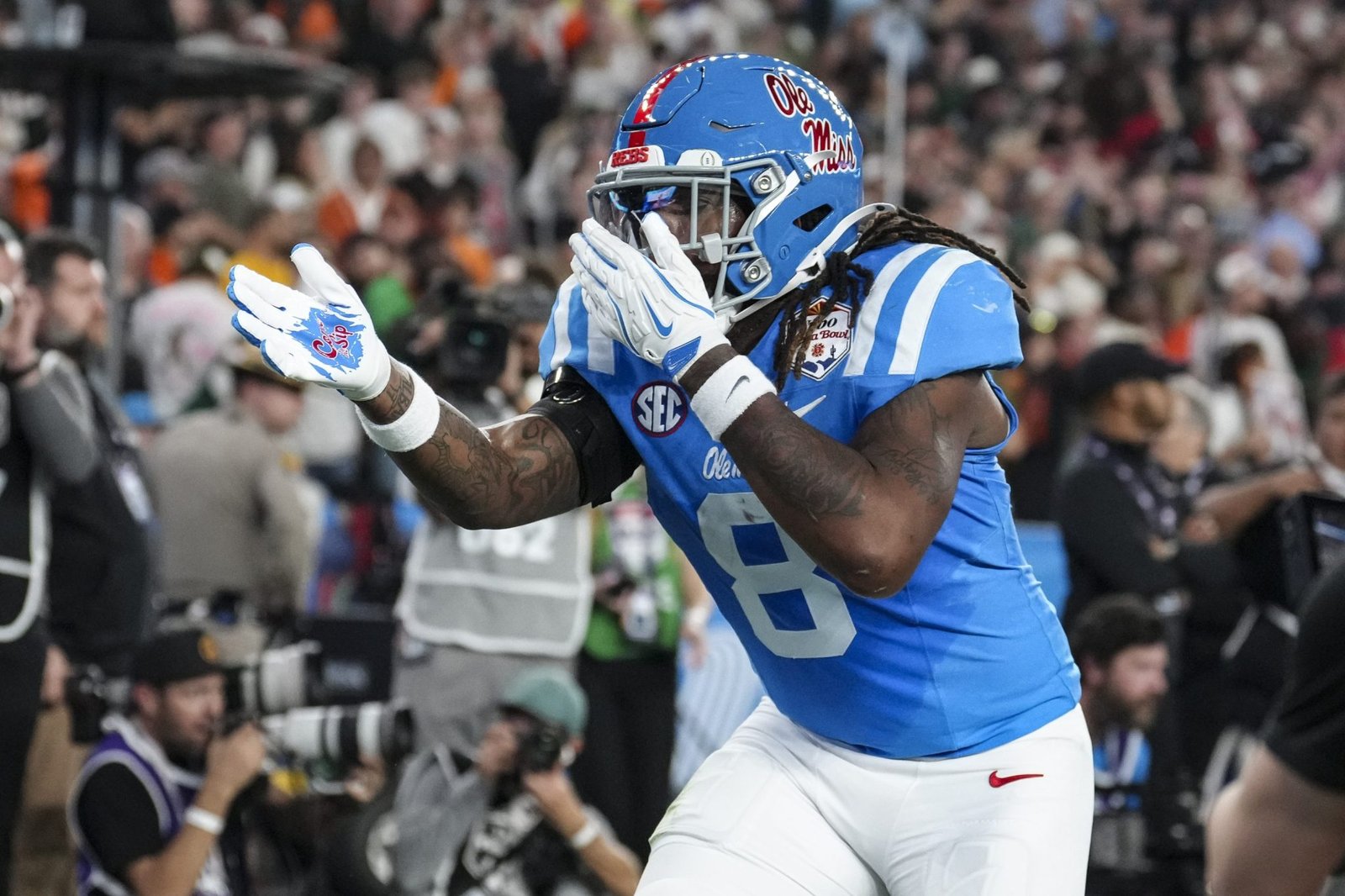
Dae’Quan Wright, the former Cleveland Browns tight end, may soon make history. The former NFL player’s stint in pro football is coming to an end after being waived, but that may not be the last time he dons a football uniform, as he’s likely to return to college sports at LSU this year.
Wright, a former Ole Miss tight end who went undrafted in the 2026 NFL Draft, signed with the Philadelphia Eagles before joining the Cleveland Browns. After receiving a temporary restraining order in a lawsuit challenging the NCAA’s eligibility rules, he entered the transfer portal and reached an agreement to return to college and reunite with his former coach Lane Kiffin. The 22-year old’s aspiration to return to America’s favorite amateur sport signals just how big college football has become.
The move would have been difficult to imagine under the traditional conception of college sports. Professional athletes have joked about it in the past, with even all-time NBA great LeBron James teasing at a potential college sports journey post-retirement—albeit as more of a joke than an actual plan. But the legal and financial changes that have transformed college athletics in recent years have made the distinction between “amateur” and “professional” increasingly difficult to maintain.
The NCAA is now fighting to preserve that distinction even as college athletes receive unprecedented compensation—and Wright’s case has become a spark in exposing the difference.
Since Wright’s arrangement with LSU became public, the fight over his eligibility has escalated quickly. The SEC, Big Ten, and other major conferences adopted rules this week banning athletes who signed professional contracts from returning to college rosters, a policy aimed squarely at players like Wright. A Dallas judge has since blocked the SEC from enforcing that ban against a group of athletes that includes Wright, though the NCAA has won reversals of similar restraining orders in other cases in the same week. The legal fight remains unresolved.
“Courts across the country granting relief to ineligible athletes who already had every opportunity to compete in college—sometimes without even having a hearing—are failing to appreciate the destabilizing effect their rulings are having on college sports,” the NCAA told Fortune in a statement.
Is college football really an “amateur” sport?
The association said Congress could address the issue by passing the bipartisan Protect College Sports Act, which it said would provide student-athletes with “a level playing field with rules that apply fairly to everyone.”
The legislation has advanced in Congress. The Senate Commerce Committee approved the Protect College Sports Act in June with bipartisan support, and the bill would establish a federal framework for NIL agreements while addressing eligibility, transfers and other parts of the college sports ecosystem.
“The lawyers bringing these cases seemingly won’t be satisfied until every professional athlete can treat college sports as a fallback option,” the NCAA said.
But Wright’s case is also illustrating why the NCAA’s argument about amateurism is becoming harder to square with the economics of the modern college engine.
Professor Victoria Jackson, a sports historian and co-director of the Great Game Lab at Arizona State University, said the NCAA’s description of college sports as a “fallback” misses the larger point of the industry.
“I think that’s among the most important questions,” Jackson told Fortune of whether athletes have adequate protections as they navigate the commercialized college sports system. “Taking a step back and thinking about the kind of unique position of college sports is useful.”
Jackson said college sports are now part of a global economy in which elite athletes routinely move between developmental and professional systems. In that context, she said, college sports are not necessarily a lesser alternative to professional competition.
“These are not fallbacks—it’s that they are good places, full stop,” she said. “The competitiveness of college sports is at the top of the world. But now also the compensation opportunities are among the most competitive in the world.”
For some athletes, Jackson explained, playing in the NCAA could potentially be more lucrative than playing professionally in another country or league. Wright, for example, had signed a three-year, $3,125,000 contract with the Eagles before being acquired by the Browns—giving the undrafted Gen Z Wright an average salary of $1,041,667. But the House v. NCAA settlement from 2025 now allows schools to participate in revenue-sharing—allowing colleges to directly pay athletes a share of up to 22% of the “average shared revenue” generated by power conference revenue. Louisiana State University—the college football program Wright is expected to join—is one of the schools enrolled in revenue-sharing, and the expected cap for the 2026-27 season is $21.3 million.
LSU declined a request to comment from Fortune regarding Wright’s return.
“Depending on what kind of package you can get for yourself,” Jackson said, “it might be more lucrative for someone to play in the college space as long as they can, or even try to return to it, than it would be to play professionally.”
In other words, college athletes are no longer just receiving scholarships while forbidden from monetizing their athletic fame. For the largest programs, athletes can now receive a package that combines scholarships, NIL opportunities and direct revenue-sharing payments. But Jackson argues the compensation itself is not a new development.
“The scholarship is just part of the compensation package now because there is direct pay to some of these athletes,” she said.
A scholastic distinction
If college sports remain fundamentally educational programs, there is a case for treating them differently from professional leagues as the NCAA stipulates. But if athletes are receiving direct revenue-sharing payments, negotiating NIL contracts and competing for increasingly valuable roster spots in a multi-billion dollar sports industry, the concept of “amateurism” becomes harder to use as the dividing line. Jackson says the better distinction may be between “scholastic” and professional sports rather than “amateur.”
“It’s a conflation of scholastic and amateur,” she said. “The fact it’s taking place within a school setting—is that enough to say that it’s different from professional sports? I’m not so sure at this point.”
Jackson also noted that in many countries, elite athletes develop through professional club systems rather than college programs. Young athletes can compete alongside professionals while receiving protections designed for minors. In soccer, for example, professional clubs operate academies that develop players before and during their professional careers.
“There is no such thing as amateurism,” the professor said of the international sports system. “You play sports and you earn money because you need to pay for the training and travel and competition to stay in that sport.”
American college sports, by contrast, have historically served as the major development system for professional football. The NFL has benefitted from colleges effectively bearing much of the cost of developing players, while college programs have used the NFL as the ultimate destination for their best athletes, according to Jackson.
There are already examples in other sports of athletes moving between professional and college systems without producing the same alarm. Jackson pointed to baseball and hockey, where players can be drafted or develop through professional pathways while retaining or returning to college opportunities under certain circumstances. That flexibility, she argued, could offer a blueprint for football, rather than forcing every sport into the same eligibility code. Football, however, remains the economic center of college sports. The sport generates enormous media and sponsorship revenues, drives conference realignment and finances many of the other sports that universities operate.
That makes it harder to separate football from the rest of college athletics. A possible solution, according to Jackson, would be to “spin off football and professionalize it,”—while maintaining university branding and still using the revenue generated by football to subsidize the other sports.
Dae’Quan Wright and his agents did not immediately respond to a request for comment from Fortune.
This story was originally featured on Fortune.com
