
The Wright brothers kept their airplane in the air for just 12 seconds.
For the next several decades, the real innovation was not simply making airplanes fly farther or faster. Airports were built. Pilots were trained. Air traffic control emerged. Insurance markets developed. Governments established safety standards. Travelers gradually became comfortable climbing into airplanes.
Today, most of us board a flight without giving any of that a second thought. We are more likely to complain about delayed departures, full overhead bins or stale pretzels than wonder whether the aircraft will remain in the sky.
The innovation became ordinary. But getting there took time.
Time for institutions to develop. Time for standards to emerge. Time for unforeseen consequences and opportunities to reveal themselves. Time for society to discover questions no one knew to ask at the beginning. And time for expectations to settle.
I wonder whether that sequence still exists.
Consider two transformative innovations unfolding right now.
Artificial intelligence is driving enormous investment in data centers and the infrastructure required to support them. But the same infrastructure welcomed for its investment, jobs and contribution to American competitiveness is encountering organized opposition over electricity, water, noise, land use and effects on local communities.
Virginia offers a striking example. A Washington Post-Schar School poll conducted in late March found that only 35% of Virginia voters would be comfortable with a new data center being built in their community, down from 69% when the same question was asked in 2023[1]. In Prince William County, a proposed data-center development near Manassas National Battlefield encountered years of organized opposition and litigation. A Virginia appeals court ultimately invalidated the county’s rezoning approvals on procedural grounds unrelated to the substantive objections to the project.[2] The county then decided not to continue defending the approvals, and the developer subsequently dropped its appeal.
Prediction markets offer a very different example of the same governance problem. Their rapid growth has occurred while a fundamental question remains unsettled: are sports-event contracts federally regulated derivatives, state-regulated gambling, or some combination of the two? Earlier this month, New Jersey asked the U.S. Supreme Court to review an appellate ruling favoring federal jurisdiction over sports-related event contracts offered by prediction markets. Other courts have reached different conclusions.
In both cases, the innovation is developing while society is simultaneously deciding what it thinks about it, and, in some instances, who gets to decide. Historically, many of these developments occurred sequentially. Increasingly, they are occurring simultaneously and influencing one another in real time.
Investment is flowing while products and business models are still evolving. Customers are adopting while policymakers are still debating. Communities are organizing while companies are still building. Courts are hearing cases while legislatures are considering whether new laws are needed. Different countries, and sometimes different states and communities, are reaching different conclusions about the same innovations.
That changes the governance challenge. For a board, the important signal is not simply whether any one stakeholder prevails, but how the environment around the innovation is changing, and what that may mean for the company’s range of choices.
Boards must still understand the innovation itself. But they also need to understand what the innovation is setting in motion around it: which stakeholders are becoming more influential, how their definitions of value differ, where separate concerns are beginning to reinforce one another and what early signals suggest that the balance may be shifting.
I think of this as stakeholder momentum.
It doesn’t just matter to the boards of companies creating transformative innovations. Some companies are developing innovations that reshape society. Many more are being reshaped by innovations they neither invented nor control. Their customers may behave differently. Their employees may have different expectations. Regulators may confront new questions. Investors may reassess risks and opportunities.
The governance questions differ depending on which side of the innovation a company sits. But neither group can afford to watch only the innovation itself. Both need to watch how the world around it is moving.
When there is no exchange rate
One reason this is so difficult is that stakeholders may not simply disagree about how to divide the benefits and costs of innovation. They may disagree about what constitutes value in the first place. Again, we can use data centers and prediction markets to illustrate the conundrum.
Consider a community evaluating a proposed data center. The company can quantify investment, construction jobs, permanent employment and additional tax revenue. Those are meaningful benefits, and they can be expressed in dollars.
But residents may be thinking about water.
How much is an additional dollar of tax revenue worth compared with a gallon of water? What is the exchange rate between economic development and the character of a community? Between national competitiveness and noise outside someone’s home? Between shareholder return and a resource a community believes is already scarce?
There is no established exchange rate.
That distinction matters. Boards are accustomed to evaluating trade-offs where the competing alternatives can ultimately be translated into financial terms. But some of the most consequential questions surrounding transformative innovation involve values that cannot readily be put on the same scale.
Prediction markets offer a different set of trade-offs. One stakeholder may value the quality of information a market produces. Another may be concerned about gambling or addiction. Another may focus on whether certain events should be subjects of wagering at all. The disagreement is not necessarily about whether the market functions efficiently. It is about what should count as value.
There are other parallels. Social media followed a similar path. Connection, access and the democratization of communication created enormous value. Over time, society began placing greater weight on other measures: mental health, misinformation, polarization, privacy and the economics of attention.
The underlying challenge is not simply balancing competing interests. It is navigating competing definitions of value, sometimes measured in units that cannot be reconciled.
The Innovation Isn’t the Only Thing That Changes
History reminds us that society’s relationship with an innovation can evolve as dramatically as the innovation itself. The physics of nuclear power did not change after Three Mile Island, Chernobyl and Fukushima; society’s willingness to embrace it did. The internet traveled in the opposite direction, from academic curiosity to infrastructure on which modern commerce, communication and daily life now depend.
Transformative innovations do more than improve an existing product or process. They reshape the environment in which everyone else operates. They alter industries beyond their own, create new expectations and introduce questions that often could not have been anticipated when the innovation first appeared.
What is different today is not simply speed. It is the collapse of sequence.
Inventors, investors, customers, communities, regulators, courts, employees and governments increasingly encounter transformative innovations at roughly the same time, and their reactions influence one another in real time. There is an irony here: the information environment created by earlier transformative innovations, and now amplified by AI, is itself accelerating stakeholder momentum. Previously separate voices can find and reinforce one another almost instantaneously. A local concern can attract political attention. Political attention can change regulatory expectations. Regulatory uncertainty can affect investors. Investor questions can change corporate behavior.
And that momentum can build in favor of an innovation as well as against it. What matters to the board is understanding when the balance of influence is changing. What begins at the edge can move toward the center surprisingly quickly. That is why a conventional stakeholder analysis may no longer be enough.
From stakeholders to stakeholder momentum
Boards have long been encouraged to understand their stakeholders. Who are our investors? What do our customers want? What concerns our employees? What do regulators expect? How will communities respond?
Those remain useful questions. But they provide a snapshot.
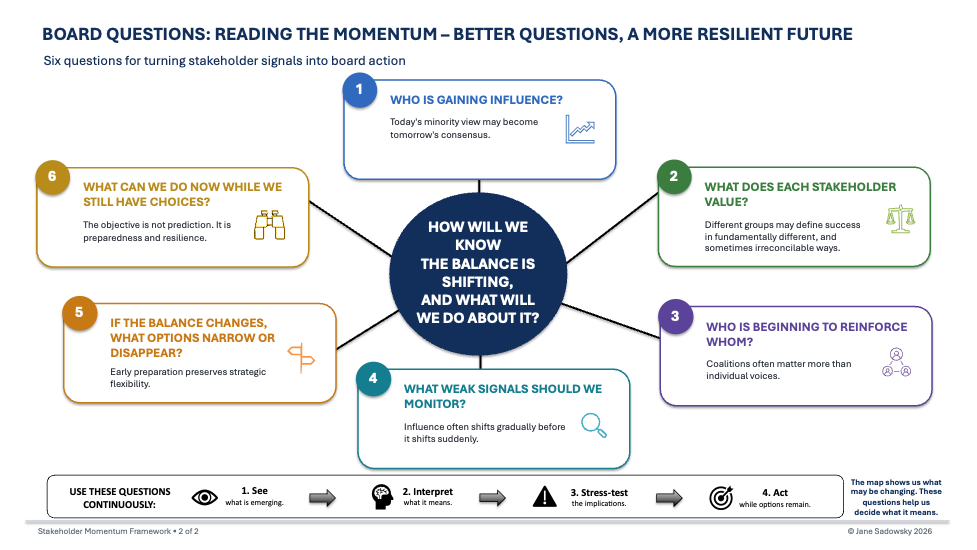
The more important governance question may increasingly be: Where is the momentum?
Which stakeholders are gaining influence? What do they value? Which groups that once appeared unrelated are beginning to reinforce one another? What weak signals suggest that an issue is moving from isolated concern toward broader acceptance or opposition? And what happens to the company’s strategic choices if the balance shifts?
This is the purpose of a Stakeholder Momentum Map.
The map is not intended to predict the future. Nor is it an exercise in satisfying every constituency. Boards will sometimes decide to proceed despite substantial opposition, just as they may decide not to pursue opportunities that enjoy considerable support.
Its purpose is to make movement visible: what different stakeholders value, where early signals are appearing and, critically, where previously separate constituencies may be beginning to reinforce one another.
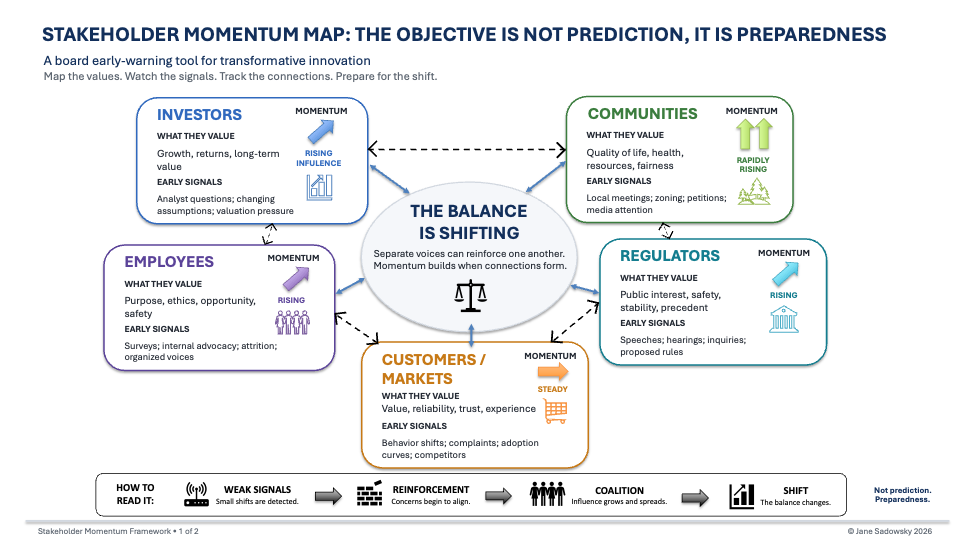
Boards routinely monitor changes in revenue, margins, market share and capital availability. Stakeholder momentum deserves similar attention because influence rarely changes all at once. Small shifts accumulate. Coalitions form. Concerns that once seemed peripheral can become central.
By the time the shift is obvious, some of the organization’s optionality may already have disappeared.
Two different boardroom conversations
The challenge looks different depending on whether a company is creating transformative innovation or being transformed by it.
Boards overseeing companies driving transformative innovation need to look beyond whether the innovation works and whether customers want it. They should be asking what assumptions they are making about societal acceptance, what consequences may emerge that no one yet sees, which stakeholders could become more influential as adoption grows and what might cause today’s supporters to become tomorrow’s critics.
Boards of companies being reshaped by transformative innovation face a different challenge. They need to look beyond their own industry and ask which outside innovations could change their economics, their customers, their workforce or their competitive environment, and which assumptions that have long underpinned their strategy may no longer hold.
For both, the essential discipline is the same: watch how the balance is moving while there is still time to respond.
Governing while the answer is still forming
Boards are spending considerable time asking how they should govern artificial intelligence. They should. But AI is one example of a much larger governance challenge.
There will be other transformative innovations.
Some will originate in technology. Others will come from new markets, new business models, scientific discoveries or ideas we have not yet encountered. What they will share is the ability to change not only companies and industries, but the expectations of the people and institutions around them.
And increasingly, boards will have to make decisions before those expectations have settled.
There may be no consensus about which benefits matter most. No agreement about which risks society is willing to accept. Different jurisdictions may reach different conclusions. Stakeholders may measure success using entirely different units of value.
There may be no exchange rate.
That makes stakeholder momentum important. The board cannot know precisely where society will land. But it can watch where influence is moving, recognize when separate voices begin to reinforce one another and prepare before the shift becomes obvious.
Perhaps the defining governance challenge of transformative innovation is not keeping pace with innovation itself.
It is governing while society is still deciding what progress means.
The opinions expressed in Fortune.com commentary pieces are solely the views of their authors and do not necessarily reflect the opinions and beliefs of Fortune.
This story was originally featured on Fortune.com