Johannesburg – South African universities cannot prepare students for a rapidly changing world by continually rewriting their strategies while neglecting governance, integrity and the basic commitments they make to the people they serve.
That warning came from Edward Kieswetter, founder and Chief Executive Officer of vEKtor Solutions Laboratory (Pty) Ltd and former Commissioner of the South African Revenue Service (SARS), who argued that institutional resilience is what makes ambitious reform possible.
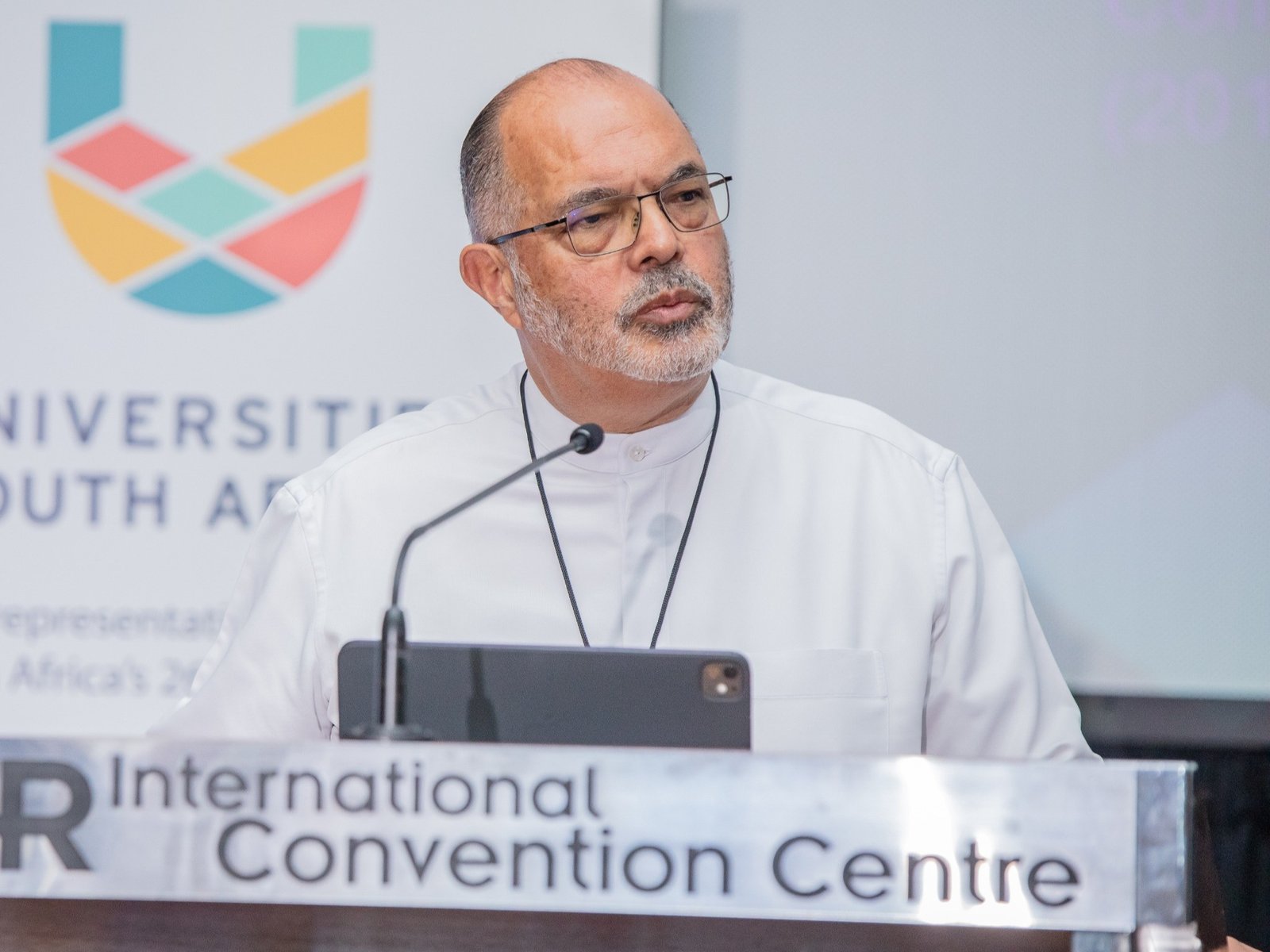
Addressing the 4th Universities South Africa (USAf) Higher Education Conference at the CSIR International Convention Centre in Pretoria on Wednesday, 7 October 2026, Kieswetter challenged university leaders to confront weaknesses before attempting wholesale transformation.
The three-day conference, held under the theme “Co-creating a Resilient Future”, opened with an address by USAf Chief Executive Officer Dr Phethiwe Matutu, who urged universities to shape change rather than merely watch it unfold.
Higher Education and Training Minister Buti Manamela subsequently addressed the gathering on the future and public purpose of higher education.
Kieswetter’s keynote address on governance, accountability and institutional renewal brought experience of rebuilding public and private organisations into the debate.
A practitioner of institutional recovery
Kieswetter served as SARS Commissioner from May 2019 until April 2026.
After leaving SARS, he founded vEKtor Solutions Laboratory, a consultancy that works with corporate organisations and public institutions on integrity, organisational improvement, and leadership.
His career spans engineering, education, financial services and tax administration.
His concern was the mismatch between the speed of technological change and the capacity of existing institutions to respond.
“The fact is that a student who enrols with us this year will graduate into a labour market that none of us can fully describe,” he said.
He argued that artificial intelligence (AI) would change the cognitive work associated with established professions, including law and medicine.
Universities could no longer assume that curricula designed around familiar occupations would remain adequate throughout a student’s working life.
A university, he suggested, increasingly exists to prepare young people to navigate circumstances that do not yet exist.
This demanded greater attention to demonstrated capabilities and social impact, not qualifications alone.
Resilience makes experimentation possible
But he rejected the idea that accelerated change could substitute for institutional discipline.
“Agility without the proper anchoring is, in fact, just reckless drifting,” he warned.
Kieswetter contrasted a conventional map, which prescribes a fixed route, with a global positioning system that recalculates the route while preserving the destination.
For universities, the destination was the institution’s enduring public purpose; governance and integrity provided the necessary foundations.
He defined institutional resilience as an institution’s capacity to absorb shocks, correct mistakes and honour its promises without losing its purpose, disconnecting from its people or eroding public trust.
Rather than treating resilience as a defensive exercise to satisfy auditors and avoid scandal, he described it as the foundation on which universities could experiment with curricula, partnerships and new models of teaching without destabilising themselves.
“Resilience is not the brake on agility; it is the chassis,” he said, drawing on his interest in Formula One racing to explain how stability enables speed.
Eight tests of institutional strength
Kieswetter presented eight connected requirements drawn from his experience at Alexander Forbes and SARS: honest diagnosis, sound governance, integrity by design, accountable leadership, a culture in which concerns can be raised safely, reliable execution, public trust and leadership succession.
Honest diagnosis, he said, required leaders to examine conditions experienced by frontline employees and service users, rather than accepting a polished account in an annual report.
Universities could not respond effectively to problems they refused to describe accurately.
Governance was tested when senior leaders disagreed, when unpopular decisions became unavoidable, or when influential individuals were implicated in wrongdoing.
Integrity could not be reduced to a framed statement of values: institutions needed arrangements that made misconduct difficult, exposed it quickly and discouraged its repetition.
“Culture is shaped by the worst behaviour a leader is willing to tolerate,” he said.
He questioned whether academic freedom and the confidence to speak openly extended beyond academic staff to administrators, support workers and students.
An institution could not credibly champion innovation if employees learnt that silence was safer than raising a concern.
Everyday delivery was equally important.
A student waiting weeks for funding to be cleared would judge the institution by its ability to resolve that problem, rather than by the sophistication of its strategic plan or promises about AI.
For Kieswetter, public trust was the consequence of consistent performance and fairness.
“Trust is not won by a better press statement,” he said.
It depended on what people repeatedly experienced when dealing with the institution.
He also argued that change should outlast individual leaders.
A university dependent on a single visionary vice-chancellor would remain vulnerable if systems, succession, and institutional learning were neglected.
Alexander Forbes: whose interests come first?
To demonstrate the approach, Kieswetter recalled arriving at Alexander Forbes in January 2010 amid serious legal exposure, financial pressures and reputational damage arising from disputes involving pensioners.
At an early briefing, he questioned why the company’s leadership was focusing on defending itself rather than correcting the harm suffered by the people whose money it administered.
He said the question changed the organisation’s legal approach and its priorities.
According to his conference account, approximately R730 million was subsequently returned to pensioners, and the company listed on the Johannesburg Stock Exchange in July 2014.
SARS: rebuilding confidence through service
Kieswetter applied a similar philosophy at SARS following his appointment in May 2019, when the revenue authority was confronting the consequences of serious institutional failures and weakened public confidence.
He said the recovery programme emphasised certainty for taxpayers, improved service and fair enforcement rather than treating higher revenue collection as an isolated objective.
In figures presented during his address, Kieswetter reported that independently measured public trust in SARS rose from 48% to 75%, while service performance improved from 54% to more than 90%.
The experience reinforced his contention that public confidence could not be manufactured through messaging. It had to be earned through the institution’s actions and the quality of its dealings with people.
For universities, that meant building credibility before expecting students, staff and communities to accept difficult reforms, whether involving academic programmes, technological systems or institutional partnerships.
He ended with questions for university leaders about what they stood for and whether their commitments were strong enough to withstand difficult decisions.
Leadership, he argued, should be judged by the institution’s capacity to continue improving after the person in charge had departed.
His final injunction was simple: leaders should take their work seriously, rather than taking themselves seriously.
The challenge for higher education leaders was to make institutional integrity visible in decisions, services and governance, while equipping universities to confront technological disruption without abandoning their public commitments, even as demands on teaching, student support and research grow more complex each year.
“The decisions made now will determine whether universities retain the public confidence needed to fulfil,” he concluded.
The post Kieswetter Warns Universities That Agility Without Institutional Trust Is Reckless Drifting appeared first on The Bulrushes.