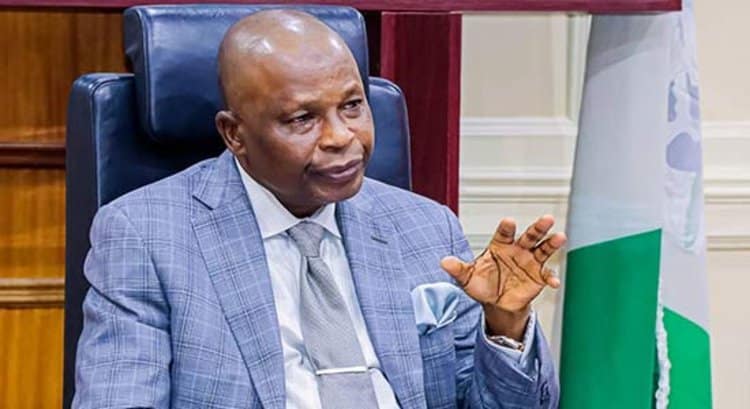
Mahdi Shehu has accused the Federal Government under President Bola Tinubu of taking instructions from foreign powers, particularly the United States, over its opposition to the death penalty for terrorists and kidnappers.
Speaking in an exclusive interview with DAILY POST on Monday, Shehu said the government’s position sends a dangerous signal at a time when Nigerians are facing widespread insecurity, killings and abductions.
According to him, “When the Tinubu government openly opposes the death penalty for terrorists and kidnappers, it sends a clear message that foreign interests are in charge and dictating what Nigeria should do.”
Shehu argued that there is no reasonable justification for sparing the lives of terrorists and bandits whose activities are based on violence, fear and the killing of innocent citizens.
“Common sense will see no reason, and will not accept any argument, in favour of sparing the lives of people whose main trade is to terrorise, incapacitate and kill innocent Nigerians,” he said.
He warned Nigerian lawmakers against supporting any move to remove the death penalty for terrorism and banditry.
According to him, such decisions could eventually affect them personally.
“Lawmakers who are tempted by money or threatened into accepting this unintelligent reasoning should remember that they, their parents, relations or loved ones may one day become victims of terrorism or banditry,” Shehu said.
“And when that happens, they will watch helplessly as the perpetrators go home free.”
Shehu also described as hypocritical what he called America’s opposition to the death penalty in Nigeria.
He noted that the United States still carries out executions for serious crimes within its own borders.
“It is ironic that America is opposing the death penalty in Nigeria, while they still execute offenders for similar or even lesser offences in their own country,” he said.
He went further to allege that foreign powers want Nigeria to remain unstable for economic reasons, claiming that insecurity could make the country vulnerable to external exploitation.
“America’s wish is for terrorists and bandits to overrun and destroy Nigeria so that we become like Sudan,” Shehu alleged.
“Then they will move in to feast on our endless deposits of rare earth minerals for selfish and greedy interests. Perish their thoughts.”
Shehu ended by calling on members of the National Assembly to be vigilant and put Nigeria’s security first.
“Lawmakers must open their eyes and be careful,” he warned.
Opposition to death penalty is irresponsible – Yahuza Getso
Security analyst, Yahuza Getso, also expressed strong support for the death penalty for kidnappers.
He described the opposition to the punishment as irresponsible.
Speaking in an exclusive interview with DAILY POST on Monday, Getso said he was disappointed with arguments against capital punishment for kidnapping.
He insisted that tougher measures are necessary to address the growing security challenge.
“Well, this is quite a disappointing situation. I really support the death penalty against any kidnapper who might be found.”
According to him, those who oppose the death penalty are failing in their responsibility to protect citizens from violent crimes.
“Anybody who goes against it, I think it’s very irresponsible. They are supposed to respond firmly, and this is the best way to deal with them.”
Mahdi Shehu and Yahuza’s comments come against the backdrop of recent actions by the Senate to confront Nigeria’s worsening insecurity, particularly the rise in kidnapping and terrorism across several parts of the country.
On Wednesday, November 26, the Senate took a firm position by declaring kidnapping a form of terrorism and recommending the death penalty for offenders, without the option of fines or judicial discretion to reduce sentences.
The resolution followed hours of tense debate triggered by the November 18 attack on Christ Apostolic Church in Eruku, Ekiti Local Government Area of Kwara State. During the attack, gunmen killed two worshippers and abducted 38 others.
Although all the abducted victims were later rescued through joint operations involving the Nigerian Army, the police, the Department of State Services (DSS), and local vigilante groups, lawmakers said the incident exposed the alarming spread of insurgent activities into southern Nigeria and the collapse of security in many rural communities.
The Senate’s decision was based on a motion sponsored by Senator Yisa Ashiru (Kwara South) titled “Urgent Need to Address Escalating Insecurity in Kwara, Kebbi, and Niger States and Strengthen National Security Frameworks.”
The motion opened wide-ranging discussions on persistent attacks on schools, worship centres, highways and entire communities across the country.
As part of the Senate’s response, a bill seeking to amend Nigeria’s Anti-Terrorism Act to impose the death penalty without the option of a fine for all kidnapping-related offences passed second reading.
The Senate President, Godswill Akpabio, announced the passage during plenary on December 3, after a majority of senators supported the bill through a voice vote.
Following this, the bill was referred to the Senate Committees on Human Rights and Legal Matters, National Security and Intelligence, and Interior for public hearing, with a directive to report back within two weeks.
Senator Akpabio later reinforced the Senate’s position when, on Thursday, December 18, he publicly threw his weight behind the death penalty for kidnappers, insisting that tougher punishments were necessary to deter criminals and restore public confidence in the nation’s security system.
However, the proposed amendment has faced strong opposition from the Attorney-General of the Federation and Minister of Justice, Lateef Fagbemi (SAN).
Appearing before the Senate on Thursday, December 18, Fagbemi opposed the plan to impose the death penalty without the option of a fine for kidnapping offences, warning that it could undermine Nigeria’s cooperation with international partners in the global fight against terrorism.
According to him, many countries would refuse to extradite suspects who may face capital punishment, as foreign courts often block extradition on human rights grounds.
He cautioned that such a situation could inadvertently create safe havens abroad for terrorism suspects.
“From a tactical perspective, it is our view that the proposal to include the death penalty for convicted terrorists should be reviewed, because it inadvertently facilitates the ‘martyrdom’ trap,” Fagbemi told senators.
“It is critical to note that the fight against terrorism deals with an enemy often driven by radical ideologies, where a state-sanctioned execution is viewed not as a deterrent but as a validation of their cause,” he added.
The justice minister further warned that introducing the death penalty could damage Nigeria’s standing in global counter-terrorism efforts, particularly in areas of extradition and mutual legal assistance.
Death penalty for terrorists: Activists lament Nigerian govt position, blame United States