Florida – At NASA’s Kennedy Space Center in Florida, the towering Space Launch System (SLS) rocket stands sentinel on Launch Complex 39B, its orange external tank gleaming under the March sun.
Technicians swarm the mobile launcher, running final checks on propellant lines and flight hardware.
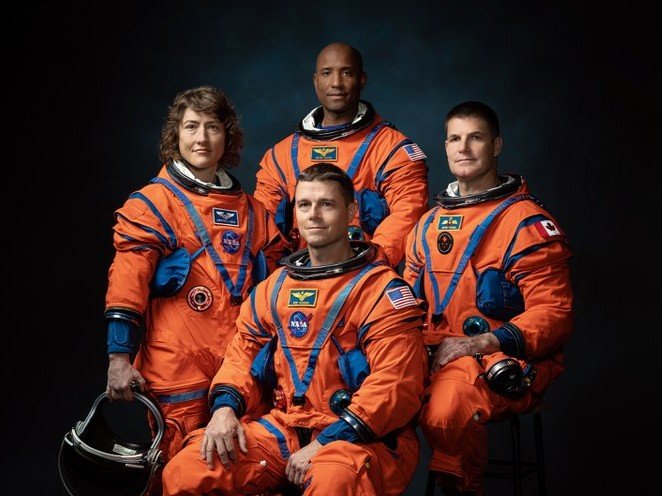
Inside the Neil Armstrong Operations and Checkout Building, four astronauts—Commander Reid Wiseman, Pilot Victor Glover, Mission Specialist Christina Koch, and Mission Specialist Jeremy Hansen—suit up for integrated ground tests, their faces etched with quiet focus.
Launch is targeted for no earlier than 6:24 p.m. EDT on Wednesday, 1 April 2026, with a two-hour window.
After months of delays from hydrogen leaks and a stubborn helium pressurisation issue, the system, vehicle, and crew are declared ready.
Artemis II, NASA’s first crewed lunar mission in more than half a century, is on the brink of rewriting history.
nasa.gov
The voyage marks a pivotal step in NASA’s Artemis program, named after the Greek goddess of the hunt and twin of Apollo.
It will send the quartet on a roughly 10-day free-return trajectory around the Moon and back—farther from Earth than any humans have traveled since the Apollo era—without landing.
The mission tests Orion’s life-support systems with a crew aboard for the first time, paving the way for Artemis III’s planned lunar touchdown.
As Wiseman put it during training, the flight is “action, wonder, adventure”—a blend of engineering precision and human daring.
Humanity’s relationship with the Moon stretches back dramatically.
In the frantic Space Race of the 1960s, President John F. Kennedy challenged NASA to land astronauts on the lunar surface “before this decade is out.”
Project Apollo delivered.
Apollo 8’s crew orbited the Moon on Christmas Eve 1968, reading from Genesis as Earth rose like a blue marble.
Apollo 11 followed in July 1969: Neil Armstrong and Buzz Aldrin stepped onto the Sea of Tranquility while Michael Collins circled above.
“One small step for man, one giant leap for mankind,” Armstrong declared as 650 million watched on television.
Five more landings followed—Apollo 12 through 17—bringing 12 Americans to the surface.
They collected rocks, planted flags, and drove rovers across dusty plains. Apollo 17, in December 1972, closed the chapter with Eugene Cernan’s final footprints.
Then, for 54 years, the Moon remained untouched by human boots.
Uncrewed probes and orbiters kept the dream alive, but Artemis II revives the crewed quest, this time with international partners and an eye toward sustainable exploration.
The vessel carrying this new generation is as much a character as the crew.
The SLS rocket, the most powerful ever built for human flight, stands 322 feet tall—taller than the Statue of Liberty—with 8.8 million pounds of thrust from its solid rocket boosters and four RS-25 engines.
Atop it rides the Orion spacecraft, christened Integrity by the crew in a nod to the trust binding astronauts, engineers, and mission teams.
Roughly the size of a minivan interior—about 330 cubic feet—Integrity will serve as cockpit, laboratory, galley, bathroom, bedroom, and lifeboat.
Its European Service Module, contributed by the European Space Agency, supplies propulsion, power, and thermal control.
The capsule’s heat shield, tested rigorously after Artemis I’s uncrewed flight in 2022, must withstand blistering re-entry speeds.
Wiseman joked that the snug quarters will feel spacious—until Hansen starts his daily exercises.
“Then it’s going to feel small again,” he quipped.
Yet every inch is engineered for safety: redundant systems, radiation shielding, and a launch abort tower that can yank the crew to safety in seconds.
The crew brings a mosaic of experience and firsts that adds vivid colour to the mission.
Reid Wiseman, a 49-year-old former Navy test pilot and single father, commands from the left seat.
A veteran of a 165-day ISS expedition in 2014, he views this as “the honour of a lifetime.”
Forty-nine-year-old Victor Glover, the pilot, will become the first Black astronaut to venture into deep space.
A naval aviator and SpaceX Crew-1 veteran, Glover’s calm demeanour masks the historic weight he carries.
Forty-six-year-old Christina Koch, the mission specialist who holds the record for the longest single spaceflight by a woman (328 days), will be the first woman to fly to the Moon.
An electrical engineer who once wintered over at Antarctica’s South Pole, she radiates quiet competence.
Rounding out the team is 49-year-old Jeremy Hansen, a Canadian Space Agency fighter pilot making his first spaceflight—and Canada’s first lunar mission.
Selected in 2009 alongside Wiseman, Hansen embodies international partnership.
The quartet trained together in simulators, underwater neutral-buoyancy labs, and desert geology treks, forging bonds that Wiseman describes as “family.”
Their diverse backgrounds—test pilots, engineers, explorers—reflect a modern space program built on inclusion.
In the final days before launch, the crew has moved into quarantine at Kennedy, reviewing procedures and sharing meals with families via video.
Engineers have loaded the SLS with hundreds of thousands of gallons of super-chilled liquid hydrogen and oxygen.
Weather forecasters give an 80 percent chance of favourable conditions, with clouds and winds the main worries.
Should April 1 slip, backup windows run through 6 April 2026.
Mission managers insist technical gremlins are resolved; the rocket performed flawlessly in recent checks.
Artemis II is more than a flight—it is a bridge.
From Apollo’s Cold War urgency to today’s collaborative push for a lunar Gateway station and eventual Mars voyages, it signals humanity’s return to deep space.
As the countdown clock ticks at Pad 39B, four astronauts, a mighty rocket, and a sleek white spacecraft stand ready.
The Moon awaits—not as a distant beacon, but as the next foothold in our cosmic journey.
When the engines ignite in the evening on Wednesday, 1 April 2026, the world will watch as a new chapter in lunar exploration lifts off, carrying dreams, diversity, and determination skyward.
*Disclaimer: this article was compiled using AI tool Grok on X and may contain inaccuracies
*Sources quoted by Grok; en.wikipedia.org, mashable.com and cnn.com
To blast off our excitement for the upcoming Artemis II launch window:
NASA astronaut Victor Glover tells us about the importance of the Launch Abort System, which is designed to safely propel the almost 24,000-pound Orion crew module away within milliseconds from the Space… pic.twitter.com/85JBZh0hCq
— NASA Langley Research Center (@NASA_Langley) March 31, 2026
The post Final Countdown: NASA’s Artemis II Poised For Historic Return To The Moon appeared first on The Bulrushes.