Participants at the Zámba Heritage Congress in Nairobi, which concluded today. PHOTO/FSC.
By PATRICK MAYOYO
The cost of carbon credits in Africa remains significantly lower than in other global regions, a disparity attributed to the fragmented approach of the continent’s 54 nations in negotiating environmental terms.
Dr Yemi Katerere, a leading expert in forestry and climate change, has called for a unified approach among African countries to combat the growing environmental challenges, highlighting the need for cohesion and collective political power akin to the European Union.
Speaking at the ongoing Zámba Heritage Congress in Nairobi, which concludes today, Dr Katerere stressed that the absence of collective action has left African countries at a disadvantage when negotiating climate policies with global economic powers.
He pointed to the example of the recent trade tariffs imposed by the United States under President Donald Trump. While regions like the European Union confronted the issue as a bloc, African nations individually approached the US, thus losing leverage.
“Africa must transform its financial systems to support economic development while ensuring the enforcement of the ‘polluter pays’ principle,” Dr Katerere stated. “We must act now to secure a future where forests are not merely resources to exploit, but integral components of our cultural heritage, economic resilience, and climate response.”
The Zámba Heritage Congress, organised by the Forest Stewardship Council (FSC) Africa and the Kenyan government, brings together experts, policymakers, and stakeholders from across Africa and beyond. The event aims to address the mounting environmental and ecological challenges threatening the continent’s vital forests.
Dr Katerere’s remarks highlighted the urgency of transformative change, emphasising that Africa’s forests are not only crucial for local livelihoods but also play a critical role in the global fight against climate change.
However, with the global warming trend continuing to intensify, Africa’s forests face unprecedented pressures, including deforestation and land degradation. The expert warned that the forests are now releasing more carbon than they are absorbing, marking a crucial turning point in the continent’s battle against climate change.
“We must not allow our forests to vanish,” Dr Katerere cautioned. “Every hectare lost is a piece of our heritage, and every tree cut down without renewal is a future denied.”
Dr Katerere’s speech also drew attention to the broader geo-political dynamics affecting Africa’s environmental efforts. He pointed out the need for African nations to harness their collective knowledge and narratives to create policies that resonate with local communities and reflect the continent’s realities.
He also highlighted the role of indigenous communities in forest management, with traditional knowledge offering invaluable insights into sustainable practices that have been passed down through generations.

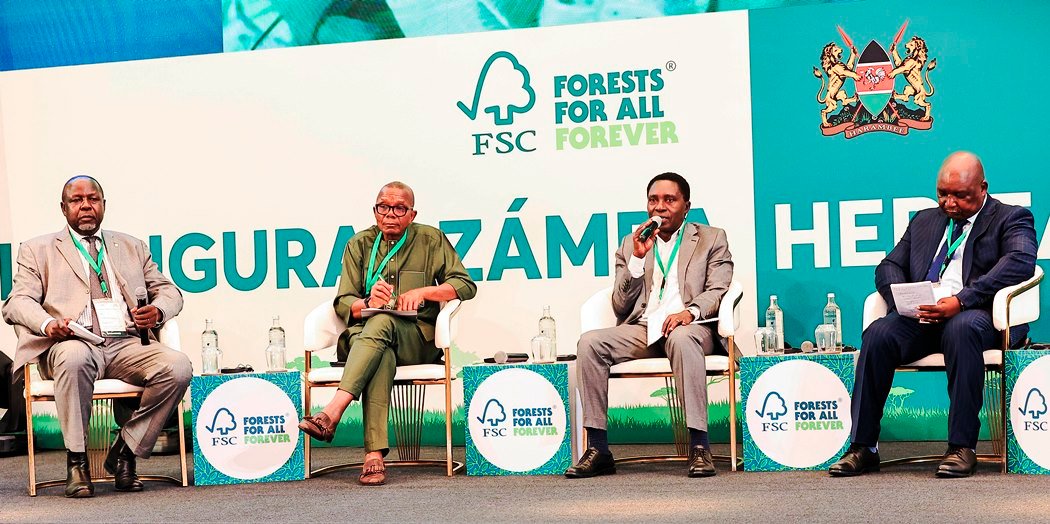
A panel of experts during discussions at the Zámba Heritage Congress in Nairobi. PHOTO/FSC.
The congress has also provided a platform for discussing the role of international agreements, such as the Belém Pact and the Tropical Forests Forever Facility, both of which recognise the importance of forest conservation but fall short in providing a binding global roadmap to end deforestation.
Dr Katerere underscored the need for greater financial commitments, particularly to safeguard the Congo Basin, one of the world’s largest carbon sinks.
Africa’s forests are a vital part of the global ecological landscape, contributing 15.6% of the world’s forest area and housing 25% of global terrestrial biodiversity. Yet, despite their importance, the continent faces persistent challenges in sustainable forest management (SFM), with a high rate of deforestation and inadequate financing to reverse the trend.
Key to addressing these challenges, according to Dr Katerere, is transformative change. This involves a fundamental shift in societal and governance structures to prioritise equity, justice, and environmental stewardship.
Such change must be inclusive, adaptive, and driven by the recognition that human society and nature are interconnected. Dr Katerere called for the integration of indigenous knowledge into policymaking, alongside innovative economic tools to promote sustainable land use and reduce the pressure on forest ecosystems.
Dr Katerere also highlighted the indirect drivers of deforestation, including population growth, urbanisation, and weak governance, which exacerbate the loss of biodiversity. He emphasised the need to address these drivers through comprehensive, multi-sectoral strategies that include agriculture, mining, and infrastructure development.
Several forest restoration initiatives were also showcased during the congress, including the Great Green Wall of Africa, which aims to restore 100 million hectares of degraded land by 2030, and the AFR100 initiative, targeting the restoration of 100 million hectares of land in Africa.
These projects exemplify the potential of large-scale, community-driven environmental restoration efforts that can help mitigate the effects of climate change while providing livelihoods and improving local resilience.
Dr Katerere concluded his address with a call to action: “Africa’s forests are our inheritance, but they are also our gift to the world. To manage them sustainably enhances the resilience of society and promises a prosperous future.”
He urged delegates to leave the congress with a renewed commitment to place people at the centre of forest management and to work together in solidarity to restore Africa’s forests.
The Zámba Heritage Congress has been a crucial platform for advancing the conversation around forest conservation and climate change in Africa, underscoring the need for bold action and collective responsibility in the face of urgent environmental threats.
As the congress draws to a close, the call for a unified African approach to forest management has never been more pressing.