The spike in oil prices was not a good look politically or economically for President Donald Trump after the U.S. and Israel launched their war on Iran, but the military campaign is going well, according to the Institute for the Study of War.
Crude eased somewhat on Monday on signs that more tankers are passing through the Strait of Hormuz, which Iran has virtually locked up after hitting commercial ships. That comes as Iran’s top source of leverage is fading.
“The war in Iran is currently in a phase in which the military trajectory is relatively positive: The United States is steadily destroying Iran’s ability to use its most essential tool in the war—drone and missile attacks—which in turn underpin the entire Iranian strategy,” ISW said in a report Sunday.
While Iran has inflicted significant damage to U.S. installations in the region and allied infrastructure, the pace of its attacks is plunging and hasn’t come close to its original plan for fighting off an existential threat to the regime with overwhelming retaliation, it pointed out.
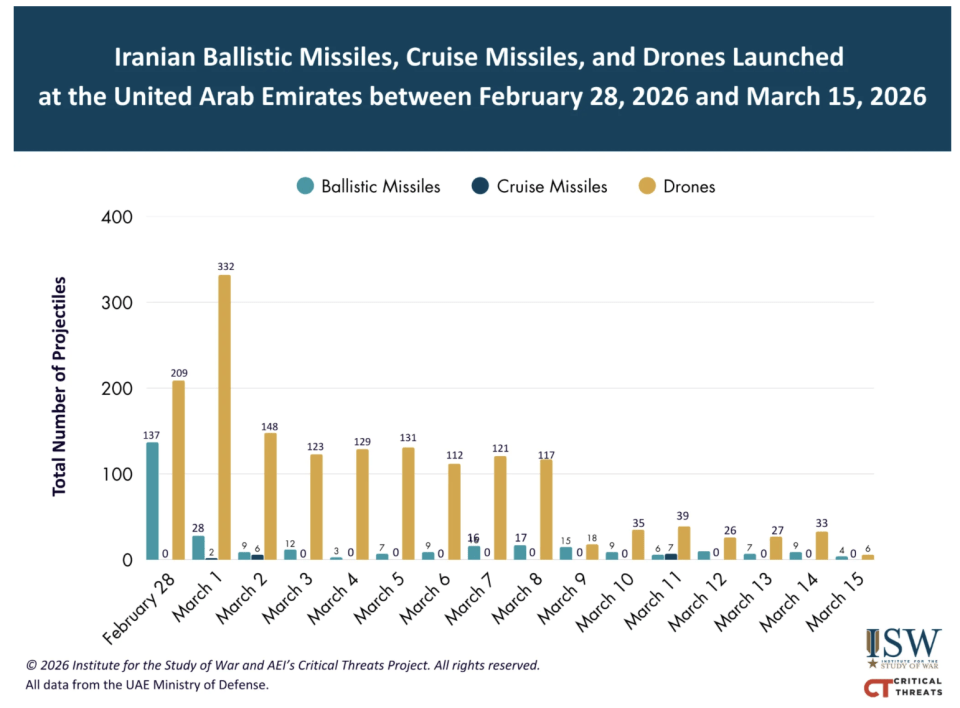
For example, drone attacks on the United Arab Emirates collapsed from 332 on the second day of the war to just six on Sunday. Ballistic missile attacks fell from a peak of 137 on the first day to four yesterday.
The U.S.-Israeli bombardment has destroyed hundreds of Iranian launchers, and its missile force troops are reportedly demoralized, deserting, and refusing orders, according to ISW.
“Some individual drones have penetrated air defenses and caused politically unacceptable damage to oil infrastructure, but the overall trend in attacks is overwhelmingly positive,” it added.
There’s also little to no evidence the reduced pace of attacks is due to Iran keeping projectiles in reserve to be used later when the U.S. and Israel will have fewer interceptors, the report said.
Such a tactic would be a major gamble that assumes Iran will still have enough launchers left in the future. It also assumes the Islamic Revolutionary Guard Corps retains enough command and control to execute that kind of coordination after the relentless targeting of its leadership.
ISW also noted the last Iranian attack on merchant shipping was on March 11, though it’s unclear whether that was due to less traffic in the Strait of Hormuz or the degradation of Iran’s military capabilities.
Of course, Iran’s plan was never to defeat the U.S. military, with the focus instead on causing political and economic pain, ISW said. Indeed, soaring crude prices have already made gasoline more expensive, threatening higher inflation and public backlash ahead of U.S. midterm elections.
Iran’s strategy rests on inflicting damage in the Gulf, disrupting shipping, activating proxies, committing terrorism, and launching cyber attacks.
“Iran has likely calculated that if these five prongs cause U.S. casualties, drive up oil prices, and impose economic costs on both the US and its Gulf allies, the United States and Israel would make a political decision to end the war without achieving their objectives,” the report said.
ISW expressed confidence the U.S. Navy can reopen the Strait of Hormuz, despite officials describing it as a “kill box” filled with potential threats, while adding “the risk-tolerance of the market will ultimately determine the length of the disruption in the Strait.”
Meanwhile, Trump has called on other countries to send warships to help escort tankers, even warning NATO failure to help him “will be very bad for the future” of the alliance. But so far, there are no takers.
Despite Iran suffering devastating losses on the battlefield, the burden is still on the U.S. to prevent Iran from using economic and political pressure to turn insignificant tactical moves into strategic successes, ISW warned. Still, Operation Epic Fury is working for now.
“The available evidence supports the assessment that the combined campaign is achieving its military objectives thus far but is not yet complete,” ISW said. “Declaring the campaign a failure at this stage is therefore premature. The collapse of Iranian drone and missile attacks—down significantly since Feb. 28—presents a compelling picture that the military campaign is degrading ballistic missile and drone capabilities.”
This story was originally featured on Fortune.com