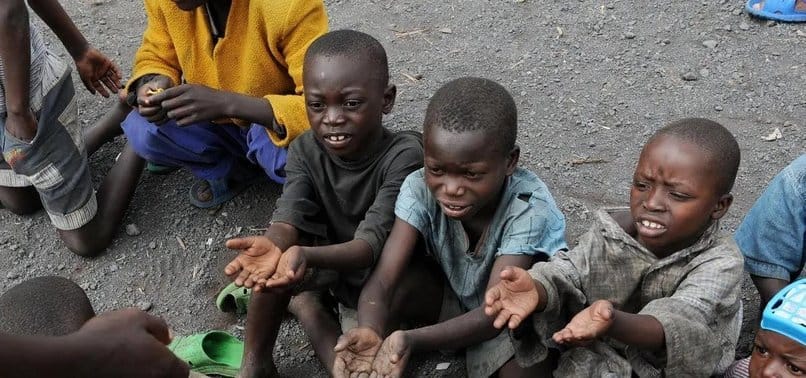

A recent study by an international nongovernmental, not-for-profit organisation, Save the Children International, that over 96,000 children risk death before the end of this year in six northern states due to malnutrition, has again brought to the fore the failure of governments at all levels to provide for its citizens and it is a big source of concern for the citizens.
The organization, alongside other partners, including PLAN, Action Against Hunger in Nigeria and OXFAM among others, has predicted a devastating public health crisis for six states in northern Nigeria, namely, Adamawa, Borno, Katsina, Sokoto, Yobe, and Zamfara, before the end of 2025, as a result of malnutrition.
The organization, at a press conference in Abuja, drew attention to the growing cases of acute malnutrition in the six states, stressing that the situation could be catastrophic in a few months’ time if urgent steps were not taken by the affected states to correct the situation.
The Country Director of the organisation, Duncan Harvey, specifically told journalists at the event that without urgent access to lifesaving treatment, the states could lose 96, 000 children to death between October and December, 2025, due to acute malnutrition.
The urgency of the situation is that going by the released figure; it means that over 1, 000 children would be dying every day.
However, the organization equally revealed that about 800, 000 pregnant and breast-feeding mothers are also at risk of acute malnutrition in the six states listed above.
According to Harvey, “Nigeria is facing a nationwide emergency due to escalating challenges of food insecurity and malnutrition; with more than 31 million people facing acute food insecurity in 2025, making it the largest food crisis globally.
“About 5.4 million Nigerian children suffer from acute malnutrition, and 3.5 million children under five suffer from Severe Acute Malnutrition (SAM), out of which 1.2 million require immediate life-saving treatment
“It’s predicted that from October to December 2025, an estimated 600,000 children under the age of five will be at risk of Severe Acute Malnutrition (SAM) in the six northern states. Over 800,000 pregnant and breastfeeding women are also at the risk of acute malnutrition in these states.
“It is for situation such as this that the African Union Heads of State and Government in 2010, at its 15th Ordinary Session in Kampala, Uganda, in a bid to address the persistent crisis of hunger and malnutrition on the continent, declared October 30 every year as Africa Food Security and Nutrition Day.
“Hunger is not just a risk; it’s a crisis of rights. Food security and nutrition must be treated as non-negotiable for child survival, growth and future productivity. No child should die from any preventable cause such as hunger, malnutrition or illness.”
In his submission, the Country Director, Action Against Hunger Nigeria, Thierno Samba Diallo, suggested that funds should be made available for lifesaving nutrition commodities like Ready-to-Use Therapeutic Food (RUTP) and Therapeutic Milk locally produced and proven to save lives. He also emphasized that long-term funding and nexus approaches linking humanitarian, peace and development efforts, are equally essential for sustained nutrition, security and development.
He said: “Severe malnutrition has irreversible impacts on physical growth, cognitive development and economic productivity, which are critical to national human capital. Hence, all hands must be decked to prevent it.
“There’s the need to expand targeted support for the 800,000 pregnant and breastfeeding women at risk of acute malnutrition to the lives of the vulnerable children. Adopt shock-responsive social safety nets to protect vulnerable households from future crises.
“There is also the need to scale up food assistance, nutrition treatment and livelihood support. Local production of fortified foods should be encouraged to ensure sustainability, strengthen collaboration on cadre harmonization and integrate phase classification analysis to inform response strategies.”
For the Director of Programme Quality and Influencing, PLAN International, Dr. Helen Idiong, the affected states should join efforts with other relevant stakeholders to tackle malnutrition and give lifesaving opportunities to affected families and communities.
“Hunger is not just a lack of food. It’s a violation of dignity, health and the right to the future. Food and nutrition security must be treated as a non-negotiable right. We urge federal leaders, state governors and international partners to act now. No child should die from malnutrition, hunger or illness. These are preventable, treatable and solvable. No child should die of hunger; not today, not tomorrow, not ever,” she submitted.
Since the report made headlines, discussions around the possible push factors and how to avoid the crisis have been raging.
Some people are of the view that if further studies are carried out, it would surprise many to know that more states, even in the southern part, are not excluded from the impending danger.
Those on this side of the argument are saying that states like Benue, the food basket of the nation, Plateau, Niger, Kogi and even some parts of Kaduna states might as well experience such a problem if the government fails to act fast.
The argument is that looking at the level of havoc that kidnappers and militant herdsmen are causing in some of these North central states of Nigeria, it is not hard to predict what will happen as food crisis ravages the people.
They, however, called on the government to sit up and ensure that Nigerians are not thrown into such a precarious situation. The solution to averting the impending hunger, which will ultimately lead to malnutrition, according to some Nigerians, is for the government to tackle the issue of insecurity in the country headlong, so that farmers can return to farm and produce food for the populace.
One of the proponents of the government’s decisive action against terrorism, banditry, kidnapping and all forms of criminalities to create enabling environments for farmers to go back to farm is the President of the Middle Belt Forum, MBF, Dr. Pogu Bitrus.
He believes that only the government has the powers to prevent the looming crisis from manifesting, by tackling insecurity headlong.
He emphasised that Nigeria does not need any international body to give her the report of the number of malnourished children at the risk of death in some states because the reality is staring everybody in the face.
If anything, he said, the organization is even under-reporting the gravity of the situation.
“We know it is a reality because banditry has reached a stage where farmers can’t go to farm, and if farmers can’t go to farm, naturally, there won’t be food to eat. And when children can’t feed properly, the resultant effect is malnutrition and death.
“So, their report is in order because it is in line with what is on ground. Unfortunately, it will not hit only six states as the report stated, because there are so many other areas where bandits do not allow farmers to go to farm. And in such situations, you will agree with me that there will be a devastating hunger unless the government takes a proactive action to address the issue of banditry, so that farmers can return to their farms in peace,” he told DAILY POST.
Also aligning with the report is an educationist in Maiaduwa Local Government Area of Katsina State House of Assembly, Abdullahi Umar.
He believes that traditionally, the people in Zamfara, Sokoto and Katsina axis experience shortage of food at certain periods of the year but lamented that the insecurity in those areas has worsened the situation such that the food shortage is now all year round.
“Ordinarily, Zamfara, Katsina, Sokoto and other states on that axis receive their first rains around May/June, which is the beginning of the harvesting season.
“And every year, we, in the north, normally experience food shortage around June/July because most people would have brought out the remaining food in stock at that period to plant for the next season. And there is nothing more for the peasant farmers to do other than to go to farm during the period.
“Now, considering the insecurity situation in the country today, where bandits and kidnappers are riding roughshod on the people, coupled with the high cost of living, obviously there will be acute food shortage.
“The terrorists, bandits and kidnappers don’t allow people to go to farm; so what do you expect? Added to that is the removal of fuel subsidy which has heightened the cost of living.
“So, for me, I think the report is a wake-up call to the government to take steps in advance so that the unavoidable deaths of our innocent children that could result from known calamity could be avoided.
“It is for the government to take the war to the bandits and kidnappers, clear them from our forests and bushes, and allow the farmers to go back to the farm. That is the long term solution.
“In the interim, the government in those mentioned states should respond by providing food and children’s supplements and making such available to poor families scattered across these states.
“Other states that are not captured in the report should also sit up and do something in that regard. That is the only way to avert the danger, otherwise it would come to pass, not only in the six listed states but in other states where insecurity has made life miserable,” he said in an interview with DAILY POST.
A lawyer and public affairs commentator, Nnanna Nwkamma, said there is no hard and fast rule to making food available apart from creating an enabling environment for farmers to do their farm work with fear of being attacked, kidnapped or even killed and churning out economic policies that are people oriented and not the strangulating economic policies of the current government.
He said many Nigerians would easily blame the acute food shortage in the country to insecurity, but emphasized that the government’s economic policies are a major contributory factor.
While speaking to our correspondent, he had this to say: “Take for instance, the issue of subsidy removal; do you know how many families that were badly affected by that singular policy? Ninety percent of hardship in the country today is attributed to that singular policy.
“Then, look at the issue of taxation; it is crazy. And in the midst of all these, you have terrorists, bandits, kidnappers and herdsmen militia killing, maiming and destroying people’s farmland and villages. Why won’t there be malnourished children, when parents barely feed once a day?
“It is a terrible situation and the government cannot just pretend that all is well. All is not well and the report, as far as I am concerned, did not capture all the states where children are at the risk of death due to malnutrition if nothing is done urgently. There are other states, particularly those in the middle belt like Benue and Plateau where insecurity is at its peak.
“Even down south, the story is still not palatable. Many families are feeding from hand to mouth. Do you know how much baby food costs today in the market? A can of NAN baby food that used to sell at a little above N1000, now sells for N10,000 or even more; so, why won’t there be many malnourished children?
“How many households in those six northern states listed and even in other states not listed, can afford such baby food?
“And when they can’t afford baby food that will adequately nourish them and keep them healthy, they resort to whatever that is available to feed the children and that is where the problem starts.
“And all these are happening because the economy is very hard and there is no food anywhere. They are very expensive for ordinary Nigerians to afford.
“So, the government must take two very important steps very fast. First, it must provide food and children’s supplement to poor families in those states at no cost or relatively cheap costs.”
“Secondly, the government must declare a total war against those enemies of state, rout them out once and for all and allow the farmers to return to the farm in peace.
“Apart from having enough food for everybody to feed on, the farmers will also be economically viable to provide the kind of food that nourishes children and keeps them healthy,” he further stated.
Report of 96,000 malnourished children at death risk in 6 northern states raises concern