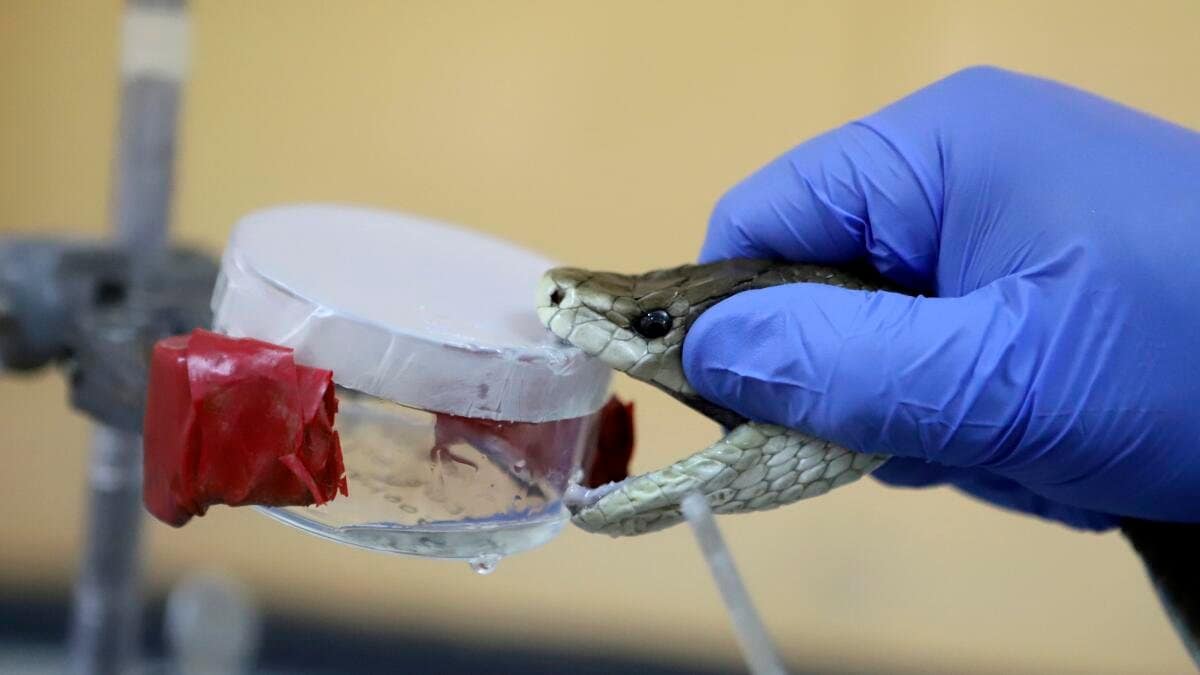

A health professional has described widespread medical misinformation as responsible for the public misunderstanding of incidents around the death of a young Nigerian singer, Ifunanya Nwangene, from a snakebite, noting that Nigeria needs a systematic overhaul of its public health education.
In an interview with DAILY POST, Clinician, Dr Stella Kokondo Essien, explained that immediate first-aid care after a snakebite is critical and must prioritise immobilisation and rapid transport to a hospital, rather than improvised traditional practices.
She warned that tying a cloth tightly around the affected limb, as widely practised in Nigerian communities, is dangerous, does not prevent venom spread and can cause additional injury.
“The very first course of emergency care will be to immobilise the affected part, that is, do not allow excessive movement of the hand or leg. Do not tie it with a tourniquet. The patient should be stabilised and taken to the nearest hospital as fast as possible.
“For you to completely stop blood flow through an affected hand would completely kill the limb. So, you are not helping; even simple splinting with a cardboard to keep the limb still would have been safer than constricting it,” the medical professional explained.
The doctor particularly addressed public outrage that followed the girl’s treatment at a health facility, where many online commentators alleged that administering intravenous fluids, commonly called a ‘drip,’ accelerated the venom in her body.
She stressed that claims that hospital IV fluids worsened the victim’s condition were medically incorrect.
“That is not true. The venom was already in the bloodstream, the drip was important because they were trying to dilute, stabilise and flush the system while the antivenom works,” the clinician said.“
According to research, many snake venoms, especially from cobras, attack the muscles responsible for breathing, and without urgent hospital care, respiratory failure may occur.
Dr Essien, however, noted that in the case of Ifunanya, the prolonged delay before hospital arrival and excessive movement after the snake bite, which was on her hand and closest to her heart, may have worsened her condition and accelerated the poisoning.
“What the venom does is paralyse the muscles of respiration, which is why supportive care such as IV fluids is routinely used while antivenom treatment is administered.”
She warned, “moving, running or struggling after a bite increases circulation and spreads venom faster, particularly when the bite occurs on an upper limb close to the heart. With all those movements, you speed up the poisoning.”
Meanwhile, the medical expert has called for a strict overhaul of the public health information space, warning that the outcry around the singer’s death points to a deeper challenge of general medical misinformation and ignorance in Nigeria.
She said misinformation shared online can influence first responders and relatives at critical moments, potentially costing lives, urging communities, media commentators and social media users to verify medical advice with qualified professionals.
She noted that emergency treatment decisions are based on established clinical protocols rather than myths circulating in public spaces.
“People should seek correct information before going on air to speak. Coming on television to say the drip administered to the victim was injurious is wrong. Nigeria needs a systematic overhaul of public health education campaigns.”
“Drip is not a treatment for malaria or any ailment. IV fluids are mainly for support, for example, when a patient cannot eat or is vomiting.”
Running after snakebite can kill – Clinician demands overhaul of public health information space