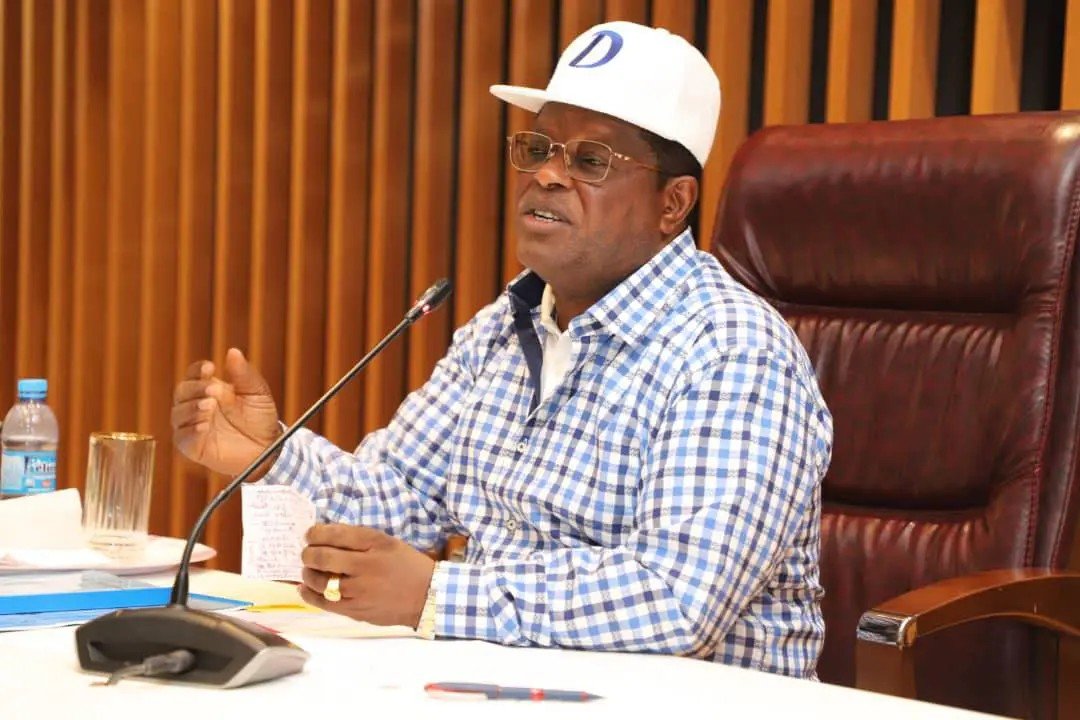

The Minister of Works, David Umahi, on Thursday commissioned completed portions of the Enugu–Onitsha Expressway, describing the development as a turning point for transportation and economic activity in Nigeria’s Southeast.
Speaking at the event, Umahi recalled the deplorable condition of the road prior to the current administration, noting that commuters previously spent over seven hours travelling between Enugu and Onitsha due to years of neglect and stalled construction.
“This is the most important route in the Southeast,” the minister said, stressing that the project had been awarded long before 2023 but remained largely abandoned for about eight years, with little or no meaningful progress.
According to him, the road was initially being handled under a tax credit arrangement involving MTN and construction giant RCC. However, he said the project suffered delays until the intervention of President Bola Tinubu, who ordered its acceleration and a redesign of critical sections.
Umahi explained that the federal government reviewed the original ₦202 billion contract, retaining part of it while carving out a 72-kilometre stretch for reconstruction using reinforced concrete pavement. The new section, valued at about ₦150 billion, is being executed to higher durability standards similar to those used on the Lagos–Calabar Coastal Highway.
In total, he said, the full reconstruction of the Enugu–Onitsha road is now valued at over ₦350 billion.
Highlighting progress made so far, the minister disclosed that the first 15 kilometres of the reinforced concrete section is about 97 percent completed and has been opened to traffic to ease movement during the Easter period. He added that another 18-kilometre stretch is under construction towards Anambra State, while a separate 39-kilometre segment extending from the Niger Bridge axis is also ongoing.
Umahi further revealed that contractors handling asphalt portions of the road have been directed to adopt the same concrete standard for the remaining 23 kilometres, citing the longer lifespan and minimal maintenance requirements of concrete roads compared to asphalt.
“Asphalt fails over time, but concrete can last between 50 and 100 years with little or no maintenance,” he said.
The minister emphasised that upon completion, at least 50 percent of the entire highway will be built with reinforced concrete, significantly improving durability and reducing long-term costs.
Beyond the Enugu–Onitsha project, Umahi used the occasion to highlight a series of ongoing federal infrastructure projects across the Southeast, which he credited to the Tinubu administration.
These include sections of the Enugu–Port Harcourt Expressway, with parts already nearing completion, and the dualisation of the Enugu–Abakaliki road. He also mentioned reconstruction works on the Afikpo–Abia–Okigwe corridor under a tax credit scheme, as well as major upgrades to the Aba–Port Harcourt road.
The minister noted that access roads and bypasses connected to the Second Niger Bridge are also under construction, alongside several flyovers and interchanges, including what he described as one of the longest flyovers in the country located in the region.
He added that previously collapsed bridges along the Enugu–Onitsha axis have been rebuilt within months and are now equipped with solar-powered lighting systems, part of a broader plan to illuminate major highways.
Umahi also referenced large-scale national projects such as the Lagos–Calabar Coastal Highway and a proposed corridor linking Calabar through Ebonyi and Benue to Abuja, which he said would drastically cut travel time between the Southeast and the Federal Capital Territory.
Addressing concerns raised by journalists about alleged abandoned projects, the minister insisted that work is ongoing across multiple sites and urged the public to rely on verified information.
“Projects are not abandoned. You need to visit these sites. Many of them are progressing steadily,” he said.
On rail infrastructure, Umahi clarified that the proposed eastern rail corridor linking Port Harcourt to Maiduguri falls under the Ministry of Transportation, adding that procurement processes are ongoing.
The minister also took time to call on political leaders and stakeholders in the Southeast to support the Tinubu administration, arguing that the region is benefiting from increased federal presence and infrastructure investment.
He maintained that governance should be judged by development outcomes, particularly in infrastructure, and urged leaders to communicate these achievements to the grassroots.
Umahi expressed confidence that the Enugu–Onitsha road project will be fully completed by 2026, assuring that the ongoing works will ultimately transform mobility, enhance safety, and boost economic growth in the region.
“This project will change the story of transportation in the Southeast,” he said. “What you are seeing today is just the beginning.”
Umahi opens completed sections of Enugu-Onitsha road

