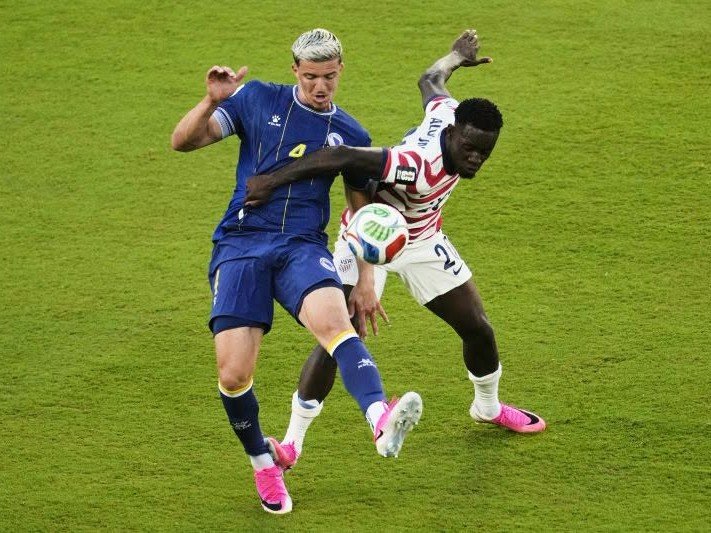
Johannesburg – Stung by criticism for suspending the red card punishment for United States Star player Folarin Balogun, FIFA’s Disciplinary Committee has issued a 13-point statement justifying the controversial move.
Balogun was given a red card against Bosnia and Herzegovina on Wednesday and was suspended for the next game.
However, after President Donald Trump personally called FIFA President Gianni Infantino to ask him to review the suspension, the player was cleared to play against Belgium for a place in the FIFA World Cup last eight.
The move has prompted an avalanche of criticism, including from Sepp Blatter.
The Belgian soccer federation demanded an explanation from FIFA about its decision to let U.S. forward Balogun play at the World Cup despite getting a red card in his previous game.
Just hours before the match, FIFA issued its 13-point statement which reads as follows:
1. On 1 July 2026, during the FIFA World Cup 2026 match between USA and Bosnia & Herzegovina, USA player Folarin Balogun was sent off on a red card in the 64th minute for serious foul play following a VAR review. After the match, he entered the field of play to celebrate with his teammates despite his expulsion.
2. On 2 July 2026, FIFA opened disciplinary proceedings against Balogun for possible breaches of 66 of the FIFA Disciplinary Code (expulsion and match suspension related to the red card) and Article 14 of the FIFA Disciplinary Code (misconduct of players related to the celebration).
3. On 5 July 2026, the FIFA Disciplinary Committee found Balogun guilty of both infringements, imposed a one-match suspension (suspended on probation for one year) and a USD 40,000 fine, and notified the parties of the decision.
4. With respect to the sporting sanction, the FIFA Disciplinary Committee imposed a one-match suspension. The decision specifically stated that this suspension included the automatic suspension that would otherwise have been served in the forthcoming FIFA World Cup match USA v. Belgium, scheduled for 6 July 2026. In practical terms, absent any further measure by the FIFA Disciplinary Committee, Balogun would have been ineligible to participate in that match.
5. However, the FIFA Disciplinary Committee went on to apply Article 27 of the FIFA Disciplinary Code, under which it has discretion to suspend the implementation of any disciplinary measures, and ordered that the implementation of the one-match suspension be suspended for a probationary period of one year. As a result, Balogun is not required to immediately serve the suspension. Instead, the sanction remains dormant during the probationary period and will only be activated if he commits another infringement of a similar nature and gravity during that one-year period. Should such a subsequent offence occur, the suspended one-match ban would be enforced in addition to any new sanction imposed for the later misconduct.
6. In addition to the suspended match ban, the FIFA Disciplinary Committee imposed a fine of USD 40,000, allocating half of the amount to the violation of Article 14 of the FIFA Disciplinary Code and half to the violation of Article 66 of the FIFA Disciplinary Code. The U.S. Soccer Federation was declared jointly liable for payment of the fine pursuant to Article 6.5 of the FIFA Disciplinary Code.
7. Firstly, the FIFA Disciplinary Committee (as any other FIFA judicial body) is independent as provided by the FIFA Statutes and the FIFA Disciplinary Code. The chairpersons, deputy chairpersons and other members of the FIFA judicial bodies fulfil the independence criteria as defined in the FIFA Governance Regulations to ensure their impartiality.
8. Secondly, the FIFA Disciplinary Committee did not reverse the referee’s on-field sending-off of Mr. Balogun but rather the FIFA Disciplinary Committee upheld the one-game suspension of Mr. Balogun as a result of the red card he was shown during on July 1, 2026. The FIFA Disciplinary Committee only decided on the further disciplinary sanctions to be imposed following the red card.
9. Article 66.4 of the FIFA Disciplinary Code states that “a sending-off automatically incurs suspension from the subsequent match”. Similarly, Article 10.5 of the Regulations for the FIFA World Cup 26 provides that “if a player or team official is sent off as a result of a direct or indirect red card (second caution), they will automatically be suspended from their team’s subsequent match. In addition, further sanctions may be imposed”.
10. Consistent with Article 27 of the FDC, the FIFA Disciplinary Committee decided to suspend for a probationary period of one (1) year the implementation of the automatic match suspension it imposed under Article 66.4 of the FIFA Disciplinary Code and Article 10.5 of the Regulations for the FIFA World Cup 26. Said suspension of the implementation was decided considering all of the specific circumstances surrounding the incident and evidence available.
11. Under Article 27 of the FDC, the FIFA Disciplinary Committee has the discretion to suspend the implementation of any disciplinary measures so long as they do not relate to match manipulation—which, of course, did not occur here. It should be added that employment of art. 27 FDC is not unprecedented, as similar decisions have previously been issued during the FIFA World Cup 2026 qualifiers.
12. There are no provisions in the FIFA Disciplinary Code and the Regulations for the FIFA World Cup 26, that prohibit the FIFA Disciplinary Committee from exercising its discretion under Article 27 of the FIFA Disciplinary Code. The exercise of such discretion is fully consistent with the general guiding principles for the determination of the applicable disciplinary sanction pursuant to Article 25 of the FIFA Disciplinary Code.
13. Reviewing the legal consequences of red cards in football is nothing new in the modern game. For instance, in the majority of top-tier leagues belonging to UEFA-affiliated member associations – the overturning of red cards is a common disciplinary measure, yet this has never raised concerns about crossing any “red line”.
And again, it should be emphasised that in the decision under scrutiny, the red card was not overturned.
Suspending the effects of a red card based on an explicit provision of the applicable regulations is a much more balanced meas
The post Under Fire, FIFA Says Withdrawing A Red Card Is Nothing New, U.S. Star Balogun Cleared appeared first on The Bulrushes.