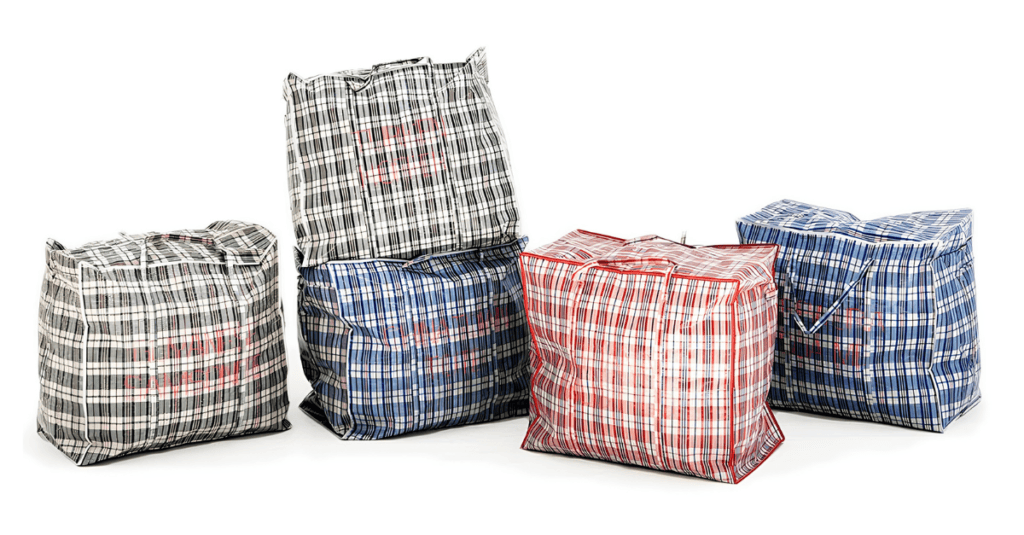
Long before its distinctive check appeared in fashion collections, the Ghana Must Go bag served a straightforward purpose: carrying things.
Cheap, lightweight and remarkably spacious, the woven plastic bags have been used for decades to transport clothing, merchandise and household belongings. Across West Africa, they are fixtures in markets, homes, airports and bus stations.
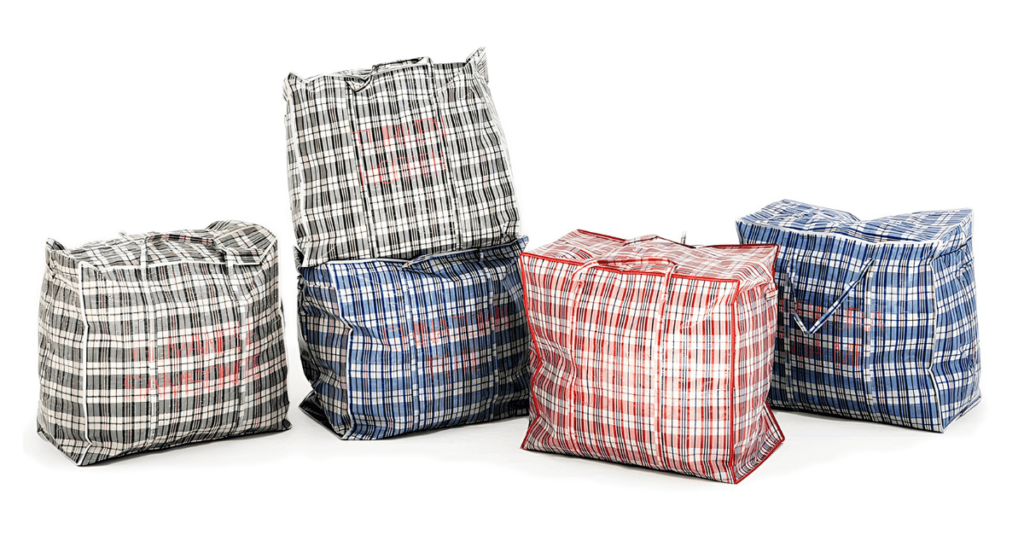
Their red, white and blue checks are also instantly recognizable.
Over time, that visual identity has appeared in photography, art, streetwear and luxury fashion.
Louis Vuitton sent one of the clearest designer interpretations down its runway nearly two decades ago. Céline later incorporated the familiar laundry-bag check into clothing. More recently, streetwear brands have continued adapting the pattern.
The history behind the bag connects fashion with migration, displacement, class and commerce, beginning with the events that gave it its West African name.
How the Bag Became “Ghana Must Go”
The woven polypropylene carryall has circulated internationally for decades, acquiring different names and cultural associations across countries.
Its West African identity comes from a specific period in the region’s history.
Migration between Ghana and Nigeria had taken place for decades. Ghana’s 1969 Aliens Compliance Order resulted in large numbers of foreign nationals, including Nigerians, leaving the country.
The direction of migration shifted as Nigeria’s oil economy expanded during the 1970s. Economic difficulties in Ghana coincided with employment opportunities in Nigeria, attracting Ghanaians and other West Africans.
Then Nigeria’s economy deteriorated.
In January 1983, President Shehu Shagari’s government ordered undocumented immigrants to leave the country. Historian Samuel Fury Childs Daly, whose research in Past & Present examines the expulsions between Ghana and Nigeria from 1969 through 1985, estimates that more than one million Ghanaians were expelled.
Many departing migrants carried their possessions in large woven plastic bags. They were low-cost, widely available and capable of holding substantial amounts of clothing and household goods.
The bags became so closely associated with the exodus that they acquired the name Ghana Must Go.
From Migration Bag to Cultural Object
The political episode that gave the bag its West African name eventually passed. Its everyday use continued.
Families traveled with it. Traders transported merchandise in it. Students moved their belongings in it. People crossing borders packed clothes and household possessions inside it.
Over several generations, the bag accumulated associations beyond the events of 1983.
The sight of one could signal someone moving, traveling home or arriving from abroad. It became associated with commerce, migration and ordinary family life.
Its check eventually became recognizable independently of the object itself, giving designers a visual motif they could transfer to other materials and forms.
Louis Vuitton Takes the Market Bag to the Runway

One of the clearest intersections between the market bag and luxury fashion came in 2006, when Marc Jacobs presented Louis Vuitton’s Spring 2007 ready-to-wear collection.
Vogue’s review documented a model carrying what the publication described as a “cheap checked shopping bag” stamped with an oversized Louis Vuitton mark.
The reference was especially striking coming from a fashion house whose history is rooted in luxury luggage.
The connection between the Louis Vuitton design and Ghana Must Go has subsequently become part of a broader discussion about how luxury fashion draws from objects associated with everyday life, migration and working-class communities.
The runway appearance also generated criticism over cultural appropriation and questions about how fashion houses acknowledge the histories attached to objects they reinterpret.
Those questions are complicated by the bag’s international history. The Ghana Must Go name describes a particular West African relationship with an object that has circulated through many other communities.
That history makes attribution difficult to reduce to a single place of origin while leaving a larger question about what happens to an object’s cultural meaning when it enters the luxury market.
Céline Turns the Laundry-Bag Check Into Clothing
The visual language of market and laundry bags continued appearing in high fashion.
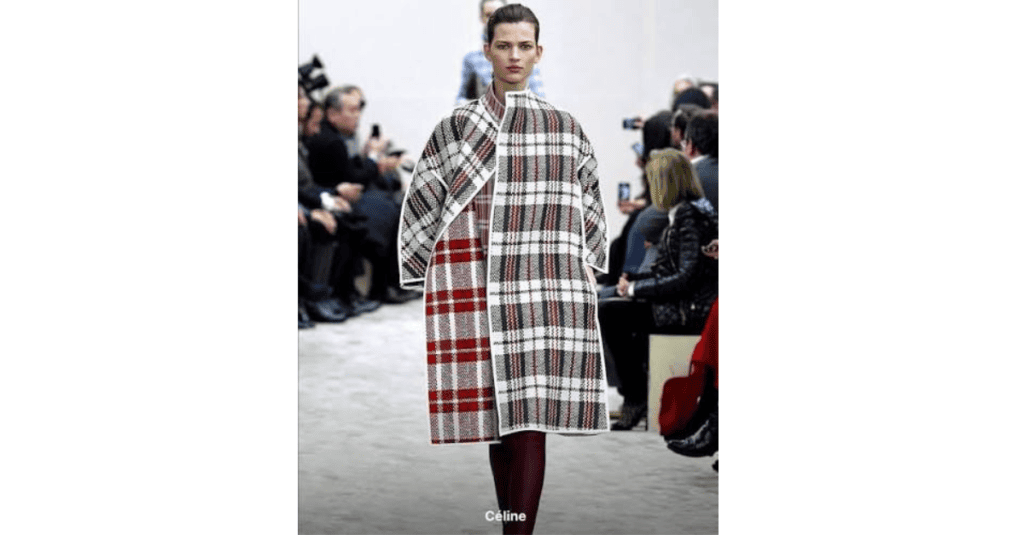
For its Fall 2013 collection, Céline, then led by Phoebe Philo, enlarged a familiar check across coats, wrap skirts and funnel-neck tops.
Vogue’s runway review called it a “laundry-bag check” and traced the motif to designer Helmut Lang. The collection sits within a broader fashion lineage in which designers have transferred checks associated with utilitarian shopping and laundry bags onto luxury garments.
British Vogue later included the “Laundry Bag Print” among Philo’s defining Céline designs, describing her Fall 2013 collection as a subversion of the market laundry-bag check.
Céline’s documented reference belongs to the broader laundry-bag aesthetic. Reporting and research on Louis Vuitton’s Spring 2007 collection have more specifically connected its checked bag with the West African cultural reference and the wider global family of woven market bags.
One Bag, Many Names
The West African history of the bag is one chapter in a much larger story of the red-white-blue woven carryall.
Design historian Min-Jung Lee traces the object across several continents in A Bag of Remembrance.
Her research documents names including “Chinatown tote” in the United States, “Guyanese Samsonite” in Trinidad, “Türkenkoffer” in Germany, “Bangladeshi bag” in the United Kingdom and “Zimbabwe bag” in South Africa.
Lee traces the red-white-blue bag to Chinese production and examines how communities adopted and reinterpreted it as it circulated internationally.
The names demonstrate how the same basic carryall can acquire different cultural meanings through migration, trade and everyday use.
Within Ghana and Nigeria, Ghana Must Go carries the specific historical association created by the 1983 expulsions and the bag’s subsequent place in West African life.
A New Generation Is Wearing the Pattern
The check continues to appear in contemporary fashion.
French streetwear label 4 The People recently translated the recognizable Ghana Must Go pattern into a polo shirt.
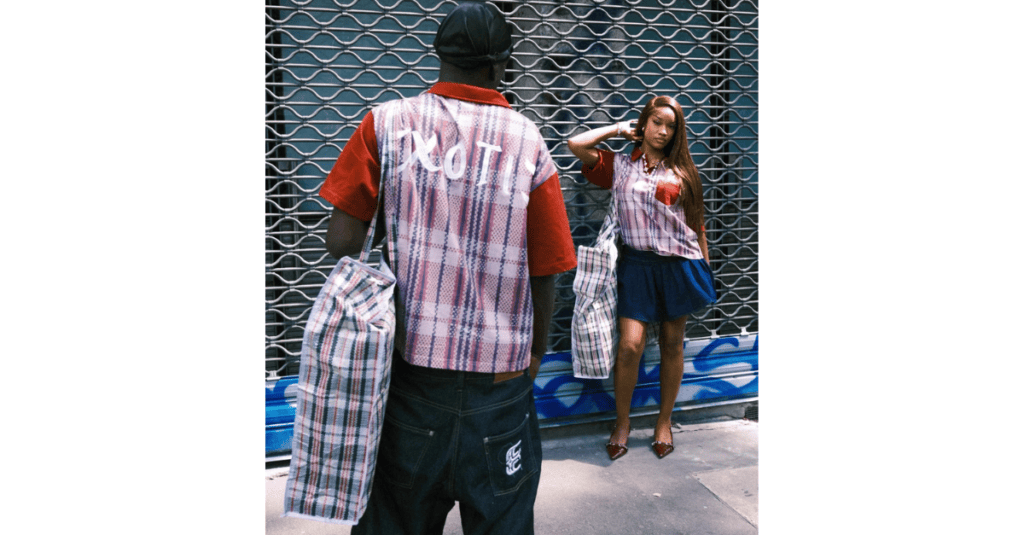
The garment takes the bag’s red, blue and white grid and uses it across the shirt itself. The brand describes the design as a tribute to the bag and its associations with migration, resilience, ambition and identity.
The release brings the pattern into a contemporary streetwear context more than 40 years after the 1983 expulsions that produced its West African name.
For younger consumers, the reference can carry several associations at once. The bag remains part of family life, travel, commerce and migration while its check increasingly functions as a recognizable fashion motif.
African Creatives Explore the History Through Fashion
The commercialization of the aesthetic has also prompted African creatives to examine who gets to tell the story attached to it.
Nigerian creative director and photographer Chioma Obiegbu addressed that question through her 2019 visual project GhanaMustGo.
Obiegbu said the idea developed after moving to New York and seeing Ghana Must Go-style bags stamped with brand names and logos. She identified Louis Vuitton, Topshop and Opening Ceremony among companies that had produced versions.
Having grown up in Nigeria, Obiegbu was already familiar with the bag’s name and history. Seeing it presented as fashion in New York prompted her to create imagery that placed the object within an African-centered context.
In an Unlabelled Magazine interview, Obiegbu explained that the project was intended to educate viewers about the history behind bags they were increasingly encountering as fashion.
Her photographs feature models wearing and carrying the recognizable woven material, using fashion imagery to document the object’s cultural meaning.
Her work adds a perspective that becomes increasingly relevant as the pattern continues appearing in fashion: the Ghana Must Go aesthetic carries a documented history that predates its designer interpretations by decades.
The post How the Ghana Must Go Bag Went From Migration to Fashion appeared first on SHOPPE BLACK.