
COP 17 President Hambardzum Matevosyan, Minister of Environment, Armenia. PHOTO/IISD/ENB – Mike Muzurakis.
By PATRICK MAYOYO
The 2026 United Nations Biodiversity Conference (COP17) is heading towards its conclusion on Friday amid unresolved disagreements over biodiversity financing, corporate contributions, benefit-sharing and measures to tackle the accelerating loss of nature.
Delegates spent Wednesday in intensive negotiations across multiple contact groups, seeking compromises on key provisions of the Kunming-Montreal Global Biodiversity Framework (GBF), the international blueprint for halting and reversing biodiversity loss.
However, deep divisions over how to mobilise resources, distribute benefits from genetic resources and coordinate environmental policies continued to threaten progress on several critical agenda items.
At the centre of the negotiations is a formidable financial challenge: bridging the estimated $700 billion annual biodiversity financing gap while ensuring that countries, businesses and other beneficiaries of nature contribute fairly towards its protection.
The negotiations have also exposed differences between developed and developing countries over the legal obligations attached to benefit-sharing, the role of voluntary contributions and the extent to which international agreements should compel action.
High-level events on Thursday included the Yerevan Call on incentives positive to biodiversity, the launch of the Friends of Target 18 initiative and the Yerevan Biodiversity Finance Challenge.
Target 18 of the GBF calls for identifying and eliminating, phasing out or reforming incentives harmful to biodiversity by at least $500 billion annually by 2030, while scaling up positive incentives for conservation and sustainable use.
Despite these initiatives, delegates continued to struggle to translate political commitments into agreed negotiating text.
Resource mobilisation remained among the most contentious issues, with negotiators unable to reach consensus on several proposed criteria governing the institutional structure responsible for administering the financial mechanism.
Disagreements centred on financial support for eligible countries, particularly least developed countries, small island developing states and countries with economies in transition.
Delegates also differed over country ownership of funded programmes, direct access to financing, and the participation of Indigenous Peoples and local communities, women, young people and other stakeholders in decisions affecting the allocation of resources.
Another unresolved issue concerns how the financial mechanism should demonstrate additional value while mobilising funding from public, private and other sources.
The debate has acquired added urgency amid concerns about the limited financial contributions so far attracted by the Cali Fund, established under the multilateral mechanism for sharing benefits arising from the use of digital sequence information (DSI) on genetic resources.

The relationship between biodiversity loss and climate change emerged as another important negotiating issue. PHOTO/IISD/ENB – Mike Muzurakis.
According to the fund’s reported deposits, it had attracted just $8,990, raising questions about whether voluntary contributions alone can deliver the resources envisaged by the international agreement.
A Zero Carbon Analytics analysis estimated that the world’s 15 largest pharmaceutical companies would have contributed $756 million to the fund in 2025 had they paid according to the agreed indicative rates.
The analysis further reported that these companies made 213 times more in profits and paid shareholders more than 175 times the suggested contribution.
The figures have intensified calls for stronger measures to ensure that commercial users of genetic resources contribute to biodiversity conservation.
However, some countries argue that legal certainty and sufficient time are necessary to encourage contributions, while others maintain that incentives may be inadequate without measures by governments to secure compliance.
During negotiations on Cali Fund certificates, delegates agreed to remove wording that would have made recognition of certificates and exemption from further benefit-sharing claims a condition for countries to receive funding.
Developing countries stressed that certificates should be distinguished from ordinary receipts or evidence of contributions, arguing that only monetary payments calculated according to agreed indicative rates should qualify.
Developed countries raised concerns about the legal implications of the proposal and the need to encourage users to contribute.
Negotiators examining the global review of collective progress towards implementing the GBF agreed on compromise language acknowledging the risk of failing to achieve its 2050 goals and vision unless action and the provision of implementation resources are rapidly accelerated.
The proposed decision also provides that the review should guide and prioritise future work towards 2030, with its provisions interpreted as facilitative, non-intrusive and non-punitive.
The Secretariat was asked to incorporate the decision and global report into reviews of programmes of work.
Delegates also discussed strengthening national monitoring and knowledge management systems, including possible support from the Global Environment Facility to improve countries’ ability to monitor progress against biodiversity targets.
The outcome highlights a central concern for the conference: governments cannot credibly promise to halt biodiversity loss without reliable data, adequate funding and mechanisms for measuring implementation.
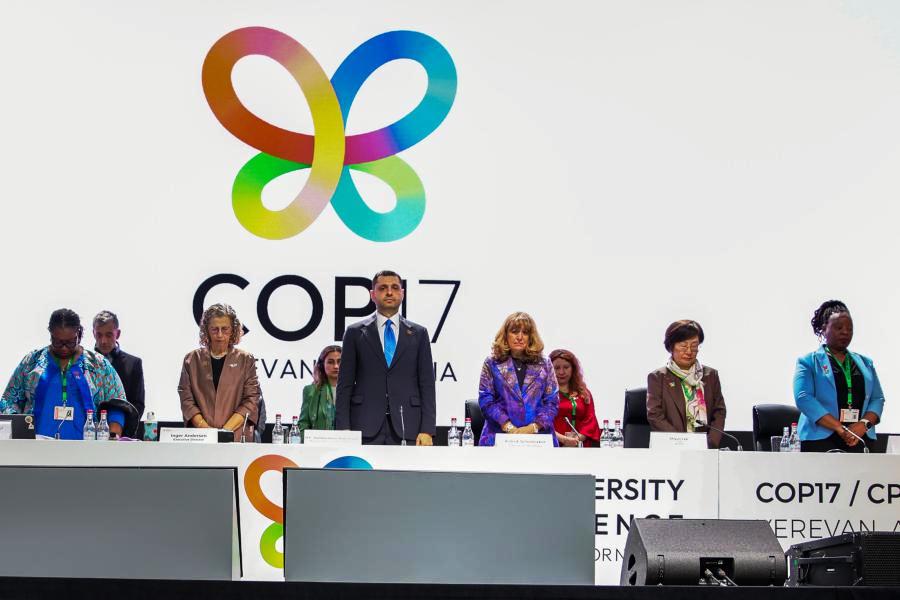
Participants observing a moment of silence for the three members of the biodiversity community who passed away: Josef Settele, IPBES lead author; Christine von Weizsäcker, CBD Alliance; and Martha Kandawa-Schulz, Namibia. PHOTO/IISD/ENB – Mike Muzurakis.
On biodiversity mainstreaming, Parties agreed to encourage stronger interministerial coordination and greater engagement by business and financial sectors.
However, they remained divided over national sectoral transition plans, the involvement of non-Party actors in knowledge-sharing and measures to eliminate harmful incentives.
Disagreements also persisted over references to scientific assessments produced by the Intergovernmental Science-Policy Platform on Biodiversity and Ecosystem Services. The relationship between biodiversity loss and climate change emerged as another important negotiating issue.
Delegates agreed on language recognising the need for short-term action and encouraging countries, according to their national circumstances, legislation and respective mandates, to pursue initiatives addressing the links between climate change and biodiversity.
However, they disagreed over whether to formally adopt or simply take note of a policy primer accompanying voluntary guidelines on ecosystem-based approaches to climate adaptation and disaster risk reduction.
Several countries supported language clarifying that the guidance is voluntary, non-prescriptive and does not create new obligations.
The debate reflects wider difficulties in coordinating international environmental agreements, despite mounting scientific evidence that biodiversity loss, climate change, pollution and land degradation are interconnected.
United Nations Environment Programme Executive Director Inger Andersen underscored this relationship at the opening of the conference’s high-level segment.
“We live on one planet, in which the climate and nature are so evidently and obviously inseparable,” she said.
Cooperation among multilateral environmental agreements and other international organisations is considered essential to tackling the principal drivers of biodiversity loss, including land-use change, overexploitation of species, climate change, pollution and invasive alien species.
Nevertheless, differences in institutional mandates, membership, legal arrangements and funding structures continue to complicate efforts to develop coordinated responses. Progress on protected areas remained mixed.
Delegates reported agreement on provisions addressing ecological connectivity and the need to strengthen the quality, representativeness and governance of conservation systems.
These discussions relate directly to GBF Target 3, which seeks to conserve at least 30 per cent of terrestrial, inland water, coastal and marine areas by 2030.
However, disagreements persisted over financial and technical support, human rights-based approaches and the preparation of a synthesis report on lessons learned.

Inger Andersen, Executive Director, UN Environment Programme (UNEP), with COP 17 President Hambardzum Matevosyan, Minister of Environment, Armenia. PHOTO/IISD/ENB – Mike Muzurakis.
Negotiators also discussed strengthening access to information and ensuring the full, equitable and effective participation of Indigenous Peoples and local communities in decisions concerning protected areas and other effective area-based conservation measures.
On sustainable wildlife management, delegates failed to reach agreement on several references concerning gender-responsive approaches, human rights, community participation and environmental human rights defenders.
They agreed, however, that voluntary guidance on wildlife management should complement, rather than replace, existing national fisheries frameworks and measures adopted by relevant fisheries bodies.
Meanwhile, discussions on pollution and biodiversity produced agreement on inviting relevant organisations to address the relationship between biodiversity and all forms of pollution. The Secretariat was also asked to organise a workshop on GBF Target 7 and map existing and potential future work.
Other unresolved matters include the global multilateral benefit-sharing mechanism under the Nagoya Protocol and risk assessment guidance for living modified organisms under the Cartagena Protocol on Biodiversity.
Delegates agreed to develop additional voluntary guidance on living modified fish, but disagreements remained over other technical provisions.
On the Nagoya Protocol, countries differed over whether further negotiations should proceed through an open-ended working group, a technical expert group or an informal advisory arrangement.
The protected areas and biodiversity mainstreaming negotiations also retained bracketed provisions, signalling that consensus had yet to be achieved.
As the conference approaches its conclusion, attention is turning to whether ministers can resolve the outstanding disputes and prevent ambitious declarations from being undermined by weak implementation arrangements.
A participant following the discussions called for stronger political intervention to bridge the gap between high-level commitments and the detailed negotiating text.
The final outcome will help determine whether governments can turn the Kunming-Montreal framework into a credible programme of action, backed by adequate finance, stronger accountability and cooperation across environmental policy.
With biodiversity under growing pressure worldwide, the conference’s success will ultimately be measured not by the number of declarations adopted, but by whether countries and businesses deliver the resources and reforms needed to protect nature.