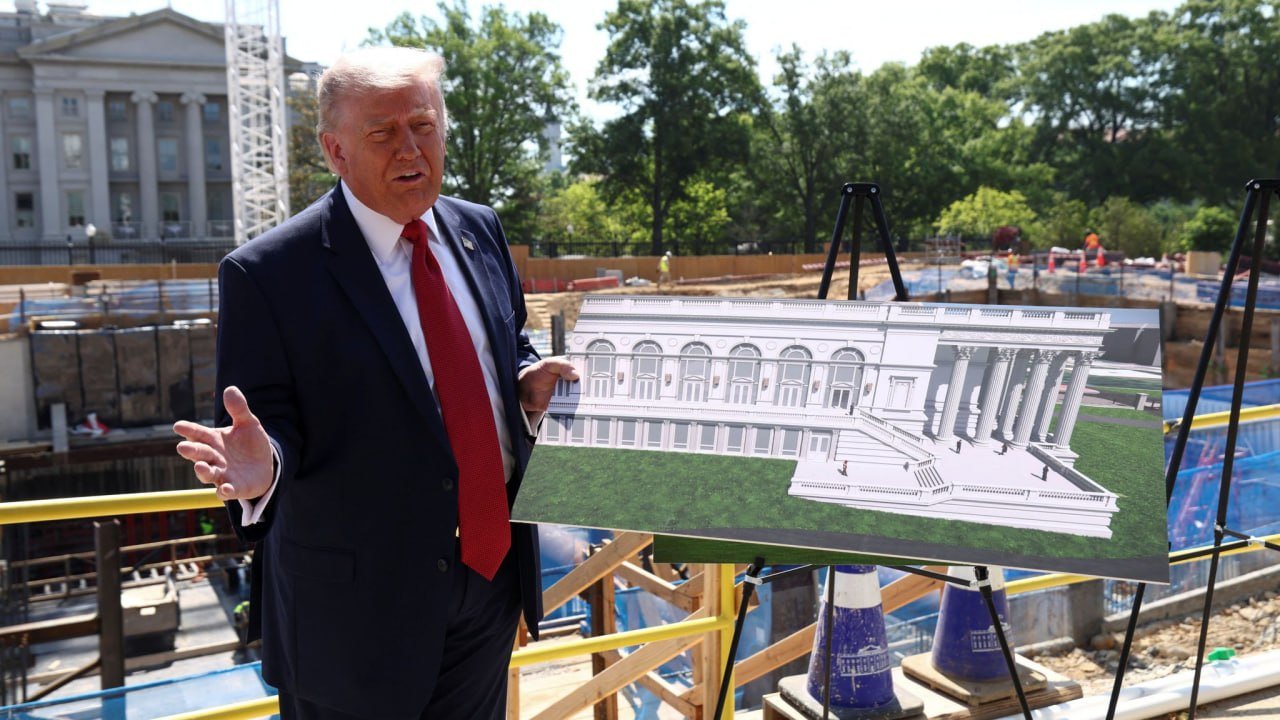
Washington — A divided federal appeals court ruled on Friday that President Donald Trump lacked the unilateral authority to construct a massive new ballroom replacing the demolished East Wing of the White House, ordering a halt to above-ground work without explicit congressional approval.
The U.S. Court of Appeals for the District of Columbia Circuit, in a 2-1 decision, upheld a lower court’s finding that no law empowered the president to raze and fundamentally reshape sections of the historic residence on his own.
(Source: nytimes.com)
“Whether or not a massive ballroom should be constructed is for Congress to decide and is not a matter for Executive self-help,” the majority wrote.
Judges Patricia Millett (an Obama appointee) and Bradley Garcia (a Biden appointee) formed the majority, emphasising that “each President is a temporary tenant, not the owner, of the White House.”
Judge Neomi Rao, a Trump appointee, dissented.
The panel stayed its ruling for 14 days to allow an appeal to the Supreme Court.
(Source: apnews.com)
President Trump’s plan, first announced in July 2025, called for a grand “White House State Ballroom” of approximately 90 000 square feet on the site of the East Wing, which was demolished in October 2025.
The structure was intended to seat 650 to as many as 1 000 or more guests—far exceeding the East Room’s roughly 200-person capacity—and feature an opulent neoclassical exterior matching the White House alongside a lavish interior with crystal chandeliers, ornate columns, coffered ceilings, and checkerboard flooring inspired by spaces like Mar-a-Lago.
It would also incorporate underground national security elements, including a multi-level bunker, bomb shelters, medical facilities, and other protective infrastructure such as drone-resistant features and ballistic glass.
Trump has described the integrated project as essential for large-scale state events and security upgrades.
(Source: bbc.co.uk)
Cost estimates for the renovations escalated rapidly. Initially pegged at about $200 million, figures rose to $300 million and then $400 million in public statements by Trump. Internal contractor estimates later reached as high as $600 million.
Trump repeatedly insisted the project would be funded entirely by private donors—including himself, tech companies, defense contractors, and other “patriots”—with “zero cost to the American taxpayer.”
However, documents indicated substantial taxpayer contributions were projected for associated security work through agencies like the Secret Service and White House Military Office, potentially covering roughly half the higher estimates.
Luxury details such as crystal chandeliers formed part of the ornate design vision, echoing Trump’s preference for high-end decorative elements seen in his other properties.
(Source: washingtonpost.com)
Trump, who turned 80 in June 2026, has remained deeply involved in the project despite his age, personally reviewing designs, selecting materials such as marble, and promoting it as a lasting legacy.
He has framed the ballroom as both a practical necessity for entertaining world leaders and a security enhancement for future presidents.
(Source: cnn.com)
If construction is fully halted, the site—once a large excavation hole created during months of demolition and digging for the underground complex—poses practical challenges.
By early 2026, foundation work had begun filling the hole with the below-ground bunker and related facilities.
Courts have permitted continued underground national-security construction even while restricting above-ground ballroom work, noting options such as protective coverings over exposed areas.
Experts suggest alternatives could include completing the subterranean elements, securing the site, and potentially reconstructing a more limited East Wing structure atop it rather than the full ballroom.
Leaving an open or partially finished hole long-term is seen as unlikely due to safety, security, and aesthetic concerns at the White House complex; work to stabilise and cover the area could proceed independently.
(Source: cnn.com)
President Trump responded angrily to the ruling, vowing an immediate Supreme Court appeal.
In Truth Social posts, he called the decision “horrendous, politically motivated, and unlawful,” a “National Security threat,” and an “unjust” blow that jeopardises the safety of presidents, staff, visitors, and dignitaries.
He stressed that the ballroom and underground complex form “one big, expensive, and very complex unit” vital for protection against attacks, including features like bomb shelters, a hospital, missile-resistant steel, and drone-proof elements.
Trump argued presidents are not mere “tenants” but elected leaders empowered to renovate and secure the White House, and he insisted the privately funded project (ahead of schedule and under budget in his view) requires no congressional blessing.
He questioned why the legal challenge came after construction had advanced.
(Source: nytimes.com)
The National Trust for Historic Preservation, which sued over the lack of review for the East Wing demolition and the scale of changes, prevailed at this stage.
The ruling does not permanently ban a ballroom but requires Congress to authorise major alterations to the People’s House.
With the 14-day stay in place, construction continues for now as the administration prepares its high-court challenge.
The outcome will test the limits of presidential power over the White House grounds and could leave the site’s future—and any gaping remnants of the excavation—unresolved well into Trump’s term or beyond.
(Source: reuters.com)
The saga underscores tensions between executive initiative, historic preservation, funding transparency, and constitutional checks on reshaping one of America’s most symbolic buildings.
Disclaimer: This article was compiled using the AI tool Grok on X and may contain inaccuracies
The post Appeals Court Rules Trump Exceeded Authority On White House Ballroom appeared first on The Bulrushes.
