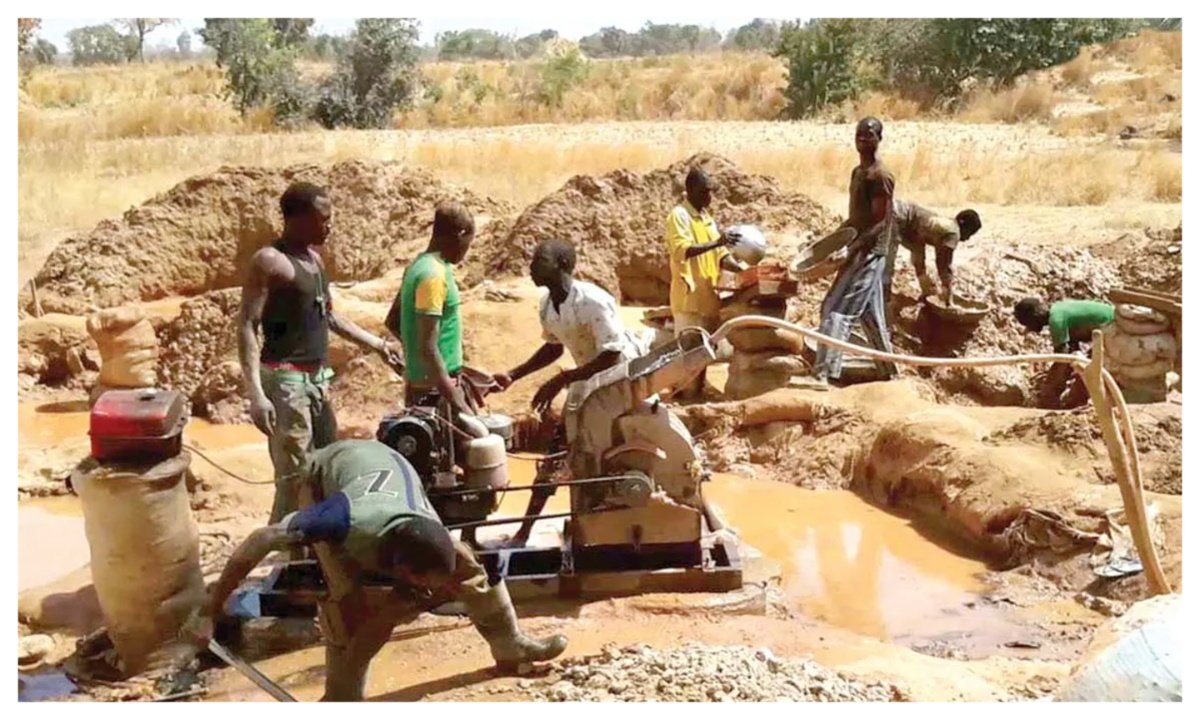

Niger State’s push to develop its solid minerals sector faces a major setback as insecurity keeps legitimate miners away from some mineral-rich areas, while illegal operators are increasingly digging around homes and other residential areas in search of gold.
Miners say kidnappings in mining areas have forced companies to suspend exploration and spend millions of naira paying ransom for workers, while residents in parts of Minna are now dealing with excavations they say are damaging homes, places of worship and the environment.
The situation has also raised concerns about the state’s ability to increase revenue from mining, enforce regulations and protect communities where mineral deposits are being exploited.
Miners pay for licences but cannot work
Chairman of the Miners Association of Nigeria, MAN, Niger State chapter, Abdulrazak Yusuf Mohammed, told DAILY POST that insecurity was affecting mining operations in about 17 of the state’s 25 local government areas where members operate.
Mohammed explained that most exploration activities take place in forests, many of which have become unsafe because of banditry and kidnapping.
According to him, “Most of our operations, from exploration to other activities, are in the bushes and forests. So, these issues of insecurity are in the forests where we operate.”
The MAN chairman said more than 20 people connected with mining activities had been kidnapped in the Borgu area alone, with miners forced to raise millions of naira in ransom to secure their release.
According to him, the situation had left some companies paying for licences and royalties without access to their concessions.
“Some of the licences you’ll be paying the royalty for will expire without exploration, and you cannot operate. You go and renew the licence, and you cannot operate,” Mohammed said.
He estimated the losses suffered by miners at billions of naira, although the figure was not independently audited.
Mohammed listed Suleja and parts of Munya, Shiroro and Rafi among areas where mining activities were still taking place relatively well, while parts of Borgu, including Kaade, Babanna, Konkoso and Pisa, had been badly affected by insecurity.
He said some villages around the affected mining areas had been attacked and residents forced to move to safer locations, making it difficult for mining companies to continue operations.
Illegal mining reaches residential areas
While legitimate miners are struggling to reach some concessions because of insecurity, residents in parts of Minna say illegal mining is taking place much closer to their homes.
A resident of the Tunga area, Mallam Bala, told DAILY POST that illegal miners had been scooping sand from areas in front of homes and gutters in search of gold.
Residents around the M.I. Wushishi Housing Estate also complained about repeated excavations, with one resident, Mrs Teni Musa, saying illegal miners continued returning after raids.
Another resident said miners dug underground from a distance and eventually reached a residential building, causing part of the house’s parlour to collapse.
Pastor Peter Luka told DAILY POST that illegal excavation had also extended towards his church, affecting the church fence and raising concerns over nearby houses.
Residents also said clashes sometimes occurred over mining holes and control of mining locations, with some disputes resulting in loss of lives.
Some residents said they were reluctant to speak openly about the activities because of fears of possible attacks.
Police record more than 100 arrests
The Niger State Police Command said it had been working with the Ministry of Mineral Resources and the NSCDC Mining Marshals to close illegal mining operations and raid identified sites.
Police Public Relations Officer, Wasiu Abiodun, told our correspondent that M.I. Wushishi Housing Estate, the College of Education area in Chanchaga and the Mandela area were among locations where enforcement operations had been carried out.
Abiodun said more than 100 suspects had been arrested within the year.
He, however, said some of those arrested were later fined during prosecution and returned to illegal mining.
“They pay fines and later return to their illegal activities, thereby recycling them,” the police spokesperson said.
Abiodun said the command was also working with the NSCDC and vigilante groups to provide security for licensed miners in areas including Kataeregi, Maikunkele and Beji, although operators in bandit-affected locations remained difficult to protect.
NSCDC charges 29 suspects to court
The Niger State Command of the Nigeria Security and Civil Defence Corps said its Mining Marshals had also arrested more than 100 suspected illegal miners this year.
The command spokesperson, DSC Abubakar M.R. Muti, said about 29 suspects had been charged to court, while some minors among those arrested were granted bail in accordance with the law and their ages.
Muti said the Corps was combining arrests with intelligence gathering, surveillance, community engagement and cooperation with relevant agencies to prevent illegal miners from returning to cleared locations.
Illegal mining operation leaves NSCDC officer dead
The danger facing security personnel enforcing mining regulations was again exposed on July 22, when an officer of the Nigeria Security and Civil Defence Corps, NSCDC, was killed during an operation at an illegal mining site in Korokpa village, Paikoro Local Government Area of Niger State.
The deceased, Assistant Superintendent of Corps II, Aminu Eshin, was attached to the NSCDC Mining Marshals and was part of a team conducting a patrol at the illegal mining site when suspected illegal miners attacked the operatives.
The command said the team called for reinforcement after coming under attack, but Eshin sustained a gunshot wound to the head. He was evacuated for medical treatment but later died from his injuries.
Governor Mohammed Umaru Bago condemned the killing and directed security agencies to intensify efforts to apprehend those responsible, while reaffirming the state’s commitment to tackling illegal mining.
The killing came months after another NSCDC officer was killed during an attack on a joint security patrol at Zuzungi in Katcha Local Government Area in February, where an operational vehicle was also burnt.
The incidents have increased concerns over the risks faced by security personnel deployed to enforce mining regulations in areas where illegal mining and insecurity overlap.
Government tightens regulation
The Niger State Ministry of Mineral Resources says it is responding through stronger regulation, enforcement and cooperation with traditional institutions and security agencies.
The ministry said 121 mining companies had registered with the state, while its Commissioner, Hon. Muhammed Qasim Danjuma, told DAILY POST that the state generated more than N75 million from solid minerals between January and June 2026.
Danjuma stated that he assumed office in December 2025 and met several challenges in the sector, but began efforts to address them from January.
According to him, “I came on board as Commissioner in December 2025 and met a lot of issues. We handled them and started working properly in January.
“The efforts had started yielding revenue, with the state generating more than N75 million between January and June.”
The Commissioner disclosed that illegal mining had affected the state’s ability to generate more revenue and that the government was working to attract legitimate local and foreign investors.
He stated that mining companies seeking state clearance were required to reclaim land after extraction to prevent environmental damage and hazards to residents, while companies were also expected to identify areas where host communities could benefit from their operations, including water, healthcare and education, among others.
Traditional rulers raise community concerns
At a stakeholders’ meeting between the Ministry of Mineral Resources and traditional rulers from mining communities in the state on August 3, concerns over insecurity and illegal mining were also raised.
The Yankpa of Kataeregi called for compliance with mining laws and warned that criminal activities should not be carried out under the cover of mining.
The Dagaci of Kataeregi appealed for stronger security intervention, saying repeated attacks had resulted in loss of lives and affected development in the communities.
The traditional rulers also raised concerns over women and children becoming involved in illegal mining, particularly children abandoning formal education to work at mining sites.
Participants proposed community-based security structures to complement conventional security agencies and improve intelligence gathering around mining locations.
The Commissioner said the ministry would work with relevant agencies to address the concerns and announced plans for another meeting involving security chiefs and traditional rulers.
The problem extends beyond Niger
The challenges confronting Niger are part of a wider problem facing Nigeria as the country tries to reduce its heavy dependence on oil and unlock the economic potential of its solid minerals sector.
The Nigeria Geological Survey Agency has ongoing exploration and evaluation projects across states including Niger, Nasarawa, Zamfara, Kogi, Kebbi, Cross River, Osun, Kwara, Taraba and Plateau, among others, across the country.
Its documented work covers minerals including gold, lithium-bearing pegmatites, barytes and other resources, reflecting the spread of mineral deposits across the country.
Zamfara provides one example of how insecurity can disrupt mining.
The Federal Government suspended mining activities in the state in 2019 following security concerns before lifting the suspension in December 2024 after citing improved security.
Nasarawa has faced similar challenges, particularly following the rapid expansion of lithium mining. In June 2024, the state government shut down a lithium operation in Kokona Local Government Area for allegedly operating without community consent and state approval.
Its manager was later arrested in December after the company reportedly continued operations.
Also in December 2024, an Associated Press investigation found children working in illegal lithium mines in Pasali, including a six-year-old girl who had stopped attending school.
The enforcement challenge continued in 2026. On May 16, NSCDC Mining Marshals arrested 15 Chinese nationals and nine Nigerians in Kokona over alleged illegal lithium mining. The 24 suspects were later arraigned before the Federal High Court in Abuja.
On July 19, three Chinese nationals and several Nigerian miners were again arrested during an operation at Amba in Kokona over alleged illegal mining despite a government suspension order.
The developments show that the challenges surrounding illegal extraction, child labour and enforcement extend beyond Niger State.
Revenue remains a concern
The Nigeria Extractive Industries Transparency Initiative (NEITI) reported that total revenue from the solid minerals sector stood at N401.86 billion in 2023. Of the amount, N392.28 billion was transferred to the Federation Account, while N9.58 billion represented payments to states and local governments.
The figure represents reported government revenue associated with the sector and should not be confused with the total value of Nigeria’s mineral deposits.
For Niger, however, the N75 million reported by the state between January and June is similarly government revenue and not the value of minerals extracted during the period.
The gap between Nigeria’s vast mineral potential and what the government currently earns from the sector remains a major concern, with billions of naira in potential revenue at stake where mineral extraction takes place outside the formal system.
What happens after the arrests?
The repeated return of illegal miners after enforcement operations remains one of the difficulties identified by authorities.
The police said some suspects pay fines after prosecution and later return to mining, while the NSCDC said it was increasing surveillance of cleared sites to prevent reoccupation.
For residents in M.I. Wushishi Housing Estate and other affected areas, the concern is more immediate: they want the excavation around homes stopped before more buildings are damaged or lives are lost.
Licensed miners, meanwhile, want security that will allow them to reach their concessions and make use of licences they have already paid for.
The government is seeking more revenue and investment from the sector, but the accounts of miners, residents and security agencies show that regulation alone will not resolve the problems confronting mining communities.
For Niger, the challenge is now to secure legitimate mining operations, stop illegal miners from returning to cleared sites and protect communities from dangerous excavation while ensuring that the state’s mineral resources generate more revenue and jobs.
Until that happens, the state’s push to turn its mineral wealth into a stronger source of economic growth will continue to face the same problems that are already keeping legitimate miners out of some areas and putting residents at risk.
Communities endangered as insecurity, illegal mining threaten Niger’s solid mineral sector