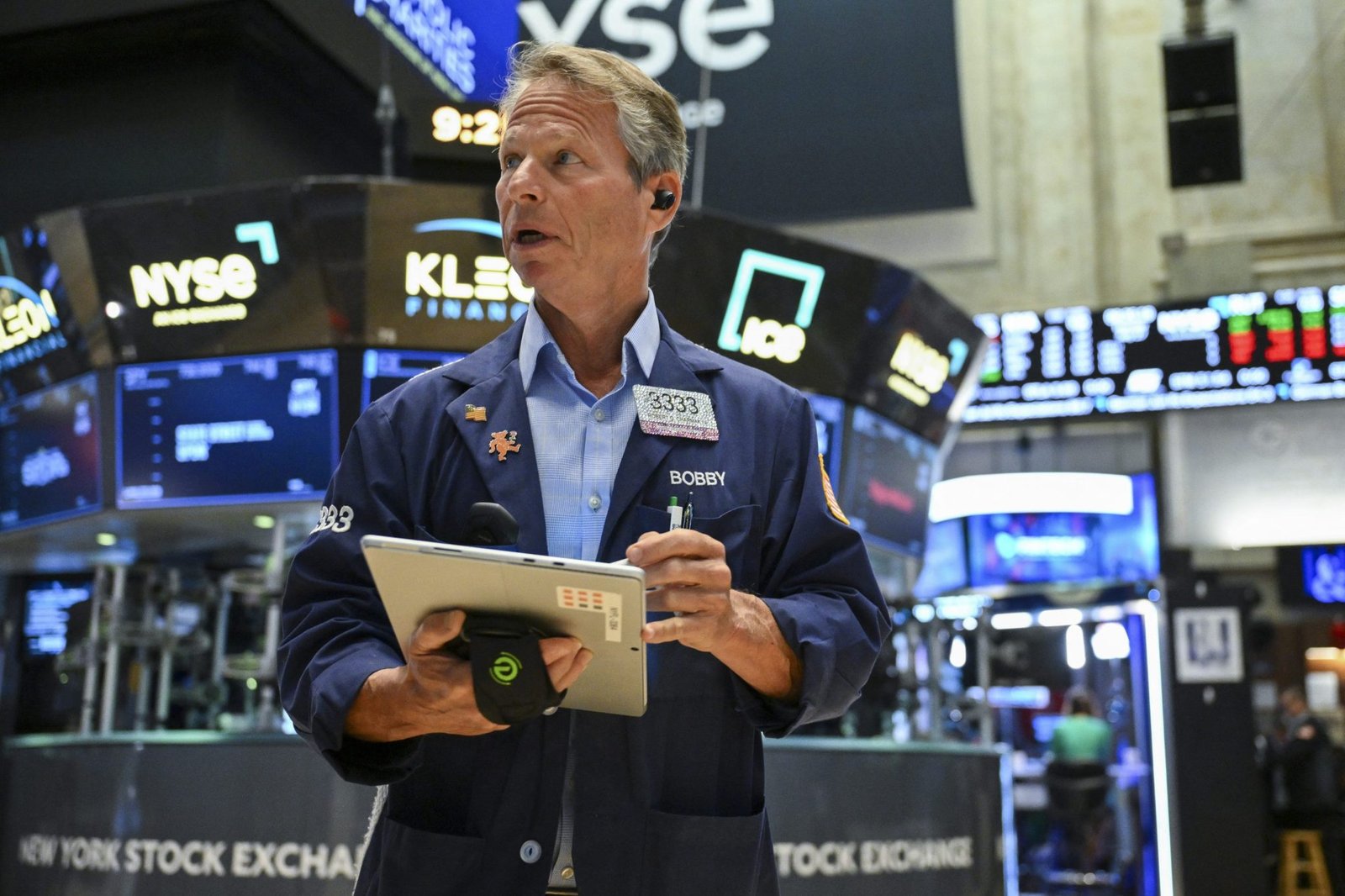
Oil prices got back to jumping on Wednesday, while sinking technology stocks dragged Wall Street lower amid uncertainty about what the Federal Reserve will do to get high inflation under control.
The S&P 500 fell 1.5% after swinging sharply between gains and losses in the last hour of trading. The Dow Jones Industrial Average dropped 1,153 points, or 2.2%, and the Nasdaq composite slumped 1.7% to fall 9.8% below its record set last month.
The action was more decisive in the oil market, where the price of Brent crude leaped 7.3% to settle at $88.09 per barrel after fighting resumed in the war with Iran and raised worries about the global flow of oil.
Brent oil’s price had swung as low as $72 early this month and as high as $102 last week on uncertainty about whether the United States and Iran could reach a deal to allow oil tankers to move freely again from the Middle East to customers worldwide.
The swings have raised worries that inflation will reaccelerate, and traders came into the day betting on a roughly 34% probability that the Fed would raise its main interest rate in the afternoon, according to data from CME Group.
Higher rates can keep a lid on inflation, but they can also slow the economy and undercut prices for stocks and other investments.
Fed officials instead voted to keep the federal funds rate steady, though three members of the policymaking committee did want to raise rates. The Fed’s chairman, Kevin Warsh, implied the bond market may already be doing some of the work to restrain inflation, and he pointed to how yields have climbed since the central bank’s last meeting six weeks ago.
He reiterated his commitment to get inflation back to 2% following years of faster-than-hoped increases in prices, but he also stuck to his plan of giving financial markets fewer clues about what the Fed may do with interest rates in the near future.
With less guidance from the Fed, financial markets may be set for more volatile trading amid the uncertainty.
“Did the Fed take an explicit change in its policy rate today?” Warsh asked rhetorically in a press conference following the Fed’s decision. “No, but I think that’s the beginning of the story.”
Treasury yields swiveled up and down following the Fed’s decision and Warsh’s insistence on not guiding the market.
The yield on the two-year Treasury, which closely tracks expectations for Fed action, fell to 4.24% from 4.26% late Tuesday.
But the 10-year Treasury yield, which moves more with expectations for inflation and economic growth in upcoming years, went in the opposite direction. It jumped to 4.68% from 4.61% late Tuesday.
That’s up from 3.97% before the war with Iran sent oil prices much higher, and the increase has already sent long-term U.S. mortgage rates to their highest level in nearly a year.
Higher rates particularly hurt stocks seen as the most expensive, and scrutiny has already been rising on makers of computer chips and other winners of the frenzy around artificial-intelligence technology.
The recent surges for sellers of computer processors and memory are backed by real revenue and profits, but the exceptional growth won’t be sustainable if AI does not produce as much profit and productivity as hoped.
The skepticism has hit South Korea’s stock market in particular because it’s dominated by two tech giants, Samsung Electronics and SK Hynix. Seoul’s Kospi index tumbled 6% Wednesday, a day after it plunged 10.8%, and trimmed its gain for the year so far to 34.4%.
SK Hynix’s stock in Seoul dropped 9.6%. It reported record amounts of revenue and profit for a quarter thanks to strong demand because of AI. But its 257% growth in revenue still wasn’t enough to meet analysts’ expectations.
On Wall Street, Nvidia was the heaviest weight on the S&P 500 after the chip company fell 3.6%.
KLA Corp., whose products and services help make semiconductors, lost 10.8% even though it reported stronger-than-forecast profit and revenue for the latest quarter. Expectations were high after its stock surged nearly 150% in this year’s first six months.
On Tuesday, gains for stocks outside of AI helped offset weakness for tech companies. Analysts have been saying such a rotation in the market from AI to less-loved areas could be healthy, but the majority of U.S. stocks fell with tech on Wednesday.
Hims & Hers Health tumbled 14.7%, for example, after the Federal Trade Commission, Utah and California alleged it shared consumers’ sensitive health information about medical conditions with third-party advertising platforms despite claiming its services maintain consumers’ privacy. Hims & Hers said their lawsuit is contorting “the law to try to manufacture claims,” which it called baseless.
All told, the S&P 500 fell 112.63 points to 7,316.15. The Dow Jones Industrial Average dropped 1,153.18 to 51,594.14, and the Nasdaq composite sank 433.97 to 24,442.94.
In stock markets elsewhere around the world, indexes were mixed. Hong Kong’s Hang Seng rose 2%, and Japan’s Nikkei 225 fell 1.5% for two of the bigger moves.
___
AP Business Writers Yuri Kageyama and Matt Ott contributed to this report.
This story was originally featured on Fortune.com