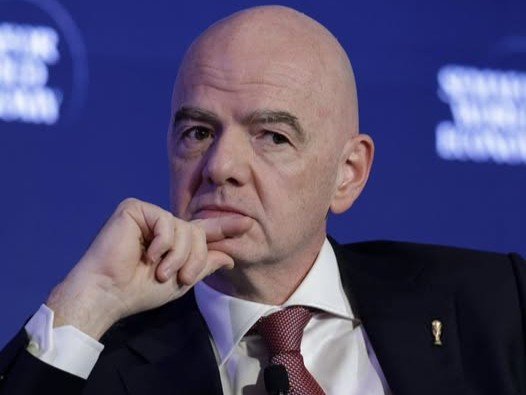
London – In an unprecedented open challenge to FIFA’s leadership, the presidents and general secretaries of UEFA, the Asian Football Confederation and CONCACAF published a joint damning letter.
In the open letter, dated 10 August 2026, these entities accused the organisation of deception and a profound failure of judgement over the aborted plan to sell a stake in the commercial rights to the World Cup.
(Source: reuters.com)
The “Open Letter to the Football Family” declared that football “belongs to no individual and no institution.”
Leadership, it insisted, “is not a possession… It is a duty of service to the football family that entrusts it.
“When trust is broken through deception, when an individual places himself above the collective that entrusted him with authority, that duty has been abandoned.”
Signed by Aleksander Čeferin and Theodore Theodoridis of UEFA, Salman bin Ibrahim Al Khalifa and Datuk Seri Windsor John of the AFC, and Victor Montagliani and Philippe Moggio of CONCACAF, the letter stopped short of naming Gianni Infantino but left little doubt about its target.
(Source: uefa.com)
It rejected FIFA’s framing of the episode as a mere “failure of communication.”
The proposal itself, the confederations argued, was “inherently wrong” — a fundamental breach of trust with the institutions FIFA exists to serve.
They demanded a fully independent review, free of any FIFA role, and criticised an emergency gathering in Morocco attended by only one elected official and selected management staff rather than the broader Council or member associations.
(Source: reuters.com)
The immediate trigger was the short-lived FIFA Forward Enterprise (FFE). In late July 2026, reports revealed plans for a new commercial vehicle that would manage rights to the World Cup and other tournaments.
FIFA would retain majority control while selling a minority stake — reportedly around 20 per cent — to private investors, aiming to raise about $4.2 billion against a valuation near $20 billion.
Potential backers included figures linked to Joshua Kushner.
Member associations were reportedly offered substantially higher development payments if they supported the scheme.
UEFA’s 55 members voted unanimously to boycott future FIFA competitions until the plan was abandoned entirely and binding assurances given that such sales would never recur.
CONCACAF and the AFC voiced deep concerns over the compressed timeline, lack of proper consultation and absence of Council approval. Within days Infantino withdrew the proposal, acknowledging it had created divisions.
(Source: latimes.com)
Discontent with Infantino did not begin in 2026. Elected in 2016 after the corruption crisis that toppled Sepp Blatter, the former UEFA general secretary promised reform and transparency.
Early ethics probes into private-jet travel and meetings with Swiss prosecutors were closed, yet critics pointed to a pattern of centralising power, expanding competitions and prioritising revenue.
The 48-team 2026 World Cup in North America generated record income but drew fire over ticket prices and commercial intensity.
Close ties to political leaders, including the award of a FIFA Peace Prize to Donald Trump and perceived interference in disciplinary matters, further alienated European stakeholders.
Reports of a departure payment by UEFA to a former employee during Infantino’s time there added another layer of personal scrutiny, which he denied.
(Source: cnn.com)
The FFE episode crystallised wider grievances: unilateral decision-making, insufficient consultation, and the sense that commercial ambition risked subordinating the game’s custodianship to private capital.
Sources close to the confederations have described the letter as an opportunity for Infantino to depart with dignity rather than fight for another term.
UEFA has maintained its boycott threat, with the Under-20 Women’s World Cup in Poland in September 2026 a potential early flashpoint.
(Source: Preliminary discussions about alternative competitions among the three confederations have been reported.
(Source: bbc.com)
What next remains fluid.
FIFA has pushed back, accusing critics of a “concerted and ongoing effort” to undermine the organisation and its president, and insisting challenges must follow statutory democratic processes.
An emergency meeting in Morocco reaffirmed internal support for Infantino among parts of the management and some associations.
Support from Africa (CAF), parts of South America (CONMEBOL) and several individual federations has held, providing a potential path to the simple majority needed among FIFA’s 211 members.
The presidential election is scheduled for the Congress in Rabat in March 2027; Infantino has already declared his candidacy for a fourth term that would keep him in office until 2031.
(Source: en.wikipedia.org)
Yet the political arithmetic has shifted.
The three letter-signing confederations represent a large bloc of members. Several European associations have withdrawn or withheld support.
Calls for resignation have come from national federations, former players and figures outside football.
Even if Infantino secures re-election, the trust deficit with Europe, North America/Caribbean and Asia would complicate governance of the expanded World Cup cycle, development funding and future tournament formats.
An independent review, if conceded, could surface further details of the FFE process and decision-making culture.
Infantino’s future therefore hangs between institutional resilience and eroded legitimacy.
His ability to deliver revenue and development money to many smaller associations has long underpinned his support.
The open letter, however, frames the issue as one of integrity rather than money: shared achievements versus personal command.
Whether Infantino can rebuild confidence, face a credible challenger, or choose to step aside will shape the next chapter of global football’s governance.
For now, the three confederations have drawn a clear line — unity must be honoured through service, not command — and the game’s most powerful institutions are watching to see how FIFA’s leadership responds.
Disclaimer: This article was compiled using the AI tool on Grok and may contain inaccuracies
The post FIFA’s Power Struggle Deepens As UEFA, AFC And CONCACAF Accuse Infantino Of ‘Deception’ appeared first on The Bulrushes.