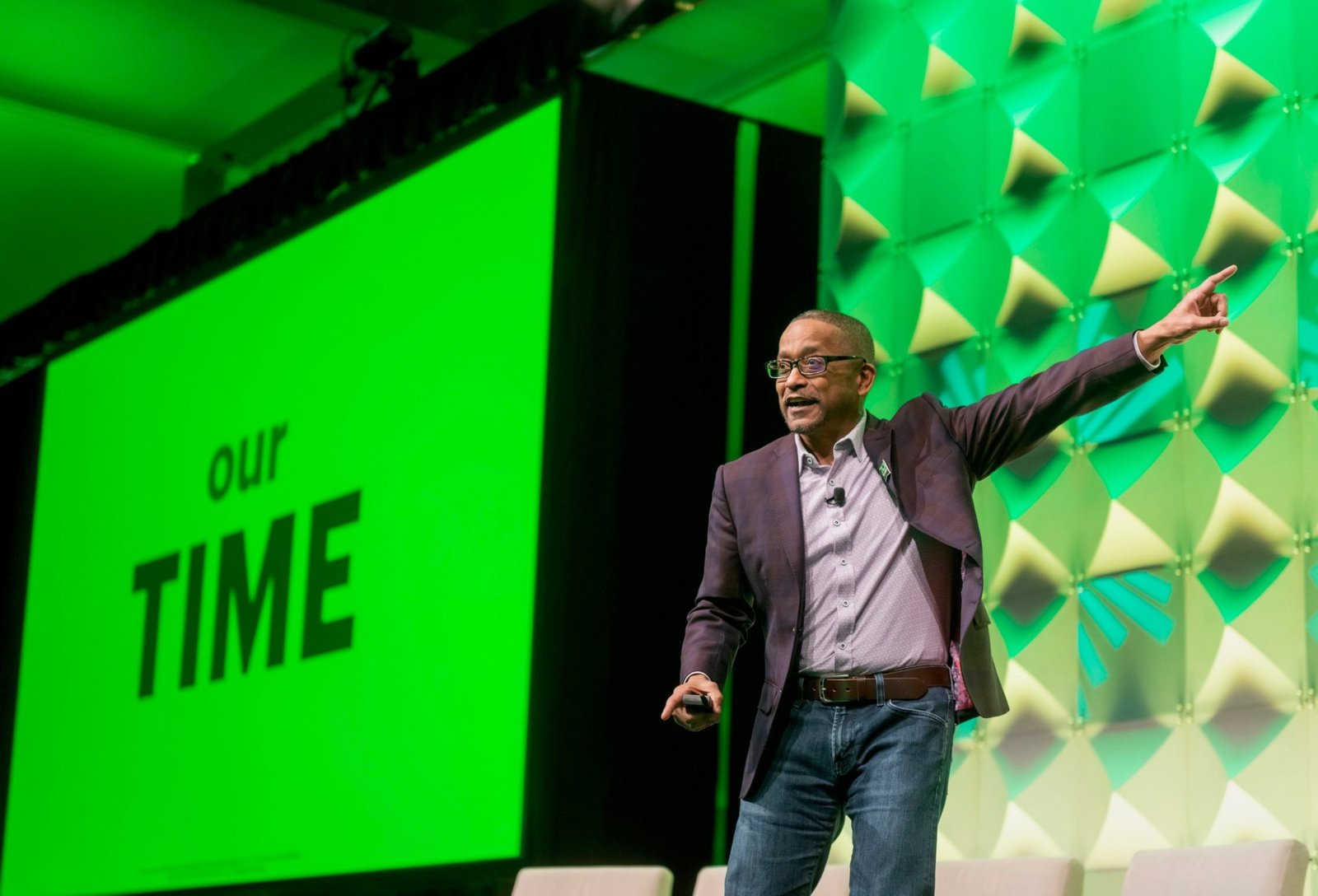
Curtis Campbell knows exactly what kind of company people think H&R Block is.
It is the place you go in late winter or early spring when your W-2s, 1099s, deductions, and deadlines are piling up, your refund feels urgent, and your anxiety is rising. It is familiar, local, and useful, but not the kind of company that usually comes to mind when people think about product velocity, AI deployment, or a culture of experimentation.
Campbell wants to change that.
The new CEO, who previously served as H&R Block’s president and chief product officer, is trying to turn the 70-year-old tax preparation giant into something more expansive: a year-round financial platform powered by software, data, and AI, while preserving the human trust that has long set the company apart. That means reimagining H&R Block not just as a seasonal tax brand, but as a business that can advise creators, serve small businesses, help customers manage money, and use technology to automate the most tedious parts of tax prep, so employees can focus on judgment, relationships, and guidance.
For Campbell, this is an operational exercise rather than a branding one. “Fundamentally, we do taxes, but we’re really not in the tax business,” he tells Fortune. “We’re in the business of trust and confidence.”
Campbell is leading H&R Block through a volatile tax period, as sweeping tax-law changes collide with a significantly downsized IRS. What he hears from the field is that clients want help understanding what the changes mean and reassurance that they are not missing out on money or making mistakes.
That urgency could benefit assisted tax preparation in the near term. But Campbell’s ambition reaches well past one potentially chaotic filing season.
More than a tax company
Campbell’s core thesis is that H&R Block should no longer think of itself as a company that shows up for customers once a year. He wants it to be present throughout the year, serving customers on their journey toward financial freedom.
Such a pivot requires looking beyond tax preparation, he says, to adjacent services such as payroll, bookkeeping, tax advisory, small-business support, and banking. It also means using the company’s enormous data set and physical footprint to build continuous relationships with customers.
Campbell describes a future in which H&R Block becomes more embedded in clients’ lives, moving from “a once-a-year engagement” to “a multi-year engagement.”
He sees a strong opening in the growing ranks of independent workers, creators, and influencers who are suddenly operating as small businesses without fully understanding the financial infrastructure that comes with that shift. H&R Block launched a Creator Suite earlier this year, bundling tax help with bookkeeping, payroll, and related services for people whose work may span multiple income streams and business entities.
“That’s a really interesting group for us to target,” Campbell says of creators. “They’re folks whose tax situation becomes more complex over time, so they’re more needy because they’re advancing their business, they’re growing their sort of portfolio of different services and offerings.”
The same logic applies to small businesses, which Campbell calls H&R Block’s fastest-growing business and one he believes Wall Street still undervalues. The opportunity is straightforward: small business owners do not want to spend their time on payroll, bookkeeping, and tax compliance. They want to run their businesses.
“I’ve yet to meet a small business owner who loves taxes or payroll or bookkeeping,” he says. “They just love the thing that they do.”
The AWS playbook comes to tax prep
What makes Campbell an intriguing fit for this moment is that he does not fit the stereotype of a tax executive. He is a southern-born tech leader who spent years at Dell and AWS, companies known for fast-moving product cycles and quick execution. He talks in the language of critical assumptions, hypotheses, roadmaps, and experiments. He sounds more like a cloud executive than the steward of a legacy tax brand. That is partly the point.
Campbell is trying to make H&R Block more technologically fluent, not just in what it sells but in how it operates. He says the company has spent considerable time defining its “ideal state,” mapping the assumptions required to get there, and building a long-term roadmap. From there, teams identify the questions they need to answer and the experiments required to answer them. Its pace has picked up sharply in recent years.
“Before I joined H&R Block, on average, we ran about five experiments a year,” he says. “This year, we’re going to average about 123.”
That shift is partly cultural. Campbell has pushed H&R Block to act more like a learning organization, drawing on a lesson from Amazon: the companies that build the fastest feedback loops are often the ones best positioned to win over time.
That has also required changing the company’s approach to failure. In the past, new ideas often carried a stigma if they did not work. Campbell wants teams to see failed tests as useful if they produce insight. In his view, a good experiment creates learning, whether it ends in a win or a loss.
That mentality is straight out of big tech. But tax preparation is not cloud software, and Campbell is quick to acknowledge that speed has to be handled differently in a business where mistakes carry real consequences.
“You don’t have to risk the business to test an idea,” he says. “You could say, ‘Hey, I’ve got a concept that’s X, Y, and Z. How can I test this within 10 customers to gain knowledge?’ If that proves to be successful, you can then start to scale it.”
Building an AI tax company
The most visible expression of H&R Block’s transformation is its use of AI.
Campbell is in an unusual position here. Unlike many CEOs who inherit someone else’s technology stack, he helped build the systems now being stress-tested under his leadership.
One of those tools is AI Tax Assist, built into H&R Block’s DIY product in partnership with OpenAI. Campbell describes it as an on-demand guide for customers who get confused while filing online and need quick answers. Users can ask whether an expense qualifies as a deduction or what a move might mean for their taxes, and the system responds in real time.
He recently tried it on his upcoming move from Dallas to Kansas City, asking about the tax implications of going from Texas, which has no state income tax, to Missouri, which does.
The company has also developed an AI assistant for tax professionals, code-named Sidekick, built directly into the software H&R Block’s preparers use every day. Campbell says tax pros have responded enthusiastically because the tool lets them ask highly specific questions and get answers grounded in the company’s own tax institute, an internal bench of enrolled agents, CPAs, and tax attorneys who monitor regulatory changes and work closely with the IRS and state authorities.
Campbell argues that AI can make H&R Block more tech-forward without stripping out the human element that customers value most. He divides tax prep into two kinds of work: the mechanical tasks of collecting information, entering it, and calculating outcomes, and the relational work of advising clients and earning their trust.
He bets that AI can take on more of the first category, freeing tax professionals to spend more time on the second. Today, he says, most office time still goes to transactional work. His ideal model flips that, with technology handling much of the back-end processing, so client conversations become the focus.
H&R Block is already testing that approach in five offices. “At the end of the day, [tax pros] view their success based on their client’s success. If we enable them to do more of that, they’re going to feel more fulfilled.”
Becoming a year-round financial platform
H&R Block’s innovation push extends well beyond tax prep. Campbell’s larger goal is to use software, data, and AI to build the company into a year-round financial platform with a deeper role in customers’ lives. As he sees it, financial pain points do not fit neatly into a filing deadline or a single season.
Spruce, the company’s mobile banking product, is one example. Campbell frames it as a logical extension of H&R Block’s expanding suite of financial services, part of a broader effort to remain relevant to customers year-round.
He also believes H&R Block’s footprint of roughly 9,000 offices still matters in a digital future. As the company becomes more virtual, Campbell expects more customers to engage with tax pros through software and mobile devices. But he sees the storefronts as a key part of H&R Block’s omnichannel advantage, especially in communities where trust is still built face-to-face. “It is important for us to be where our clients are,” he says.
That line captures the core of Campbell’s strategy. He is trying to modernize H&R Block without losing its local presence, human expertise, and credibility within the tax space.
The challenge is persuading the market to see H&R Block as all of those things at once: a techie tax company with thousands of offices, a compliance-heavy business trying to move faster and experiment more, a human service brand adopting AI aggressively, and a seasonal name aiming to become a year-round financial platform.
Campbell seems comfortable with that tension. If he succeeds, H&R Block’s next chapter will be about more than improving tax prep. It will be about turning the company into a more innovative business with a deeper presence in Americans’ financial lives.
This story was originally featured on Fortune.com