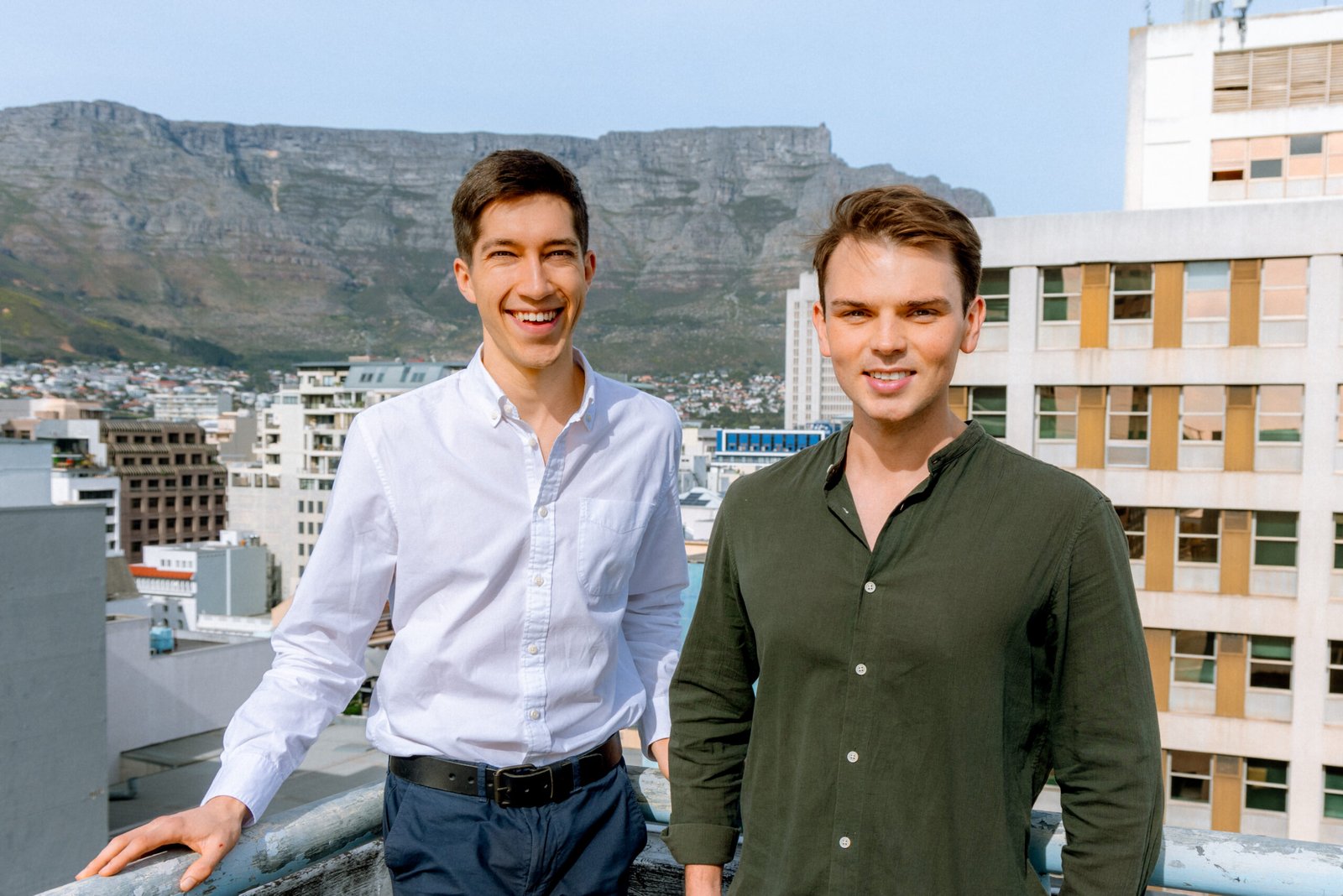
Cape Town – South African-founded AI startup Verascient says it has raised US$1.2 million (R19.5M) in its first funding round to help companies build faster and more capable teams with AI.
Verascient turns knowledge scattered across documents, systems and individuals into shared organisational context, then builds the workflows and agents that allow teams to use it in their day-to-day work.
The raise comes as businesses face growing pressure to move beyond AI experimentation and create practical, secure and commercially valuable ways of working with it instead.
The oversubscribed round was backed by Founder Collective (an early investor in Uber, Airtable and Whoop, among other unicorns), Andrena Ventures (led by Gideon Valkin, former Commercial Director at Monzo), Cambridge Enterprise (the University of Cambridge’s investment arm), and Summit Ventures, with participation from Alan Knott-Craig, Shayne Mann and other select angel investors.
Founded by South Africans Emile Ferreira and Keagan Stokoe, Verascient works directly inside companies where Verascient’s proprietary AI infrastructure serves to improve the operations of businesses.
Its initial focus includes organisations operating in financial services, insurance and logistics: sectors where large volumes of institutional knowledge, data and operational processes are often distributed across emails, documents, meetings, spreadsheets, internal systems and individual employees.
Building the infrastructure underneath enterprise AI
“At the centre of Verascient’s technology is a temporal knowledge graph designed to build and maintain a comprehensive understanding of an organisation, ensuring that information that was once scattered quickly becomes securely available to AI agents while preserving the history, permissions and provenance behind the information,” shares Emile Ferreira, Co-Founder and CTO at Verascient.
The company believes the fragmentation of company knowledge is one of the biggest barriers preventing businesses from extracting meaningful value from AI.
“There is a significant difference between giving employees access to an AI tool and building a company that can operate intelligently with AI,” said Ferreira.
“Verascient bridges that gap by working directly with businesses to understand how their people and processes operate, and providing the secure infrastructure that enables AI agents to understand the organisation, work within its existing systems and access controls, and deliver valuable results.”
Keagan Stokoe, Co-founder and CEO at Verascient, said: “AI is far more capable than most businesses yet realise.
“The opportunity is to improve existing processes and, in many cases, rethink how the company works altogether.
“We start with the work that matters: revenue, operations, customer experience, decision-making and delivery.
“Sometimes we improve a workflow. Often, we show the team there is a better way to do it.
“We build the context, systems and agents around the team, then work alongside them to make that change real.
“The result is a company that is faster and more capable.
“Each improvement makes the next one easier, so the advantage compounds over time.”
A key part of the model, however, is human
Rather than expecting companies to determine their AI strategy and implementation requirements alone, the infrastructure built by Verascient is always accompanied by one of its highly-skilled AI engineers.
The Verascient engineers work closely with businesses to identify inefficiencies and build AI systems around genuine commercial requirements.
Stokoe explained this as a fundamental aspect of their product offering.
“Ambitious leaders who see AI as a chance to reinvent how their company works will need people who understand both the technology and the realities of deploying it inside an organisation,” said Stokoe.
“That’s why our model combines infrastructure with engineers working directly alongside our customers.”
From South African founders to global AI ambition
The funding also represents another chapter in two young South African founders’ technology careers.
Ferreira taught himself to program at the age of 12 and went on to become one of the early developers at Replit, now valued at more than US$9 billion.
He subsequently built one of the world’s very first on-device AI assistants, which attracted more than 200 000 users and won Most Innovative Solution at the App of the Year Awards, all while he was still in high school.
He later graduated with distinction with a MPhil in Advanced Computer Science from the University of Cambridge.
Ferreira recently co-authored a paper on enterprise AI cost of ownership with the United Nations International Computing Centre, and published research on optimising AI for energy efficiency at the 2026 IEEE/ACM International Conference on AI Engineering.
Stokoe was previously part of the founding team at Fibertime, the South African company led by Alan Knott-Craig that builds pay-as-you-go fibre infrastructure for township communities, now serving over 1.5 million users per month.
He later founded Purple Dorm, an AI consultancy that helped organisations across South Africa and the UK identify and implement practical AI opportunities.
Stokoe sees the raise as part of a broader opportunity.
“We are living through an extraordinary technological revolution, and we’re fortunate to be building at its outset, while the companies that will define the next era are still being created,” said Stokoe.
“We plan to be one of them,” he says.
Verascient wants South Africa’s top 1% of AI talent
“This raise enables us to build a small, exceptional team of engineers and AI builders,” said Stokoe.
“We are looking for high-agency people with the curiosity, technical depth and ambition to build something meaningful to solve real-world problems.
“We’re looking for the top 1% of AI talent, who are excited to take genuine ownership with the freedom to do the best work of their lives.”
For Verascient, this is also an important counterpoint to fears that the adoption of AI will inevitably mean fewer opportunities for people.
Stokoe argued that: “AI will change the shape of many jobs. It also creates a real opportunity for South Africa to develop more people who can build and deploy these systems in the real world.
“South Africa has extraordinary talent.
“Our ambition is to build a world-class team, working on hard problems for companies anywhere in the world, and helping shape what comes next.”
Ferreira adds that they liken what they’re building to an operating system.
“The temporal knowledge graph is the file system, offering structured storage that keeps history and provenance, not just the current state,” explained Ferreira.
“Our agent-to-agent messaging protocol is how these processes communicate. Our background agents are the system services, running without anyone prompting them.
“Role-based access control and secrets management are the permissions model, and the 1 000+ integrations are the drivers for every app and service the business already uses.
“When running on our system, an agent doesn’t start from a prompt; it starts with the collective knowledge and established workflows of the company.”
With their first round secured, Verascient will use the capital to expand its engineering team and deepen its technology to support further enterprise deployments.
The post Two South Africans Raise R19.5M From Global Funds And Hunt For Country’s Top AI talent appeared first on The Bulrushes.