After his seven-year-old nephew developed brain lesions, Salynt founder Jeremy Lawson redirected his AI company toward neuroimaging.
Now the Baltimore startup is working toward its first independent clinical validation study and raising $100,000 to help fund the next stage.
A phone call from his mother changed the direction of Jeremy Lawson’s company.
Lawson’s seven-year-old nephew was experiencing brain lesions, and his family in Mississippi had spent months trying to understand what was happening.
His mother called him in Baltimore with a simple request: “Jeremy, you need to do something.”
“I’m just a mathematician. What can I do?” Lawson remembers thinking.
Lawson wasn’t a physician. But as a mathematician and data scientist who had spent much of his career developing AI and data systems, he understood how technology could help people make sense of complex information.
“I realized that while I couldn’t personally treat my nephew, I could build technology that helps clinicians interpret imaging information more clearly and consistently,” Lawson said.
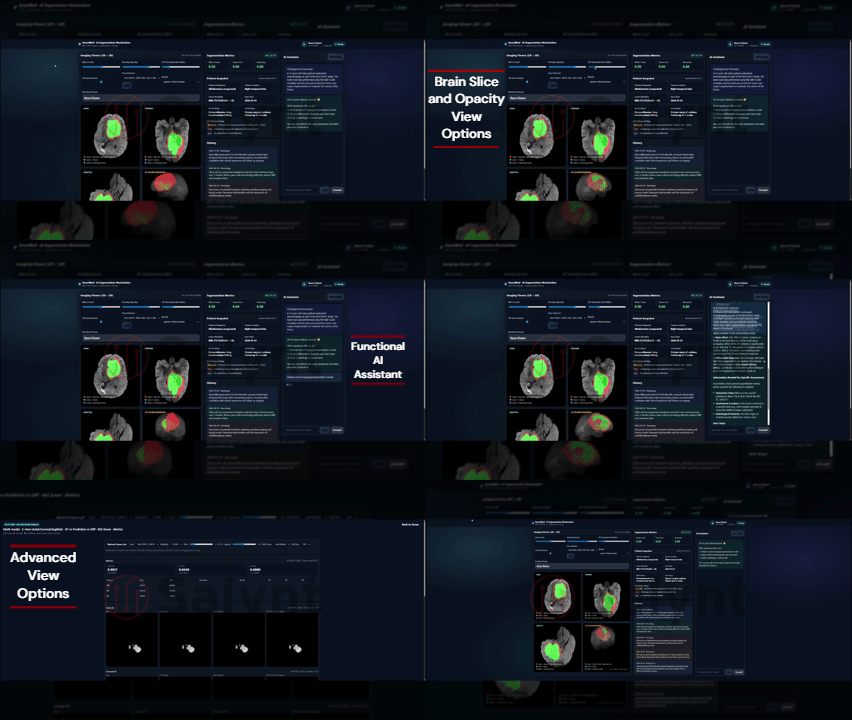
That realization changed the direction of Salynt, the technology company he had founded several years earlier, and led his team to begin developing the Salynt SmartMed Workstation, an AI-powered neuroimaging platform.
Making Complex Brain Imaging Easier to Interpret
For Lawson, the problem SmartMed addresses is not the expertise of physicians. It is the amount and complexity of information they have to work through.
A clinician evaluating a brain tumor may review hundreds of MRI images, compare scans taken at different points in time, measure a tumor and communicate findings among radiologists, neurosurgeons and oncologists.
“The problem isn’t a lack of talented doctors,” Lawson said. “The problem is that they’re often working with fragmented information and tools that haven’t kept pace with what is technically possible.”
SmartMed is being developed to bring more of that information into a structured environment.
The current MVP includes capabilities for brain-tumor MRI segmentation, volumetric measurement, comparison of scans over time and interactive 3D visualization.
The goal is to help clinicians more easily see tumor boundaries, understand changes between scans and review the information supporting those results.
Lawson emphasizes that the technology is designed to assist clinical decision-making rather than make those decisions itself.
“The clinician still makes the decision,” he said. “We’re helping make the information behind that decision clearer, faster and more consistent.”
From an Idea to a Functional Platform
Salynt had existed for several years before Lawson’s family experience pushed the company toward healthcare.
The company was originally exploring other applications for artificial intelligence and virtual reality. Once Lawson began investigating the challenges surrounding his nephew’s imaging, he saw an application for technology his team already understood.
“We train on images all the time,” he recalled thinking. “We could build something.”
That early concept eventually brought Salynt into the Johns Hopkins Ward Infinity program, where the team interviewed clinicians and received $12,000 to further develop the technology. Salynt later received the program’s Top Technology Award.
Lawson has since assembled a six-person core team spanning AI, engineering, operations and clinical strategy. The team is currently working largely for sweat equity as Salynt moves toward its next funding and validation milestones.
The company now has a functional MVP and is working with Johns Hopkins collaborators on a proposed retrospective study initially focused on adult glioma cases.
The study is intended to compare SmartMed’s measurements and tumor boundaries with expert clinical review. It has not yet begun: institutional approvals, research administration, data access, budgets and final agreements are still being worked through.
For Lawson, completing that process would move SmartMed from a functioning technology demonstration toward independently evaluated clinical evidence.
Raising $100,000 for Clinical Validation
Salynt is currently raising $100,000 as an initial portion of a broader $1.5 million clinical bridge intended to support its next stage of clinical and commercial development.
The first $100,000 would help the company prepare for and conduct its proposed retrospective study, including data and imaging infrastructure, validation work, clinical and research administration, and security and compliance expenses.
“The milestone is very clear,” Lawson said. “We want to finish our first independent retrospective validation and leave with credible clinical and technical evidence, not simply another demonstration.”
That milestone remains contingent on the study moving through the required institutional approval process.
If completed, the results could give Salynt evidence to refine SmartMed, inform its regulatory strategy and begin pursuing structured hospital evaluations.
From Adult Brain Tumors to Broader Access
Salynt’s initial clinical work is focused on adult brain tumors, with a longer-term goal of expanding into pediatric cases.
That expansion would bring Lawson closer to the problem that originally redirected the company.
“Then I can take this technology back to Mississippi and help my nephew,” he said.
Lawson also sees potential applications beyond major academic medical centers, particularly in places where access to specialized expertise is limited.
Salynt has spoken with a hospital in Tanzania, according to Lawson, and he says the company has seen potential opportunities across other African markets and the Middle East.
In health systems with fewer specialized neurosurgeons, Lawson believes technology like SmartMed could eventually help clinicians interpret complex cases and determine when additional specialist expertise is needed.
His long-term ambition is to affect 100 million lives. His definition of success, however, starts much smaller.
“The moment we save one life, that’s my goal,” Lawson said.
Learn more about the campaign and contribute here.
The post A Family Crisis Led Salynt’s Founder to Build AI for Brain Tumor Imaging appeared first on SHOPPE BLACK.