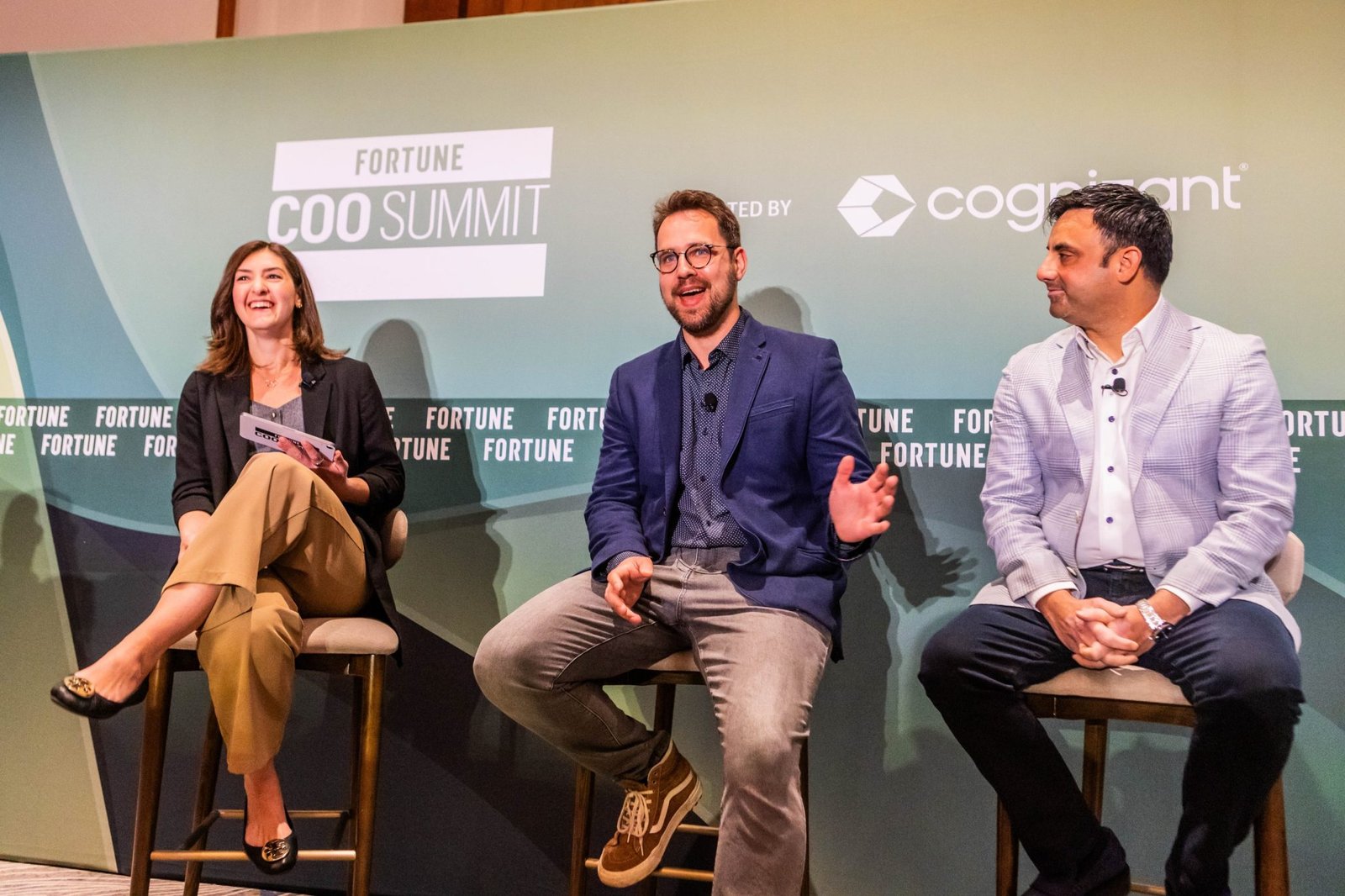
Eric Kelleher has a problem that no amount of AI can solve for him.
The President and COO of Okta has agents on his team. He’s named them—Leo, Sloan, Hank, Walker—and they show up in business reviews alongside his human staff. He’s personally booked a flight to Bangalore and spent the entire trip standing up an open-source agent on a separate machine, a deliberate act of immersion he then assigned to every member of his leadership team. “That flight to me was transformative in how I recognized what the capabilities of this technology are,” he told a roomful of top operations executives at the COO Summit this week.
And yet, he added, the hardest part isn’t the technology. It’s the managers.
“We have trained every manager in the world to think about one thing and that is: what’s their headcount,” Kelleher said. “Our managers have spent decades learning how to think about headcounts and payroll.” The shift he’s advocating for at Okta — getting managers to budget explicitly for both human labor and digital labor, to think about work charts that include AI agents as genuine colleagues—is, he said, “a much harder problem than getting people to experiment with Claude Code.”
“One of the things I’m really advocating for within Okta is to get our managers thinking about how to design work to include human workers and digital workers,” Kelleher told a room of top operations executives. “Everyone has the mandate [to adopt AI],” he said, but people are not really thinking through what it means to tackle that mandate. “One added piece that’s very top of mind for me right now is: when we go into budget planning, when we go into cycles, we have trained every manager in the world to think about one thing and that is, what’s their headcount? What’s the org chart look like? Who reports to who? How many layers do we have? How does this span of control?” That thinking doesn’t fit this moment, he added.
It was appropriate for the session hosted by Cognizant: New Work, New World: How AI is reshaping your org chart, with Head of Research Ollie O’Donoghue and Chief Business Officer, AI, Sushant Warikoo, digging into the topic.
Kelleher’s remarks crystallized a growing frustration among executives: companies have largely figured out how to experiment with AI, but remain in collective denial about how to actually redesign work around it.
From headcount to ‘work planning‘
Kelleher’s proposed solution is deceptively simple: stop thinking about labor purely in terms of people. His fix? Push token budgets down to people managers. The idea is to force a concrete reckoning with a workforce that now includes AI agents operating alongside human employees—and to make that trade-off visible in the budget itself. “What we want to start seeing is how do work charts evolve where we have digital workers working alongside human colleagues,” he said. The current conversation is focused too much on AI displacing jobs, he said, “not changing the nature of work itself.”
Kelleher’s remarks came as Cognizant released new research showing that the AI transformation is happening far faster than anyone predicted—and yet its value is failing to materialize. In 2023, the firm projected 90% of jobs would be disrupted by AI by 2032. Today, that figure is already 93%, six years ahead of schedule. But the productivity gains that were supposed to follow haven’t.
O’Donoghue described this as an “activation gap,” or a chasm between what AI can theoretically do and what companies are actually achieving. “There’s a bit of a disconnect between theory and reality,” O’Donoghue said, citing analysis of 80,000 different tasks, conducted each of the last three years. “Ninety percent of the tasks that we analyze … the human still needs to be involved in some way.”
That makes the organizational redesign problem more urgent, not less. If humans are still in the loop, the question isn’t whether to replace them—it’s how to restructure their roles around machines that are increasingly capable of doing the transactional parts of their jobs.
The harder management problem
Several executives in attendance described trying to crack this problem from different angles. Jon Blotner, President of Wayfair, said the company had reversed course on a top-down AI mandate and instead gave every employee access to Claude, Gemini, and ChatGPT—then watched teams start reinventing their own roles. “We see people reinvent their jobs and say, okay, look, I basically automated my work,” he said. “That person’s incredibly valuable.”
Cognizant’s Warikoo agreed that is the unsexy core of the problem. “Humans and agents have equal privilege,” he said. “But the entire architecture for enterprises was built on the notion of humans working on business workflows with static application architectures.” AI agents require persistent context and operate continuously, a fundamentally different model than the episodic, batch-driven systems enterprises were built around.
“It’s not about the AI,” Warikoo said. “At the end of it, it’s about the humans. It’s about amplifying human potential, where humans get to do higher-value work.”
Kelleher’s diagnosis is that most organizations aren’t there yet. The instinct, still, is to think about digital workers the way companies once thought about software: as a tool employees use, not as a category of labor to be managed, budgeted for, and integrated into the org chart alongside people.
“I see the future now,” Kelleher told Fortune on the sidelines of the panel, “and it’s clear to me, we’re not going back.” He said a turning point for him was a standup with staff when he asked staff to give names to thieir OpenClaw agents. “In that exercise, AI became a colleague as opposed to a tool and that catalyst is valuable.” He agreed that it is similar to the adoption of electricity, when whole factories were slow to realize they didn’t need their old steam engines anymore. He said it’s similar to how current AI adoption is “just, like, asking people to add chatbots.”
Later that afternoon, Kelleher told other executives that his team has started realizing that digital agents are colleagues, of sorts. “It’s really uncomfortable, but it’s very transformative.”
“We evolve from workforce planning to work planning,” Kelleher told the room. “What I’m finding right now is that’s a really big leap for people to make.”
This story was originally featured on Fortune.com