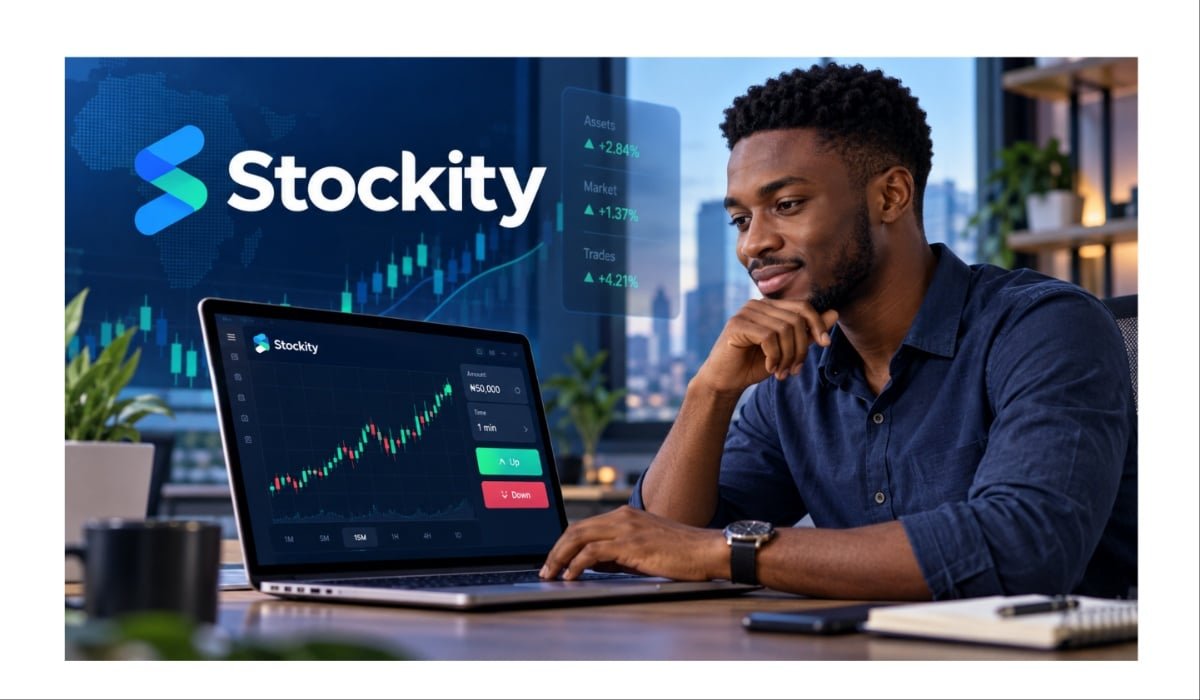

The way people access financial markets has changed sharply in recent years. A smartphone and an internet connection can now provide tools that once required specialist terminals, extensive software and far more technical knowledge.
That shift has helped online trading platforms attract a wider audience. It has also created a new challenge: making sure easier access does not encourage people to underestimate financial risk.
For users in Nigeria and other fast-growing digital markets, the attraction is clear. Mobile services already play a major role in everyday payments, banking and commerce. Trading platforms are increasingly part of the same broader move towards digital financial services.
A simpler interface does not mean simpler markets
Modern platforms are designed to remove unnecessary friction. Charts are easier to read, asset lists can be searched quickly and account controls are often available from a single screen. Stockity https://stockity.com/en is one example. The platform currently highlights access to more than 140 assets and provides a demo account for users who want to practise before moving to real-money trading.
Those features can make a platform easier to understand, but they do not make market movements predictable. Prices can change quickly and even a well-reasoned forecast may prove wrong.
This is an important distinction for beginners. Learning how to open a trade takes only a few minutes. Learning when not to trade can take much longer.
Why demo trading deserves more attention
A demo account is often treated as a short introduction before a user deposits money. In practice, it can be more useful than that.
Because the balance is virtual, users can test the platform without putting their own funds at risk. They can compare different approaches, become familiar with price charts and see how quickly emotions can affect decision-making when a market suddenly changes direction.
The strongest reason to spend time in demo mode is not to prove that a strategy works. It is to discover where a strategy can fail.
A person may notice, for example, that they tend to increase trade sizes after a loss. Another user may find that they make poorer decisions after opening several positions in quick succession. These patterns are easier to recognise when real money is not involved.
Trading journals can expose costly habits
Some of the most useful trading tools are not sophisticated at all. A simple journal is one of them.
Recording the asset, the reason for entering a position, the time of the trade and the final result creates a history that can be reviewed later. Over time, that record may show whether decisions are being made according to a plan or simply in response to short-term market movement.
This matters because memory is selective. A successful trade is easy to remember. The rushed decisions that produced several small losses are easier to forget.
A spreadsheet or notebook can make those patterns much harder to ignore.
Risk management starts before the first trade
Technology can improve access to information, but it cannot decide how much risk a person should take. That remains a personal financial decision.
Before using a real account, users should decide how much money they can afford to lose without affecting rent, food, education, loan repayments or emergency savings. Trading capital should be treated separately from money required for everyday life.
It is also sensible to set limits before a session begins. Deciding in advance when to stop can help prevent a losing trade from turning into a sequence of emotional decisions.
Stockity itself warns that online trading involves significant financial risk and may result in the loss of all funds held in a trading account. That warning is worth taking literally rather than treating it as routine fine print.
Local rules and verification still matter
Another point that can be overlooked is regulation. Online platforms operate across different jurisdictions, and availability does not automatically mean that every service or payment method is appropriate for every user in every country.
Anyone considering an online trading platform should check the rules that apply in their own jurisdiction, review the platform’s terms and understand its identity-verification and withdrawal requirements before depositing funds.
On Stockity, identity verification becomes mandatory for access to all platform features and withdrawals, according to the company’s current FAQ. Users should therefore understand the verification process early rather than waiting until they want to move money out of an account.
Digital access is useful, but judgement remains human
Online platforms have lowered many of the practical barriers that once surrounded market participation. That is a meaningful technological change. It gives more people access to charts, learning materials and practice environments from devices they already use every day.
But accessibility should not be confused with certainty.
A sensible approach is still built around preparation: learn the interface, use a demo account, keep records, set financial limits and understand the rules that apply where you live.
Platforms such as Stockity can provide the tools. The responsibility for deciding whether, when and how much to trade remains with the user.
Risk notice: Online trading can result in substantial losses, including loss of the full amount placed in a trading account. Users should assess their financial situation carefully and consider independent financial advice where appropriate.
Stockity: Digital Trading Platforms Gain Ground as More Users Explore Financial Markets Online